wisdom teeth

This book is dedicated to a nameless curator or interpreter in the British Museum who opened a cabinet for Mary Beard when she was a child so she could look a loaf of Egyptian bread that was on display in a cabinet too high for her to see. That experience was part of what launched her on her path to study the classics. In many ways, her book performs the same service for the rest of us: selecting a set of diverse topics from the classics to bring before us.

The main question that drives the book is, “Why should we study the classics?” For the author, interest in the classics was driven by “thauma” or wonder. She was simply amazed, delighted, and fascinated by the ancient world — and the incredible richness of what is available to be studied.

The subtitle, “the shock of the old,” is a nod to a 1980s book and television series, “the shock of the new.” When people encounter ancient works they often are unaware of how controversial the works were at the time. And many still have power to shock and provoke people today. They often deny simple analysis or expectations which, in part, explains their staying power.

The author reflects on how and why the classics have been taught. In Britain, learning Latin and Greek were required for post-secondary study and so a vast number of people studied them. She tries to knock down the fig leaves that have been offered for why they were required: they are not uniquely suited to exercising human faculties or understanding civilization. Interestingly, she mentioned a proposal that would have offered Sanskrit, in addition to or instead of, Latin or Greek. Having just read Proto, I’ve just been lamenting that I never studied Sanskrit. Of course, I never studied Latin or Greek either.

Privilege was a large driver of the use of classics. And the right-wing patriarchy still tries to use the classics to justify their positions. The author does a good job of stripping away this fig leaf as well. She also lays bare a number of ways in which the classics were taught, historically, to disadvantage people who lacked privilege. Boys and girls were taught Greek differently (with or without “accents”) that ended up penalizing girls in advanced study. Also, a number of the “tests” of Latin and Greek used passages that would be familiar in translation to people from a privileged background, rendering their need to understand the language nearly nil, which penalized people from other backgrounds.

In the end, she identifies two factors that make the study of classics particularly useful. First, they offer a level playing field for discussing current issues. Nobody can truly take sides in debates in the classics as they are so separated from us in place and time. But the issues that were relevant to those debates are still relevant today. This enables people to take positions without necessarily having to take sides. Second, they offer practice in difficult reading. To be honest, this rationale doesn’t particularly resonate with me: lots of things are difficult to read and understand.

As someone who has made always eclectic choices about what to learn, I don’t really need a case to be made for why to study the classics. Knowledge is an end in itself. It reminds me of my many students who, at the end of their university education, were so incredibly invested in the next step: “What if I make the wrong choice?” There is no wrong choice. Any step you make offers new perspectives and vistas from which to decide what to do after. Sure, some might be only, “Well, I sure don’t want to do this again!” But that too is useful. Experience is what you make of it.

My own perspective is that there is no such thing as a “well-rounded education” because there is too much to know for anyone to encompass it all. You always have to pick and choose. Furthermore, you can really only become an expert in one or two things — or perhaps a handful — over the course of a whole life. People just don’t live long enough for more than that. (Also, as one ages, it gets harder and harder to learn. Ask me how I know…)

Mary chose classics and it was a good and satisfying choice for her. It was a delight to read her book and get a sense of the thauma (or wonder) that brought her to the discipline and kept her it its thrall for a lifetime.
potsherds

History and languages are always interesting to me and this book marries them in exquisite detail. I know relatively little of bronze-age history and, although I’m aware of the relationships among Romance languages, I’m much less familiar with the early progenitors that originated in the Caucasus and around the Black Sea. I learned a lot reading this book.

The early parts of the book simply set the stage with almost nothing about language itself. But the rest of the book is organized around broad groupings of related languages and tries to present the data: historical, archeological, linguistic, and — increasingly — genetic that provide insight into the movements of people, culture, and — ultimately — languages.

There is so much here the treatment is often superficial. I found myself, over and over again, going off to Wikipedia for a deeper dive into tantalizing mentions that I wanted to know more about: Tarim Mummies, Soma, Ephedra, Harappa, Indus Script, William “Oriental” Jones, etc., etc.

There is so much detail, it becomes overwhelming. It would have helped to have additional figures. At the very end of the book is a kind of phylogenetic tree that shows how the proto-indo-european languages might be related. Smaller trees to supplement the chapters that actually showed how the characters used to construct the trees (sound changes, word borrowings, etc) might have been helpful. As it was, a lot of the detail just kind of slides past because — without some way to visualize it or relate it — it just becomes noise.

Another helpful tool might have been a timeline. Or multiple time lines. The book keeps jumping forward and backward in time with references of 1700 bce then 500 ce then 300 bce. It would have been really helpful to have time lines to show which events were happening at the same times. (Or something like this graphic that Tufte used as an example of effective information design.)

The last chapter, which looks at the places of indo-european languages in the current world was thoughtful. Much of region where important events in the book took places are now a war zone. And language is as politically contentious as it has ever been.

Earlier in the book there’s even a brief mention of Esperanto. In Krakow, the author describes visiting the lair of a dragon named Smok and remarks on the choice of Tolkien to name his dragon Smaug. Tolkien believed that stories needed a legendary backstory to make them seem real and believed constructed languages like Esperanto were “dead, far deader than ancient unused languages, because their authors never invented any Esperanto legends.” Maybe that was true in Tolkien’s time, but that’s only because he never heard La Romanco de l’ Eminentulo.

It’s a good book. A bit of a slog to get through the details, but with so many fascinating leads to interesting stuff that it’s well worth the effort.

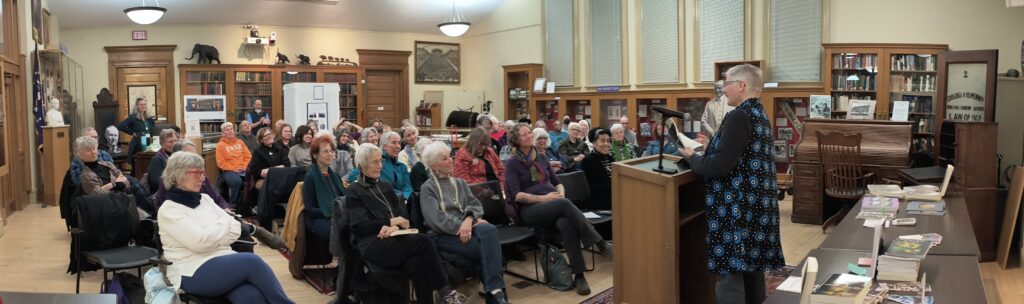
LJ Cohen reads in front of a sizeable audience

On January 31, 2026, I gave a reading from A Familiar Problem as part of the Straw Dog Writers Guild January Showcase. Authors who published a book in 2025 were eligible and a dozen were drawn from a hat. I got to read third.

As I arrived, the traffic in downtown Northampton was terrible. I had left plenty of time because I know that parking can often be hard to find, but just getting to the venue was a challenge. Luckily I found a parking place without difficulty and arrived in good order.

There was a sizeable audience. The Straw Dog Writers Guild tends older, female, and queer. I think there were two other men besides me. But I’ve been involved with Straw Dog long enough that I’m nearly a fixture, so I always feel welcome.

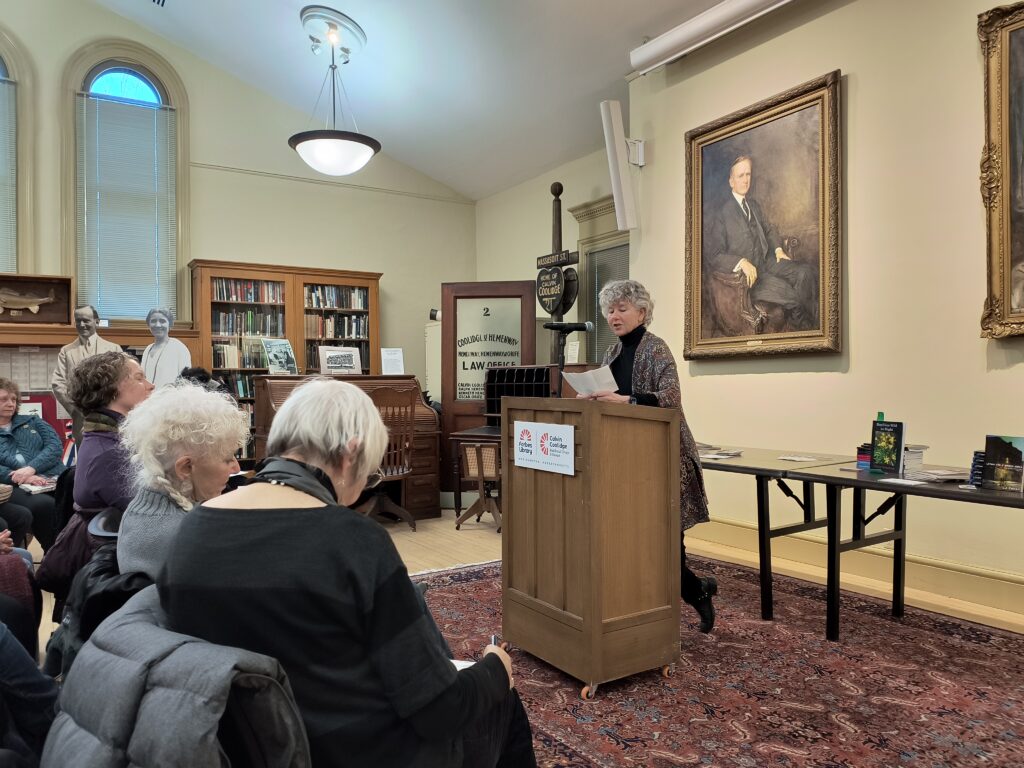
The reading was held in the Calvin Coolidge Memorial Museum in the Forbes Library in Northampton. The wood paneling and large portraits of the former President and his wife made for an elegant backdrop to the reading.

Lindsay Rockwell (pictured to the left) led the organizing for the event and welcomed the audience. I’ve served with Lindsay for several years on the Program Committee and she did a fantastic job bringing everyone together.

Andrea Hairston served as emcee. She introduced each author and brought an enthusiastic energy to the role.

Most of the readings were of poetry or memoir. My offering of my weird speculative fiction was accepted with good humor, although someone always comments how weird my writing is. And I don’t even read any of the REALLY WEIRD bits.

One of the readers, LJ Cohen (pictured at the top), also write speculative fiction. I know her from Mastodon and we’ve met a couple of times at conventions (Arisia and Readercon). I decided to buy a copy of her book and got her to sign it.

After the reading concluded, I was able to pitch my books. I even sold a couple.

After I left, I saw why the traffic had been so congested: there were ice sculptures all over town, beautifully illuminated in the dark. It was a nice way to end the day as I headed home.

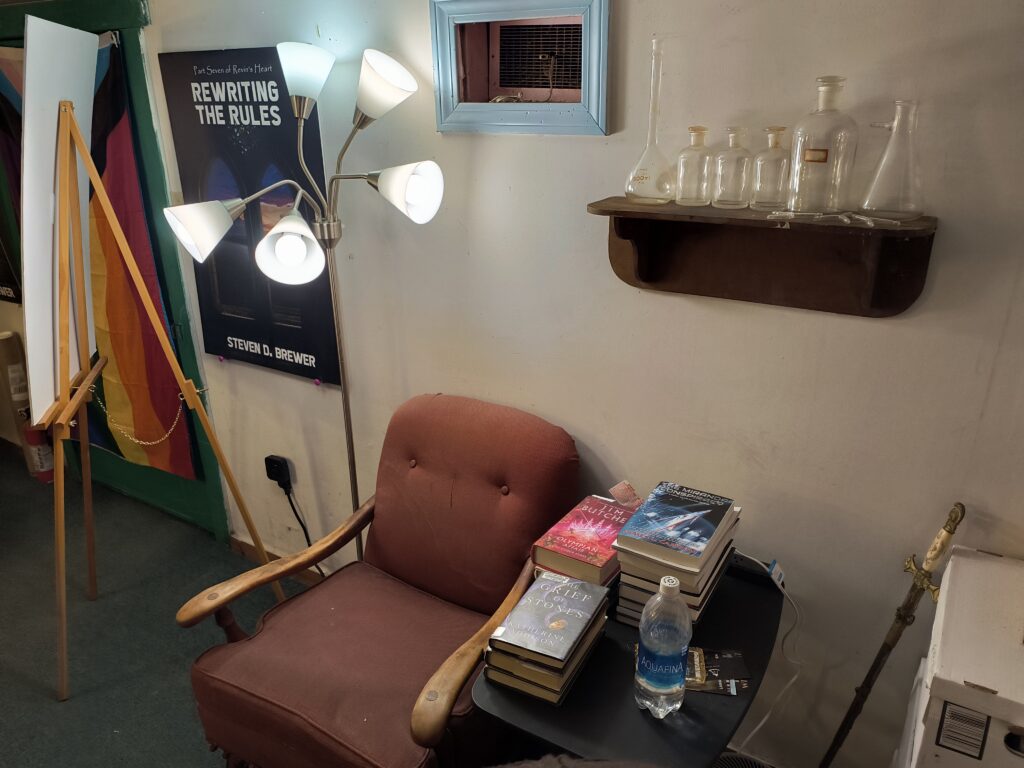
Reading nook with an old chair, floor lamp, and large TBR

I’ve been reluctant to admit it, but I’ve been having trouble finishing books. Or, indeed, even starting books. I’d heard of “writer’s block” but is there such a thing as “reader’s block”? It perhaps began even before the pandemic — certainly since then — that I’ve struggled to make myself read whole books. Over the past few months, I’ve checked out perhaps a dozen books from the library and returned them all unfinished — some unopened.

I decided recently that I was going to make myself start reading again. I spent some time thinking about it and realized one problem was that, for various reasons, I didn’t have a place to read anymore. So I set about to create one.

My office had gotten taken over, at one point, as a storage room, and was choked with boxes. Buried in them was an old antique chair, so I extracted the chair and banished enough of the boxes to make a space. Then I went to the store and bought new floor lamp, so I’d have enough light to read by. And I set up a side table to hold my TBR pile and a coffee cup. And then I started to read.

On my last trip to the library, I had checked out Katherine Addison’s The Tomb of Dragons. It was wonderful! I enjoyed reading it a lot. And I finished it. After reading it, however, I realized something else.

I read books differently now that I’ve written books of my own. Rather than becoming purely immersed in the story, I find myself frequently distracted by observations on the craft of the author. Why did they choose to include this detail? Why did they select a conlang term for this item and not that? Why? Why? Why? I think that was part of what was making it hard to read books. Now that I’ve recognized it, I can adapt.

Anyway, I went through the house and collected together my whole TBR pile(s) and, while I have the holiday and intersession before me, I plan to try to make plenty of time to read.

name tag and lanyard

My first appearances of 2026 have been scheduled! Some of these are still preliminary and may change, but I wanted to get them out in time to share in my January newsletter.

At Arisa 2026 (January 16-19), I am scheduled to moderate one panel and serve on four others:

Manga 101: Introduction to Japanese Comics
Kendall Square Saturday, January 17, 2026, 10:00 AM EST

Don’t Know Much About Geography–But You Should!
Porter Square A Saturday, January 17, 2026, 5:30 PM EST

Artist, Craftsperson, Maker, Crafter, Hacker – What’s in a Name?
Central Square Saturday, January 17, 2026, 6:45 PM EST

Your Fat Friends
Porter Square A Sunday, January 18, 2026, 10:00 AM EST

Isekai 101: Surviving Your Time In Another World (moderator)
Harvard Square Monday, January 19, 2026, 10:00 AM EST

There is still a chance I will get an opportunity to read at Arisia. The schedule is still being finalized.

On January 31, I have been selected to read from A Familiar Problem at the Straw Dog Writers Guild Author Showcase at 4pm at the Forbes Library in Northampton. I will also be bringing copies of my books to sell!

Later in the year, I’m tentatively planning to attend Watch City, the Nebula Conference, and Readercon again. I’m also proposing myself to be a participant at Worldcon. I’ll post further updates as we get closer!