
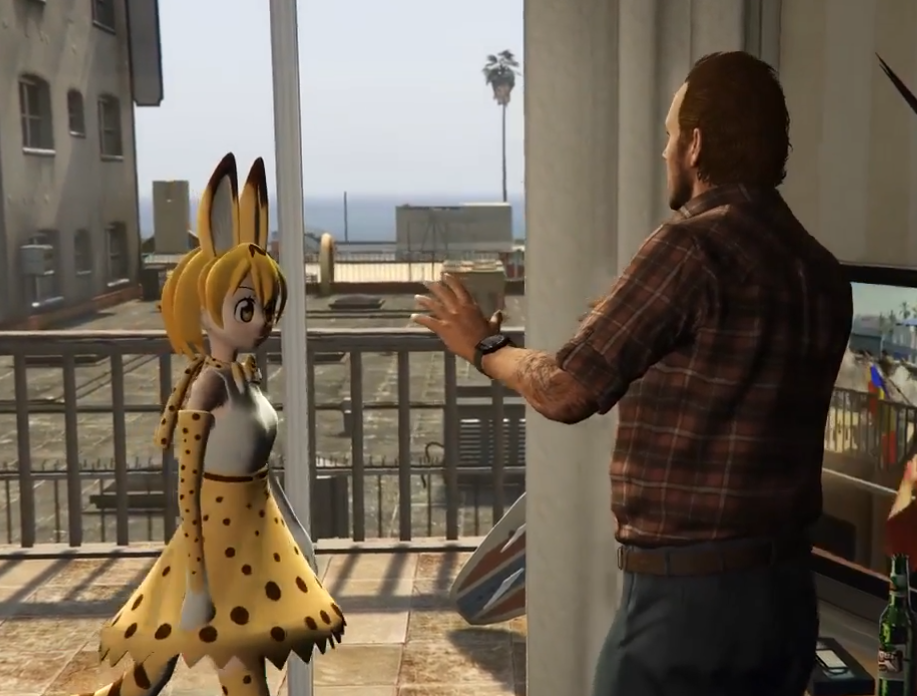
An interesting article in the NYT reviews the new Grand Theft Auto (gift link). I didn’t originally read the article because the only GTA thing I’ve ever had even the tiniest interest in was when someone replaced one of the models with Serval-chan. But my brother’s wife said the article was good, so I went ahead and read it.
It’s excellent. There’s a lot of thoughtful commentary about how the franchise has evolved with the times. It includes some background on how the game is made with deep dives into some of the particular features that give the system an almost unmatched verisimilitude for the current zeitgeist.
It also has a lot of quotable quotes, like:
Rockstar seems to have decided, in the main, that lampooning the particulars of Trump’s America through exaggeration is like bolding 72-point type.
and
[…] A.I. advocates have posted footage from their own enormous “open world” games generated by prompting Claude. The games look stupid, like something a dog would make.
Nailed it.
I’m reminded every day (while walking a dog) how dogs live in a radically different world than humans. The things a dog cares about are completely different than a person. Dogs can see a sign, but they can’t read the words. Dogs can see people, but they can’t infer their relationships. Or social class. The lack of understanding really resonates with something I’ve been thinking for a long time related to AI.
My doctoral research in science education was about expert performance. One of the distinguishing characteristics of expert versus novice performance on problem solving is the ability to recognize deep structure. Novices tend to focus on surface features of problems. In physics, for example, a novice classifies pulley problems together whereas an expert would classify them by which law of thermodynamics you needed to use to solve them.
Being able to solve novel problems is one thing that AI does very poorly. If it’s seen an identical problem before, it can probably solve it. Or when the problem space is domain-limited, like mathematics, it can do well. But, although it has a lot of context through training, it is without understanding. It can’t analyze a novel problem to recognize the deep structure and apply the correct model to solve it. Because it doesn’t actually understand anything.
Of course, experts also can’t solve problems outside of their area of expertise. Or, minimally, they do no better than a novice.
Once you see this pattern — novices fixating on surface features — you see it everywhere. When teaching, I tried to never give students examples because they would try to copy the surface features of the examples rather than trying to think for themselves. A lot educational resources made by university faculty replicate the surface features of the educational resources they were exposed to as students, because they never studied pedagogy.
A significant part of why I retired from university teaching was that students were no longer willing to even look for examples but, instead, to just ask AI to do it for them. It was incredibly discouraging to look at a student paper that was mostly written by AI and wonder what kind of feedback was worth giving. Why bother even reading something that a student couldn’t be bothered to write?
Anyway, it was a good article And there were a bunch more interesting quotes in the article. Recommended.