a selfie showing some participants of the Straw Dog Writers Guild retreat participants

On April 25, 2026, the leadership of the Straw Dog Writers Guild gathered at the WOW Creative Arts Center in Westfield for a day-long retreat to discuss the organization. Fifteen people — the entire Steering Committee plus a handful of others — spent the day getting to know each other and the organization a bit better. By the end of the day, all of the world’s problems had been solved. Well, maybe not all of them. But we did have a productive conversation.

Due to my chronic health condition, I wore a mask for the event. It appears to me that respiratory illness is not particularly high right now, but I normally avoid spending long periods of time indoors with groups of unmasked people. I really don’t want to end up in the hospital again. The last time I attended an indoor Straw Dog retreat, I had persuaded the participants to mask for my benefit. But it was controversial and unpopular with some people, so I didn’t try to do that this time.

In the interests of full disclosure, I should point out that the post that follows is not a comprehensive report of what happened at the meeting. I did not take sufficiently detailed notes to represent everything that everyone said. This over-represents what I said and offers reactions primarily from my own perspective.

We began with an ice breaker. Becky Jones called on each of us to identify some symbol or metaphor to define ourselves. I broke the ice by saying what I typically say in such circumstances. Other people had similarly whimsical perspectives about themselves.

Ellie Meeropol provided a sheet with a summary of Straw Dog Writers Guild accomplishments from 2025 and 2026. For 2025, there were around ten on-going regular activities (Writer’s Night Out, Straw Dog Writes, Second Sunday readings, etc.) and around twenty one-time events (workshops on the craft and business of writing, Author’s Showcase, etc.) and this year looks on track to be similar. It was impressive to see all of our work represented.

a diagram showing straw dog activities, committees, and how they're organized.

Jacquelyn Sheehan and Bill Mailer led a discussion to flesh out a diagram (click to see full size) listing all of the on-going activities. We began with just trying to catalog everything then show how they map into committees and standing bodies. Finally, participants were invited to initial the parts they are involved with. I’m listed for Straw Dog Writes, the Program Committee, and website. I’m currently scheduled to chair a committee to coordinate with Christopher J. Sparks and Electropoetics, that will start redesigning the Straw Dog website in the coming months.

Don Lesser brought forward a question of whether Straw Dog should charge non-members to participate in workshops. This generated a lot of discussion that included a consideration of Straw Dog’s mission and the history of this topic, which was tried before and rejected. Making non-members pay a nominal fee to attend both has the potential to get people to see more value in the workshops and actually show up, if they’ve registered. It also might give members an increased sense of value for their membership. It also could suppress participation and raised concerns about its alignment with Straw Dog’s mission. My primary contribution to the discussion was about practical concerns: It sounds simple, but would require a fair amount of staff support to build out the infrastructure to collect the money, track which registrations were by members, check attendees for payment, integrate with online registration systems, etc.

During the potluck lunch, I stayed inside without eating because I avoid unmasking indoors. The last time I attended a Straw Dog retreat, I took my lunch outside and ate by myself. But I found that rather stigmatizing because everyone else was having conversations that I was excluded from. (I had persuaded people to mask that time, but they all necessarily unmasked during lunch and I didn’t feel safe staying indoors.) So this time, I just didn’t eat and talked with people while they ate. This was also stigmatizing (as if being the only person wearing a mask wasn’t stigmatizing in itself). But it was OK and I had some nice side conversations with people.

After lunch, we did another community building activity where we interviewed another person and then reported a summary of the conversation to the group. I met a young woman named Emily whom I hadn’t met before. At least I don’t think I’d met her before. I summarized the blog post I was writing about work and she talked about how her conception of location or place had evolved as she transitioned from childhood to adulthood. It was charming to get to know her a little better —and to learn a bit more about all of the other participants from their reported conversations.

Julie Schlack and Mary Ann Scognamiglio led the final activity of the day, to brainstorm ideas to aid recruitment and retention of new members. There were a lot ideas about building and sustaining community. I had been spending the day making notes of ideas that I had, which I then shared with the group. My ideas were:

  • Recruit member representatives for local organizations in the communities we serve to facilitate communication and ensure our activities are made visible on event schedules, bulletin boards, etc.
  • Develop a recruitment presentation that members could use to describe Straw Dog to other audiences.
  • Bring some focus to a national recruitment campaign (as our workshops are increasingly available via zoom, we’ve already picked up a substantial number of members across the country, which we could grow.)
  • Offer support and coordination for book launches to members. (We have a virtual book launch coming up that we’re hoping to use as a template.)
  • More committees or advisory boards for program elements, to provide increased opportunities to members to grow into leadership positions in the organization. (We have only a small number of actual committees currently, but it was pointed out that the WriteAngles conference could always use more volunteers.)
  • Set up book vending machines to sell books for members. This is an idea I’ve seen be successful in other areas. It would require some capital, but I think a lot of authors would jump at the chance to have their books available via vending machines and the machines themselves would serve as advertising for Straw Dog and its authors.
  • Offer more articles via the website and coordinate with the newsletter. Offer posts about writing, about members, about events, and maybe book reviews. Have teasers in the Newsletter and use it to drive more traffic to the website.
  • Use communication software more effectively. Currently most Straw Dog communications occur via email which has a lot of downsides. Committees mostly communicate by people just using “reply-all” to the last message sent to the group, which has the potential to miss some people, propagate typos in email addresses, or include the wrong people (if someone was copied into a previous message). We could use Discord or a threaded-discussion system (or someone recommended Slack) to communicate more effectively. This would ensure the history of groups remains accessible so that interested members or newcomers could lurk and more easily get up to speed..
  • Use our CRM more effectively. We have a new CRM, but it could track more information about members and our previous contacts with them, so that we can target subpopulations and follow up with people better.

There were a number of other ideas as well, but those are the ones that I brought forward.

At the end, Bob Plasse, the President of the Board of Directors of WOW was given an opportunity to comment on our retreat and tell us more about the WOW Center. He had a lot of insight into a community organization like ours and described what WOW was doing that we could consider replicating or articulating with.

The retreat was time well spent and I’m hopeful that we can implement a number of the ideas in the coming year.

Early this spring, at a meeting of the Faculty Senate Rules Committee with the Campus Leadership Council (the Chancellor, Provost, and Vice Chancellors), a key campus administrator mentioned that they didn’t understand why it was so difficult to recruit people to serve on the Faculty Senate. I was able to enlighten them with a story.

I read to him an excerpt of what my department’s Personnel Committee wrote about my service on my Annual Faculty Review (AFR) from 2023:

Recap: Dr. Brewer was a member of the biology awards committee, the biology climate committee, Chair of CNS lecturer review & promotion committee, Presiding officer of faculty senate, a member of the rules committee of the faculty senate, a faculty senator, an ad hoc reviewer for the journal American Biology Teacher, and serves on the Program Committee of the Straw Dob Writers Guild, an organization that supports writers in Western MA. Although not part of his job responsibilities, Dr. Brewer also published several short stories, novelettes, and flash fiction works.

Evaluation: Dr. Brewer’s service contributions meet departmental expectations.

For comparison, in many departments service on a single departmental committee would be considered sufficient to “meet expectations”. By contrast, I served on two departmental committees, I CHAIRED a personnel committee for the College (which is a particularly heavy load and for which many faculty would secure a release from other service), and I served as one of the two highest, elected positions that lead the Faculty Senate. I have to preside over the Senate meetings plus my service on the Rules Committee is heavier than most departmental committees. Moreover, I do additional outreach outside the University. (It’s Straw Dog Writer’s Guild, btw.) In short, I did a fuck ton of service that year. I’m not sure what I would have had to have done to get an “exceeds expectations” — maybe win a MacArthur Genius Award or something.

For 2024, BTW, my assessment was the same, even though I didn’t chair the College lecturer review and promotion committee. But they didn’t even mention the General Faculty Meeting that was one of the most difficult and challenging things I’ve ever done in my life (which I did prominently cite on my AFR — they just didn’t mention it). But departments just don’t value Faculty Senate service much. And that’s why it’s hard to recruit people to serve.

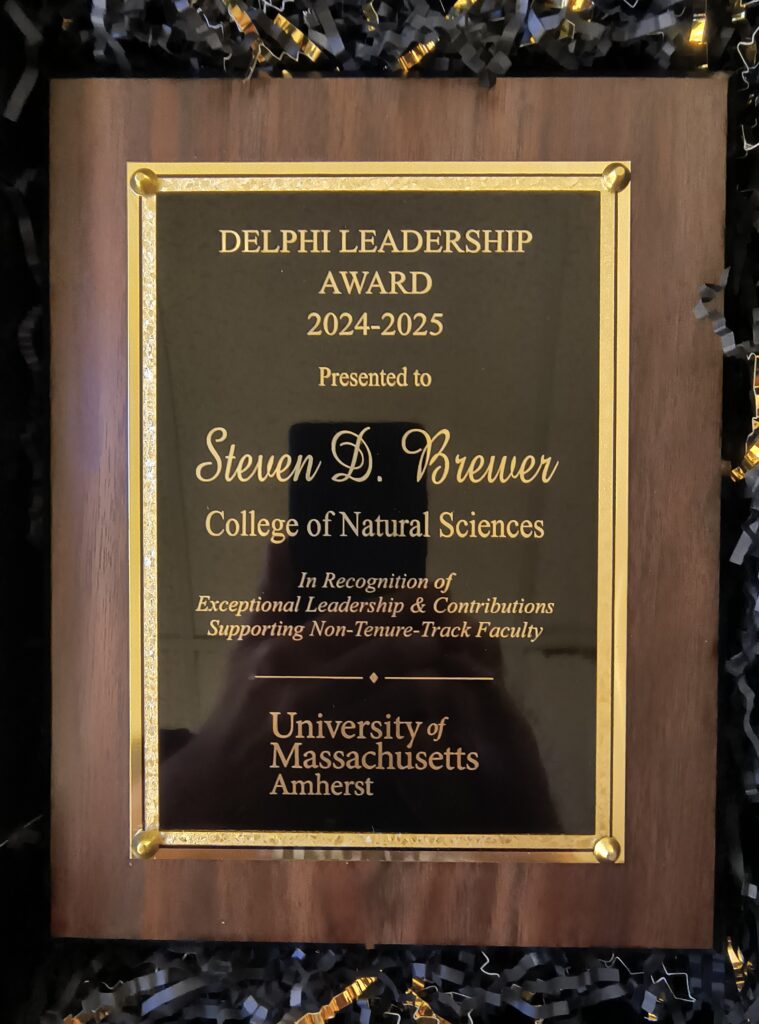
Several weeks after this happened, I happened to be awarded an inaugural Delphi Leadership Award by the Center for Faculty Development, which recognizes exceptional leadership in service to non-tenure-track faculty. It was nice to have my service recognized by someone, even if my department does not.

Plaque that reads, "DELPHI LEADERSHIP AWARD 2024-2025 Presented to Steven D. Brewer; College of Natural Sciences; In Recognition of Exceptional Leadership & Contributions Supporting Non-Tenure-Track Faculty; University of Massachusetts Amherst

Steven D. Brewer is recognized for his sustained leadership in the Massachusetts Society of Professors (MSP) and in the Faculty Senate in improving working conditions for NTT faculty. In MSP, Steven has served as an Officer, on the Executive Board, as the only NTT member on the MSP bargaining team, and multiple bargaining subcommittees to establish NTT promotion ladders, continuing appointment status, and the professional development fellowship. Steve was the first NTT member of the Senate Rules committee and now serves as Presiding Officer of the Faculty Senate.”

I’ve always known that my department did not really appreciate my university service, but it never stopped me from serving. I’ve always believed that faculty governance is critical to a university’s independence from outside influences. The faculty need to be involved in order to push back against efforts to control the university. Without a strong culture of engagement with faculty governance, there would be little to stop the university from being taken over. So, even though I knew that my service efforts would not lead to recognition at the department level, I believed it was important enough to do anyway. And it’s gratifying to see that service recognized, even if not by the colleagues in my department.

There is one kind of service I’ve stopped doing. For 25 years, I served as Director of the Biology Computer Resource Center and, during that time, I did extensive university service related to information technology (IT), serving on the Faculty Senate University Computing and Electronic Communications Committee (the euphonious FSUC&ECC). When I served on the Rules Committee the first time, I was involved in rewriting the charter for the committee to elevate it to become the Information and Communications Technology Council (ICTC), which had a larger charge and higher level administrative representation. During those times I worked ceaselessly to try to make the University IT responsive to the needs of departments and the faculty. But when the department rewrote my job description so that I wasn’t responsible for information technology anymore, I dropped all of my service related to IT. It’s not my job anymore.

Next year, I will complete my phased retirement and then none of it will be my job anymore. It’s been an wonderful career and I’m looking forward to one more wonderful year. But I’m also enjoying my transition to new challenges.

As was predicted, the Trump administration has targeted higher education and, putting the “bully” in bully pulpit, has begun to menace universities with funding cuts and other punitive measures if they do not undermine academic freedom. Some institutions, like Columbia, sought to comply and found themselves both reviled by other higher ed institutions and singled out by the administration for yet more humiliation and sanctions. But some have begun to fight back.

When Harvard was served with a letter with illegal demands, they refused to comply. The Trump administration has called for a variety of further, probably illegal, sanctions. The idea that I would see a president use the power of the US government to persecute political enemies would have been nearly unthinkable to me prior to this election. But the brakes are gone and who knows how deep this rabbit hole will go.

The faculty of my university, the University of Massachusetts Amherst, have been at the forefront of resistance. At the April Faculty Senate meeting, we passed a resolution calling for mutual academic defense compacts. This has attracted interest among other universities across the region and nationally. On April 25th, we will hold a General Meeting of the Faculty to consider endorsing a Statement in Support of the Core Mission and Shared Values of Higher Education in the United States of America.

As I suggested previously, there are some things we can do. We need to dedicate ourselves to public advocacy in support of higher education. Making statements of principles is a good start. But, of course, it’s not enough. We need to be visible writing articles, editorials, social media posts, and appearing in public. And we need to turn out in support of one another.

At UMass Amherst, the faculty have primary responsibility for academic affairs. That means that we can hold the line on our academic programs and there is very little likelihood that the outside political influence will be successful in undermining our commitment to our principles. There are certainly dark times ahead as the Trump administration seeks to undermine science and choke off the enlightment. But if we stand together, we can present a united front and push back against the fascist agenda.

Steven D. Brewer
At Poet’s Seat in Greenfield

I am running for re-election as Secretary of SFWA. I have been serving in this role since the special election in November 2024.

My overriding goal as Secretary is to make sure that decisions of the Board are communicated to the membership clearly and in good time. Beyond that, I hope to continue to serve the organization while it navigates a complex transition to new leadership and a more solid foundation during a period of extreme political instability. 

When the previous Secretary changed positions last year, another candidate initially stepped forward and I thought, “Great! Someone else wants to do the work!” When that candidate withdrew after the deadline for announcing oneself as candidate, I proposed myself as a write-in candidate and was elected.

I am familiar with the role of Secretary in a non-profit, having served multiple other non-profits in various roles including as Secretary, Vice-President, and President. I believe I am generally effective at working within organizations for positive change.

The most important thing the volunteer Board needs to accomplish first is simply to restore the normal functioning of a member-led organization that has been riven by change, with nearly a complete turnover in staff and leadership over the past year. Restoring and then maintaining normal functioning is a necessary precondition for restoring trust of the membership. I share the frustrations of those who want us to move faster, and I want us to do that effectively by working from a solid foundation.

I am always an advocate for greater transparency, and have proposed the Board consider open meetings. I live in a state that requires open public meetings and I am very familiar with the trade-offs.. At minimum, there need to be clear definitions of what must be discussed in Executive Session and what must be discussed openly. Whether those definitions continue to be done by policy, or via bylaw changes, is important for the membership to consider.

I have already suggested we undertake a bylaws review. This is often a dull, tedious task that may seem to consume a vast amount of time for relatively little direct benefit, but our bylaws are out of date and at variance with how the organization now operates and should operate.

At the same time, SFWA needs strategic planning. We need to assess the current state of the organization, make decisions about what we want to see as a future state, and then develop a plan to move from where we are to where we want to go. By restoring normal functioning and reviewing the bylaws, we can develop an assessment of current state. Then we must engage in the long-range thinking necessary to envision the future state for the organization. Only then can we develop a plan for how to get there.

I would be honored to receive your vote to continue as Secretary of SFWA. I will do my best to work in the best interests of the organization.

Everyone I know is worried. They’re wondering what they can do, given the incoming federal administration that will put immense pressure on marginalized people and the norms and values of our country. There is no simple answer to this question. Recently I wrote about strategies my university is considering. These are all well-and-good, but what do they mean in terms of action? There’s a lot we can do.

My first suggestion is to do no harm. The biggest challenge to maintaining a fragile coalition is to avoid turning on one another. Our opponents will look for ways to divide us. They know, for example, that Israel/Palestine is a fracture plane in our coalition. They will use inflammatory language to try to get different sides to turn on each other to destroy our coalition. Does that mean we can do nothing? No: But we need to not attack one another for holding the “wrong” idea or for not supporting any one particular thing.

We should try to amplify voices calling for positive action. In 2016, the Straw Dog Writers’ Guild organized Voices for Resistance, a project that brought celebrated writers together to offer a reading on the theme of resistance. I was able to invite Kelly Link and was very gratified when she participated. With current events, our committee is discussing how to organize going forward.

Finally, we need to play the long game. We shouldn’t try to do everything. Pick a few things that are important and commit to working on them personally. There’s a lot we can do. But pace yourself! It’s going to be a long four years.

For myself, my primary goal is going to be to defend the LGBTQIA+ community. I don’t yet know exactly what I’m going to do, but I will continue being visible, writing fiction that features queer stories and characters, and offering myself up for panels that discuss issues of gender and sexual identity. Are those the most important concerns? There are going to be many, many fronts in this struggle. But these are the issues I’m going to focus on and, even if only from the sidelines, I will try to support people that choose other hills to die on.

Recently at the Faculty Senate, there were calls for the Chancellor to make public statements about what the University will do in response to changes implemented by the incoming Federal administration. A number of people were dissatisfied with his reply. They seem to want him to just come out and say, “We will break the law.” They don’t seem to understand that it would irresponsible and short-sighted make performative statements like that prospectively.

I was given the opportunity to attend a presentation by consultants advising about strategies the University should consider heading into the new year. Some key take-aways: We should avoid getting drawn into speculative debate about what might happen, redouble our efforts to maintain internal solidarity, and look to build external partnerships.

The incoming administration will make a lot of noise about things they want to do, but the actual changes they can make will be more limited. It’s distraction to spend a lot of time trying to respond to everything they throw up against the wall and instead, we should try to work in partnerships to find ways to ameliorate the worst effects of the things they can actually change.

We can expect to see concerted efforts to keep us divided and off balance. They will look for points of division among us and try to exploit them to get us to fight among ourselves. We need to resist the temptation and show solidarity around the things we can actually agree on, regardless of whatever points of division may exist.

Finally, we should look to partner with other organizations that we can ally with to maintain solidarity and support our goals: the Association of Public and Land-grant Universities (APLU), other universities, etc. There are a lot of things we can’t do as an organization. But we can ally ourselves with other groups that can.

It’s going to be a dark time for our country. The incoming administration is antithetical to many of the things we believe in, like the rule of law, equal rights, and social justice. We’re going to be challenged as never before to find ways to move forward even while the rest of the country goes backward. I see the same pressures being bought to bear on other organizations I belong to. But we should focus on what we can do.

I’ve served in leadership and Board roles in non-profits a number of times over the years. I’ve been a Secretary, Vice President, and President, in addition to serving on boards. I’ve learned some things about what makes a Board work.

Foremost is that the primary goal of the leadership should not be to make decisions, but rather to defend the power of the Board. I’ve served in organizations where tensions develop between the Executive Director and the elected leadership. And sometimes Presidents bring their own agenda that they would like to push through. It can feel simpler for the leadership to try to push their own agendas and treat the Board like a rubber stamp. But the leadership needs to resist that. The Board should remain in control and the leadership should only decide when the Board cannot.

Second, any decision you make as a Board is going to make some people unhappy. In dysfunctional organizations, the leadership can become paralyzed because it can feel like only way to avoid making people angry is to do nothing. Of course, doing nothing will also make some number of people angry. But it also guarantees the organization will founder and drift, rudderless.

A former Chancellor at my university had a saying about leadership that’s stuck with me. He said, “Money matters, quality counts, and time is the enemy.” Point being, money matters, but it’s not everything. Quality counts. If something is worth doing, it may be worth doing badly. But you need to prioritize, make tradeoffs, and not try to do everything if it means that everything is bad. Finally, the more time you spend deliberating and deciding will put the organization behind.

Since my recent election to SFWA, I’ve been reassured to find that the Board and leadership are aligned and prepared to work on addressing the real challenges that exist. I have great confidence that we are well positioned to more forward together as an organization.

One more observation: Shortly after I assumed a leadership position for the first time, I discovered an interesting phenomenon. The moment you step into the role, it’s like a target gets painted on your back. You assume ownership of all of the problems of the organization. And people who bear some grudge against the organization immediately start targeting you. So it has been here.

You can’t let it stop you.

I remember as I became an adult, beginning to adopt responsibility for the actions of my country. I was a voter and, even though my candidates frequently lost, I accepted that I was a participant in the imperialist and capitalist society that was visiting harms on the rest of the world. And I started using the language of “we” when talking about my own culpability in these harms. Today, regarding the failure of the UN to achieve the sustainability goals, Ross Douhat says:

Lofty goals could be forgiven if they inspired progress, but I worry that they were sometimes less a spur to action than a substitute for it. Yes, the pandemic created setbacks, but let’s be honest: We dropped the ball.

That’s bullshit. I didn’t drop the ball. I’m being disenfranchised by fascists that are gerrymandering the shit out of the country. My voice and agency are being drowned out by a firehose of money coming from oligarchs that can hire whole stables of unscrupulous lobbyists that make sure that their voices are heard and not mine. I’m being overwhelmed by a flood of disinformation that rises like a tide from a stockyard waste pond over the civilized discourse of the country.

It’s not my fault. And I don’t have to accept responsibility for it.

We need to stop saying “we” and start saying “they.” It’s the billionaires and the unscrupulous greedy people that accept their money who are to blame. Not us. And don’t let them make you forget it.