
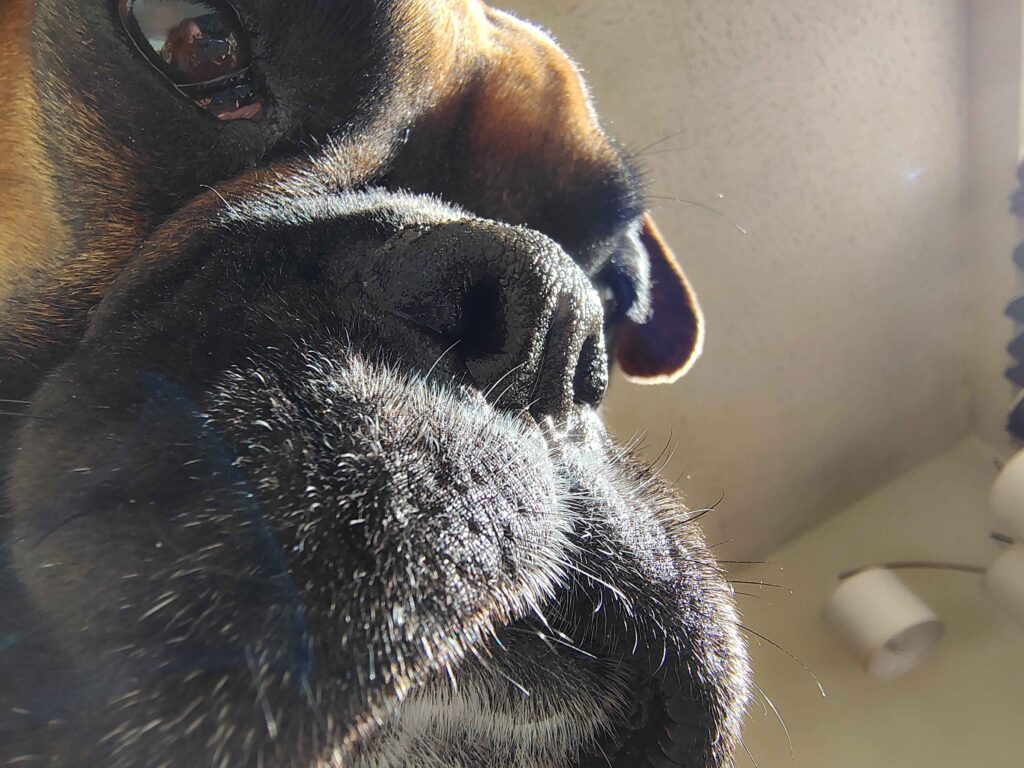
Thanksgiving is a useful moment to reflect on things we should be grateful for. I certainly have many! I’m particularly grateful for my family and friends, who have rallied around me and supported me through both good and difficult times. But there’s one special individual I’m particularly grateful for this year: Tanuki.
Tanuki is my son’s emotional support animal. Previously in my blog, I’ve written about boxer dogs in general and about Tanuki several times. In particular, I wrote a long piece about getting some extra Tanuki time when my son was in the hospital. She’s an incredibly important part of all of our lives.
A couple of weeks ago, she started to seem under the weather. At first, she would eat grass and sometimes didn’t want breakfast. She also seemed subdued and lacked energy. Normally, she is incredibly eager to eat her breakfast and loves to play. After a week, we were concerned enough that, after consulting her vet, we scheduled an ultrasound for as soon as we could get her in.
She got worse. She started vomiting and had diarrhea. She refused her meals for a whole day and quit drinking. I arrived in the evening to visit and noticed that her collar felt loose. I could see that she was dehydrated. We decided to rush her into the animal hospital emergency room.
A brief digression: Tanuki, like all boxer dogs, is a little weird. Unusually, although extremely devoted to her family, she does not trust strangers and does not really like to be touched by anyone. When she was a puppy, she really only tolerated being stroked between her shoulders and pelvis. If you reached a hand toward her head, or touched near her tail, she’d bite ya. Not hard, but enough to tell you that she really did not want to be touched. She has become a lot more tolerant with family and will (generally) let us touch her. But woe to the person who tries to “pat” her. When Philip visited recently, he forgot and went to pat her vigorously, like he would with his own dog — or like I would have done with any of our previous boxers. She whirled around and went after him to make it clear that his liberties with her person were not to be repeated. And Tanuki’s distrust of strangers goes double for veterinarians and their assistants. She does not suffer lightly being inspected or poked or prodded.
When we arrived at the hospital, an attendant came out. He carefully did not look at her, sat on a chair, turned his back, and let Tanuki approach him from behind. Then he invited us to lead her back and get her on the scale. At his direction, after he got her weight, we passed off the leash to him and retreated back to the lobby. We waited anxiously while they did their intake and, eventually, the vet came to speak with us. She said she had arrived to find Tanuki curled up in the lap of the attendant (who had gotten “Dad’s” seal of approval). But that Tanuki had given her the “stink eye”.
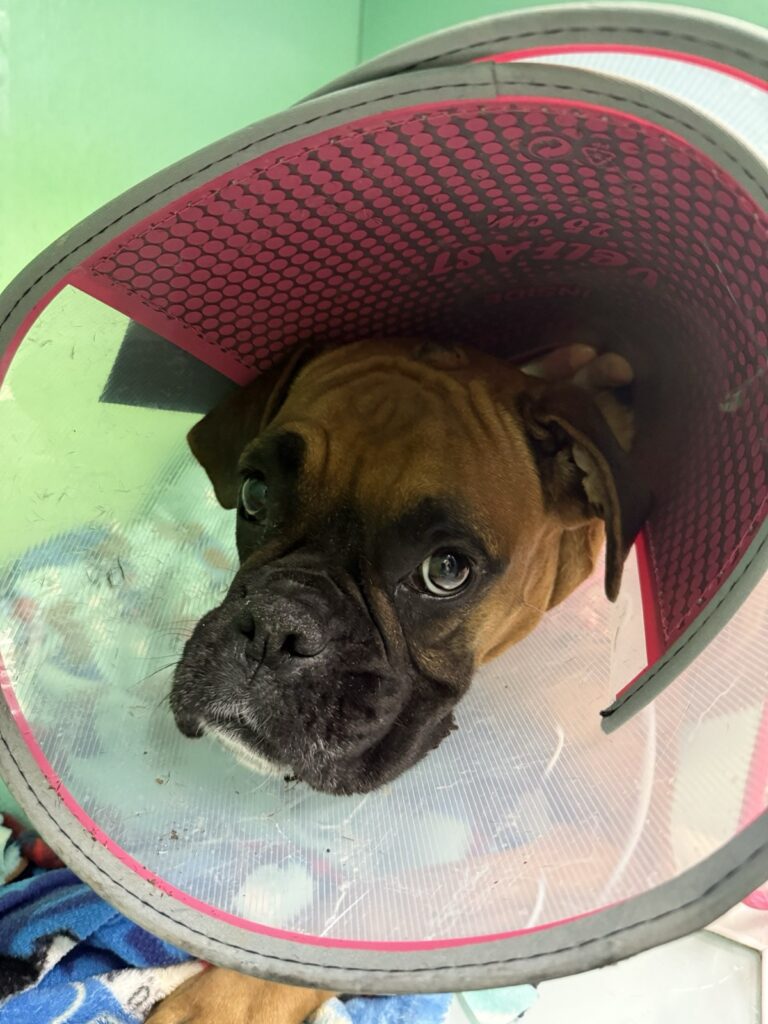
They had to put her in two cones to evaluate and treat her. The vet diagnosed Acute Hemorrhagic Diarrhea Syndrome (AHDS). She was significantly dehydrated, which was the most serious risk. They said they would keep her overnight, give her IV fluids, start antibiotics, and then perform the ultrasound the next day to check for more serious complications.
We went home: alone, sad, and worried. But relieved that she would get care overnight.
The next day, they performed the ultrasound. It was negative. No pancreatitis, obstructions, or foreign objects. They said they keep her for another night — or until she started eating and drinking again.
Overnight, we got word that she was eating again!
Finally, the next afternoon, she was discharged. We all went together to pick her up in the car and bring her back home.
I was encouraged to see that the assistant who brought her out (a different person) seemed to have been able to get the leash and slip lead on her without a problem. So maybe Tanuki has learned to trust the veterinarians a bit more.
We’re still working our way through her post-hospitalization treatment. She had four prescriptions initially. Now we just need to finish the course of antibiotics and transition her back to her regular food. But she seems fine: her appetite is good and she seems to have fully bounced back. She’s full of energy and as playful as ever.
I’m so relieved and thankful my son has her in his life. I enjoy seeing her every day my own self too, of course. She’s so full of enthusiasm and excitement. But he really needs the emotional support and it would have been devastating — for him and for all of us — to lose her so young. She’s barely three.
Boxers, like all large, highly-inbred dogs, never last very long. My family had three boxer dogs when I was growing up and I had two of my own. Most lasted around 10 years. My big boy, Plato, got canine lymphoma and died way too early at six. It nearly broke my heart.
Boxer dogs are like meteors. They don’t last very long, but they burn bright — so very blindingly bright. I’m thankful for every day of my life that I get to spend with boxer dogs. They’re the best.