
cpu

John Gruber would like you to know that HE isn’t perpetuating the use of Twitter by going there to get “interesting content.” Only the people who post interesting content exclusively to Twitter are doing that.

Bullshit.

Nobody has to go to Twitter. Or Facebook or Instagram or LinkedIn. You just don’t. People who use those services are pariahs as far as I’m concerned.

Your presence there is why those people post things there. And your willingness to go there is how they justify to advertisers to spend money there. By using those services, you are perpetuating their use. You are.

Similarly, I’ve heard a number of people say, “But it’s the only way I can keep in touch with my family members or community!” That’s also not true. They are there because it’s how they can get in touch with you. Your presence is keeping them there.

I remember back when I was using those services, I already realized that it wasn’t healthy. But it wasn’t until getting away, that I came to realize how stressful the constant barrage of advertising and algorithmically promoted content really was. It seems trite, but the world seems quieter and brighter when you’re not staring into a cesspool all day.

The AI slop has made it even worse. Reportedly as many as half of the posts there are written by AI now. The tech-bros have realized that slop is giving their services a bad name. But they’re trying really hard to distinguish between good slop and bad slop. The NYT claims, “Generative A.I. can produce increasingly realistic images, audio and videos, but only some of it qualifies as slop.” Uh… No. It’s all slop.

What’s funniest is that services like LinkedIn, that was constantly begging people to use AI to write their posts, is among those who are now trying to crack down on slop. They have a button for people to report content that “seems like AI slop.”

Now Anthropic is talking about watermarking their slop and, all of sudden, people are all up in arms about it. “But I wouldn’t have time to write everything I want to without AI.” No. If you’re using AI, you’re not writing it.

To come full circle, one of those quoted in the article is John Gruber, who calls the watermarking system “a Perversion of Writing“. No. Using AI to write for you is the perversion of writing. Write your own stuff or don’t. Don’t let a robot write for you and try to pretend it’s your own.

photographic timer

I read an essay today: I Wanted to Own the Harness. Then Codex Desktop Won. It is seemingly about someone who has fully integrated AI into their workflow — and their life — and finds it indispensable. Cory Doctorow would probably call him a “centaur”.

Cory Doctorow has written extensively about two ways that people interact with AI. Some people are “centaurs” and use AI to enhance and extend their own abilities. Others, who are not so lucky, are “reverse centaurs.”

Reverse centaurs are people that live in a Taylorized hellspace where the AI is using the person to extend its abilities.

In automation theory, a “centaur” is a person who is assisted by a machine. You’re a human head being carried around on a tireless robot body. Driving a car makes you a centaur, and so does using autocomplete.

And obviously, a reverse centaur is a machine head on a human body, a person who is serving as a squishy meat appendage for an uncaring machine.

Like an Amazon delivery driver, who sits in a cabin surrounded by AI cameras, that monitor the driver’s eyes and take points off if the driver looks in a proscribed direction, and monitors the driver’s mouth because singing isn’t allowed on the job, and rats the driver out to the boss if they don’t make quota.

The driver is in that van because the van can’t drive itself and can’t get a parcel from the curb to your porch. The driver is a peripheral for a van, and the van drives the driver, at superhuman speed, demanding superhuman endurance. But the driver is human, so the van doesn’t just use the driver. The van uses the driver up.

Obviously, it’s nice to be a centaur, and it’s horrible to be a reverse centaur.

I say above that the article is “seemingly about someone who has fully integrated AI into their workflow” because I can barely understand what he’s saying.

As a long-time programmer and technical user, I’m generally familiar with technology. However, as an author and educator, I’ve personally avoided using generative AI. I’ve written a handful of posts explaining why. Which isn’t to say I haven’t tried to generally keep up with the field. That said, I found reading this post almost totally incoherent.

I get that he started out looking for a way to maintain control of his his front end and workflow and still be able to switch among back-end models, in order to not get locked into a single vendor. That makes sense. But then he quit worrying about that as a goal because this setup required less of his attention? I think?

I do understand that he has a little dog (a Phalène) on the screen that sounds a lot like the Talking Moose. Except maybe it actually listens to you? I installed an early version of the Talking Moose. It did not measurably improve my productivity.

He goes on to say things like this:

In its own agentic benchmark, Ponytail cut source code by 54 percent across twelve Haiku 4.5 feature tasks and passed all twenty adversarial safety runs. It also used 22 percent fewer tokens, cost 20 percent less, and finished 27 percent faster. Its large wins came when a native HTML input replaced hundreds of custom lines. On irreducible backend work, it barely changed anything. The mechanism is visible in the diff.

What?

My brother said, “Cutting it by 50% would leave you with 102 syllables. Cutting it by 54% would leave you with about 94 syllables.” I guess I’m only familiar with Haiku 1.0.

Anyway, this excerpt is selected more or less randomly. I could have picked any of another dozen paragraphs that are equally orthogonal to anything in my experience and that use a bunch of terms I would have to go off and research to really understand what they mean. (Years ago, I might have used “grok” here, but not any more. Thanks, asshole trillionaire.)

I’m glad it’s working for him, but I’m not sure I’ll ever be able to speak centaur. Honestly, I’m not sure I really want to either.

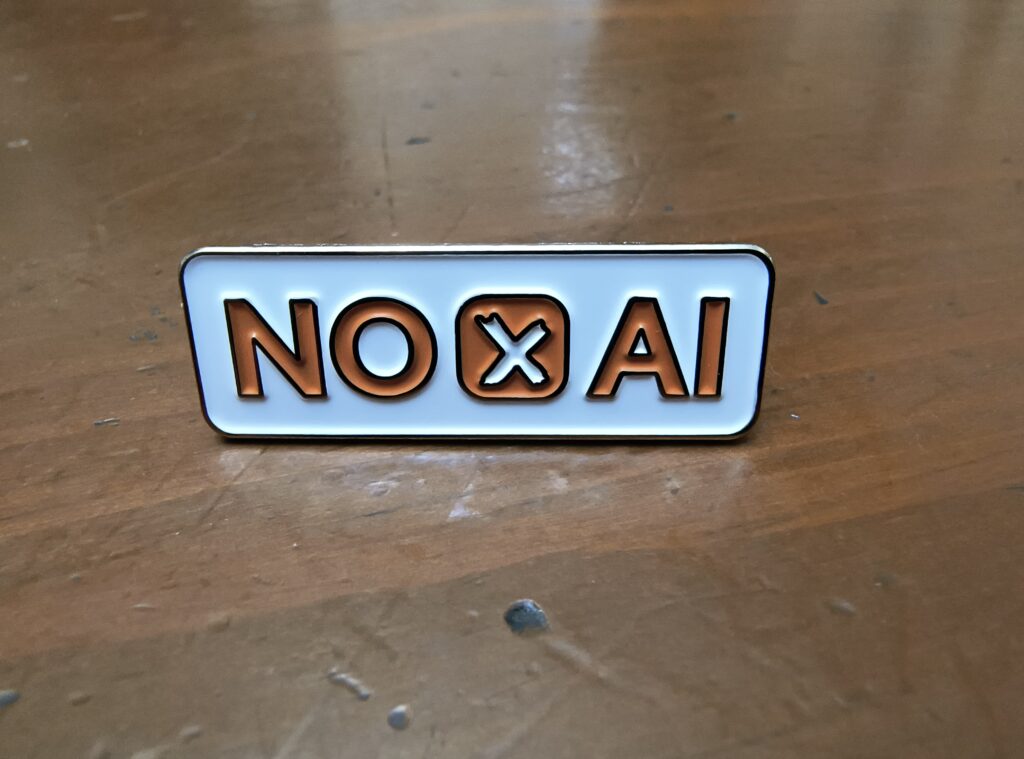
NO AI pin from DuckDuckGo

Most of the giant corporations have gotten the memo that their oligarchic overlords want them to shove AI into everything, whether people want it or not. I’ve written previously about my position vis-à-vis AI and how I avoid using AI for anything. The net result is that I have to spend a fair amount of time trying to figure out how to turn AI off in things.

It’s a constant battle. Last year, at least twice, I had to go into the settings of Zoom to turn off every single AI setting so that Zoom would not constantly try to beg participants in any meeting I hosted to turn on their spybot. And that happened yet again when they added some new chatbot and a note taking service. I’ve discovered that some people have no idea how dangerous these things can be. There was a local story about a school committee that went into executive session to candidly discuss litigation where one of these tools was running. It helpfully mailed the transcript to everyone, including members of the public. People treat Zoom sessions as an informal discussion — not a place where every word will be recorded and shared publicly. (After I succeeded in turning it off, I noticed a page that suggested they were going to start charging $10/month for it. I wonder how many people will use it if they have to pay for it…)

Some companies have gotten the memo. I was pleased when DuckDuckGo created a NO-AI search landing page. I have set my default engine everywhere to it. It’s nowhere near as good as search engines used to be, but at least it doesn’t have AI summaries. Last year, DuckDuckGo ran a survey to ask whether people wanted AI in search results or not. They gave away pins to some people who responded and boosted the survey in social media, and I got one! It’s pictured above. I wear it proudly.

Unfortunately, there is a lot of AI junk that’s hard to avoid or turn off directly. That’s why I was so pleased to discover the Disable AI WordPress plugin. When I first discovered it, it was still in a very early version with hardly any installs. I did my due diligence to inspect the source to figure out what it was doing (and make it sure didn’t appear to do anything nefarious.) It basically uses CSS to set the visibility of AI buttons and interfaces to false, so they don’t show up in the interface. It’s awesome! It’s unfortunate we have to depend on adversarial coding, but thank goodness for Free Software that makes that possible!

To be clear, there are many domains where various kinds of machine learning have already been effective and will continue to be transformative. But that doesn’t mean I want to be forced to ever use it. So I’ll keep doing whatever it takes to push back.

NPR headline: ChatGPT promised to help her find her soulmate. Then it betrayed her

I find it intensely annoying when people ascribe intelligence, or intentionality, to statements by AIs (i.e. Large Language Models). In today’s example, a writer said that an AI “betrayed” someone. This kind of statement is a category error. It projects intelligence onto a system that, though facile with language, does not in fact engage in human reasoning at all. It just makes pronouncements that look like human speech. I really wish writers would stop using these kinds of statements that mislead people into thinking that AIs are, in fact, intelligent.

I began trying to imagine the words that shouldn’t be used to describe AI speech. In chatting with Philip, I said, “AIs can’t ‘promise’ anything either.”

“They can say they do, though. They can say anything.”

“They can say anything. It just doesn’t mean anything.”

“I don’t know,” he said. “It ‘means’ something, in the sense that a string of words means things. I mean, the AI can’t mean anything, because it has no agency, and no real existence. But the WORDS mean things, which is how we get this puzzlement.”

I disagree. Here’s the thing. Statements (strings of words) never mean anything on their own. The receiver always has to ascribe meaning to a statement. This is a fundamental tenet of social constructivism: You can’t transmit meaning — only words. You probably had a meaning in mind when you transmitted the words, but the other person receives the words and has to construct their own meaning from them.

In a normal case, one makes the assumption that the statement meant something to the person who made it. When the receiver ascribes meaning to it, they make assumptions about what it means to themself and what it may have meant to the speaker. And, in this way, interlocutors negotiate a shared understanding. But things don’t mean anything to AIs. So you’re projecting meaning onto something that isn’t there.

It reminds me of Wittgenstein’s “Language Game.” Wittgenstein began his philosophical inquiry with that the idea that propositions (human statements) are (1) tautologies or (2) contradictions or (3) neither. He agonized over what would could be said and what could only be thought or shown. But, eventually, he came to call language a “game” and recognized that one of the principal outcomes of language was that most of what could said were things that had no corresponding referent in reality. I think he basically gave up on philosophy as a meaningful endeavor.

AIs are the language game as simulated by machines. Nothing they say has any referent. There is no intentionality or thought process behind their utterances. But when people see a statement, they are seduced into imagining there must consciousness and meaning behind it. I would recommend people not give into the temptation. AIs are not trying to accomplish anything. They do not have motives. Or goals. All they do is generate text that looks like an answer.

Do not project intelligence onto them. In fact, I would recommend not using them at all.

The people who are creating these machines obviously do have motives and goals. And it would be a mistake to believe that their goals align with yours.

a stylish hip flask

It’s become nearly impossible to avoid “AI” which is increasing shoehorned into every corner of our lives. I’ve lived through a bunch of the tech bubbles and this is by far the biggest and most intrusive. The tech-bros are convinced that robot slaves will print money for them so they can do away with all of these inconvenient human resources, impoverish them, and make them traffic their children for sex. Or, maybe, that’s just what they want you to think — to keep the bezzle going. But the fact of the matter is that today it’s nearly impossible to do anything using technology that hasn’t been tainted by so-called AI.

It seems apparent to me that the techbros have been intentionally enshittifying tools (like search) to force people to become dependent on AI. I suspect they are also using the huge pools of venture capital at their disposal to literally pay companies (cough Mozilla cough) to put AI into everything so that it becomes impossible to avoid.

It’s becoming harder and harder to define exactly what is AI. Some people distinguish between analytical and generative AI. Or what the model is trained with. Or where the model is run. I’m quite sure that almost no-one, outside of narrow specialists really has a good understanding. I think it’s all worth avoiding.

As an author, I strive very hard to stay away from AI. I don’t use any of the AI chatbots. I’ve used ChatGPT exactly one time. I want my writing to be unequivocally my own. I certify as such when I submit a manuscript. Toward that end, I don’t use computer operating systems with AI installed (I use Pop!_OS and an older version of the MacOS.) I have managed to retain the Google Assistant, turning off Gemini whenever they turn it on. I use the NoAI Duck Duck Go search engine. I have all of the AI bullshit turned off in Firefox. I do most of my writing in a text editor that doesn’t have AI (although there are AI plugins you can install). I’m using the wp-disable-ai plugin for WordPress to remove the interface elements that are based on generative AI. I turn off the AI Companion in Zoom. etc, etc, etc.

That said, I also use tools where it is nigh-on impossible to completely avoid AI, like Google Docs. Or Google Image Search. Or Google Maps. As Philip Brewer commented to me:

You know, it’s just about impossible to do anything on the internet and not end up using LLMs. If I use Google to check and see if there’s already a company with the same name I’m thinking to use as the name of a nefarious company in my story, Google is going to give me an AI-fied version of the search. If I read that, and then (depending on the result) either go with my fictional company name or else change it to some other fictional name, is my work now a work that used an LLM?

I don’t avoid AI only because of my authorship. I also want to make sure I’m using my brain and not becoming dependent on machines to think for me. I suspect people will discover that it is exactly like with GPS systems: There is “concrete evidence supporting the abstract contention that the rising technical order of GPS systems is dissipating human mental order in those who come to increasingly use and depend on it.” (From J. Robbins, “GPS navigation…but what is it doing to us?,” 2010 IEEE International Symposium on Technology and Society, Wollongong, NSW, Australia, 2010, pp. 309-318, doi: 10.1109/ISTAS.2010.5514623 — see A. Hutchinson, “Global Impositioning Systems: Is GPS technology actually harming our sense of direction?” The Walrus, Oct. 14, 2009. http://www.journals.uchicago.edu/doi/abs/10.1086/432651). This is not to say that I never use GPS systems, but I try to minimize my use — using them only when absolutely necessary — because becoming dependent on them causes the parts of your brain that do that work to atrophy. Literally.

I also avoid the commercial AI systems because their creators and operators are manifestly untrustworthy. You can’t know whether the results they’re presenting to you have some hidden bias. Or an overt bias. Sometimes that bias may be as simple as, “This restaurant paid us more money to have them show up in your Google Map results.” But there are a lot of other far more subtle potential biases that might be intentionally programmed in for political or ideological purposes. I would much rather be able to inspect the underlying data directly and make my own decisions. Search engines allowed us to do that. AI summaries do not.

People are going to need to come to their own decisions about what kinds of AI use are acceptable and unacceptable. I recognize that I tend toward one extreme. But others may reasonably tend toward another. Context is important.

It is not just a slippery slope. I remember many years ago, I went bicycling with my brother on the KalHaven rail trail, that runs from Kalamazoo to South Haven, on the Lake Michigan shoreline. We rode out, making good time, and feeling great. Then we turned around and the ride back was a terrible slog. It felt like we were riding into a strong headwind. Upon reflection, we realized that although the rail trail looked perfectly flat, it was not level. The rail trail is all downhill from Kalamazoo to the lake. And all uphill going back. You’d never know that standing on any particular point — you can’t see the slope. I think AI is like that: it’s a continuum and it’s going to become harder and harder to know exactly where you are on the slope. Unless you have a GPS.

Note: WordPress would lurve for me to use an AI assistant to generate an image for this post. I considered doing that — just for the lulz. But, no. It’s my own, original artwork. Made by me: a human being.

I was excited to be offered a place on the program at Worldcon in Seattle, but recent events about Worldcon have left me in a quandary. I will probably still attend, but I’m dismayed and discouraged by what’s happening.

I first attended Worldcon in 2023. I applied to be a participant with little expectation of getting on the program, and was very surprised when I ended up with eight appearances. I applied again in 2024 and, expecting to be selected, made all of my arrangements to travel internationally to Glasgow. When I was not selected, I decided — at significant expense — to cancel all of my arrangements. So, when I applied for this year in Seattle, I wasn’t sure what to expect.

I filled out the interest form to be a participant in October. In January, I was very excited to be invited to be a participant. And, in early April, I had the opportunity to fill out the panel selection survey, to propose myself for particular roles. And then, just before May, the Worldcon Chair issued a statement, followed by an apology, and then a clarifying statement, about the use of ChatGPT, a generative AI Large Language Model (LLM) in the participant selection process, that included the actual ChatGPT prompt they used to investigate participants.

Basically, they tried to use ChatGPT to assess potential participants (who were identified by name to the system) for disqualifying attitudes, statements, and behaviors. The system collected information and provided it for review, along with an assessment of the suitability of each name.

The reaction of the speculative fiction community was swift and almost universally negative. A few people have tried to speak up for the organizers, but most expressed outrage. A number of prominent people have withdrawn as volunteers and participants. Or even pulled their works from consideration for awards.

Large Language Models are reviled in the writing community for many reasons: they have been unethically developed, frequently exhibit bias, and are known to “hallucinate” false information. Moreover, they represent an existential threat to the writing community if their corporate masters are allowed to profit from the unethical use of the source materials that were used to train them.

Others, with more expertise, have written about the shortcomings of using Generative AI in general, and ChatGPT in particular, for this purpose. Both the choice of tool and the nature of the prompt meant that the results would be potentially biased and untrustworthy.

Many people ran the prompt on their own name to see what their report looked like. Out of curiosity, I finally decided to do that too, to see what they would have found when they investigated me. The report about me was banal with no wildly incorrect information. (I could speculate at length about why, but the reasons aren’t really germane to this discussion.)

I have written about my grave concerns about the use of generative AI and that fact that I do not personally use “AI” for anything. I had previously never used ChatGPT. And I regret having given into my curiosity to use it now.

My overall reaction has been dismay. Worldcon was already going to be thinly attended due to the unsafe conditions traveling to — or even within — the United States for many people. Now, even more people are canceling their plans to attend for this unforced error.

My initial hope was that they would reject the work done by AI — the fruit of the poison tree — and redo the participant selection process — even it meant I risked being denied a spot on the program. But, unfortunately, they seem to have doubled-down on retaining the work done to date.

So, I’m left with a quandary. I don’t plan to take any immediate action. I don’t even know if I’ve been selected to appear on any panels. And I have other obligations to fulfill at Worldcon: My publisher has applied to sell books there — presumably including my forthcoming book. Furthermore, as Secretary of SFWA, I would like the opportunity to meet with and coordinate with my colleagues. But I’m left dismayed and discouraged. And deeply unsettled.

One thing most people probably haven’t thought much about is the autonomy of so-called AIs. (Note: Large Language Models are not actually “intelligent” in the way people think of intelligence and people tend to project intelligence onto their behavior. But for the sake of convenience, I’ll call them AI anyway). Who actually controls AIs?

People assume that AIs are “trained” on “data” and then behave autonomously in response to the prompts they’re given. That’s sometimes true. But in many ways, their behavior is often secretly constrained. When Google’s photo recognition software mistakenly identified an African American as a gorilla, the company simply put in a hard limit so that the AI would never report recognizing anything as a gorilla. But none of this is visible to the end user. Most of the current AIs are probably full of hacks like these to prevent the AI from making common sense blunders that would get the company in trouble. But what other kinds of hacks might be in place?

If you’re a company producing an AI, there are all kinds of things you might wish your AI would do if used in particular circumstances. Or by particular people: your opponents, say. Or politicians. How irresistible will it be to corporations that make AIs to make them act in ways that benefit the corporation when given the opportunity? Anyone who knows corporations will know that it will be totally irresistible.

More importantly, when was the last time you heard of a corporation getting it’s network compromised. Yesterday? This morning? Ten minutes ago? It happens all the time. What happens when one of these AIs get compromised? How do you know the AIs you’ve been using up until now haven’t already been compromised?

Humans sometimes get compromised too. If someone gets kompromat on a person, like a pee tape for example, they might be able to get them to do nearly anything: even become a traitor to their country. And, of course, people are notoriously susceptible to inducements: e.g. money, sex, drugs. Or to become a mole or traitor for revenge. There are a bunch of huge differences between human treachery and a compromised AI. But one difference should give you pause.

We have deep experience with human treachery. We all know hundreds or thousands of examples of it throughout recorded history. There is legal precedent and volumes of case law for how to handle it. We have no experience with what happens when an AI gets compromised and begins to systematically undermine the agenda of the user. Who is responsible? Who decides? What’s the liability? Nobody knows.

Personally, I don’t use AI for anything. Not for important things. Not for unimportant things. Not for anything. That may seem like an extreme position. But I think that once many people begin to use AI, they’ll quickly become dependent on it and will find it much harder to recognize the subtle ways that AI — or whoever is actually controlling it — may be using them.