pepper box

Cory Doctorow says to Stop hitting yourself. It’s easier said than done. But it’s possible.

His main point is that people with power (e.g. the techbros) like to pretend that every person is a fully independent individual with the total freedom to choose whatever they want. They claim that everyone is “free” to reject their abusive, vertical, monopoly technology solutions. Cory says, “if you’ve avoided the self-inflicted neurological injury we call ‘studying economics’ (which leaves you incapable of reasoning about or even perceiving power), you’d call this coercion.”

I agree, but only to a point. In my life, I’ve made many difficult choices that many other people said they couldn’t do. I call bullshit.

My wife and I chose to live on a single salary while we raised children. While I was a doctoral student, I received a small assistanceship while she worked as a customer-service and regulatory affairs representative. We lived in a tiny student-housing apartment. I provided full-time child care for an infant while she was at work, and then I worked on my dissertation evenings and weekends. It was an extremely difficult period of my life. When I finished and got a job as a non-tenure-system faculty member, she gave up her career to stay home and have a second child.

Many people have told me, as we did this, that they needed two salaries.

Similarly, when we went to buy a house, we discovered that there were no houses in our price range that weren’t condemned (literally). We considered buying farther away, where our budget might have gone a bit farther, but we wanted to live closer to campus. Thanks largely to my wife’s ingenuity, we identified houses in a neighborhood near campus where the owner wasn’t the resident. We made a direct approach to several owners and were able to identify a small, rundown house that was walking distance from my office and an elementary school. We are still living in this house, 30 years later.

Many people, some who live in large, new houses in a forest, have told me that they couldn’t afford to buy a house in town.

While I was a doctoral student, I used a piece of proprietary software to conduct my research. Just at the time I was about to start interviewing, the software company went bankrupt and I discovered that all of my work was held hostage to their business model. They got a new infusion of capital and resuscitated enough that I was able to finish my research, show my work, and get a job. But I decided I was never going to let my work be held hostage by a software company. I made the commitment to use Free Software and open standards whenever possible or, minimally, to make sure that I could do the work with Free Software. And, if I couldn’t, I wouldn’t do it.

I have watched many, many people get burned by technology companies gradually enshittifying their products. And I keep wondering how bad it has to get for people to jump. For example, yesterday I sent a note to my old faculty to let them know that you can no longer predict which tools in Photoshop use AI — and add metadata to your file to that effect. This should be a deal breaker for anyone making scientific imagery. I tried for nearly my entire career to persuade faculty to switch from Illustrator to Inkscape (which is actually much better for their purposes). And to switch from Photoshop (which many of them use when they really should use a vector illustration program) to GIMP. I can count the number who switched on zero fingers.

When my son was in fourth grade, he had a particularly coercive teacher. He told me he hated the way she made him do things. I thought for a moment, took a deep swallow and said, “You know. She really can’t make you do anything. You can choose whether or not to comply. If you choose not to comply, there may be consequences. And the consequences may be unpleasant. But she can’t make you do anything. You can choose.”

As I spoke, I watched the lightbulb go on as he realized that he had power. He wasn’t powerless in the relationship. He could choose. It’s a moment that I will never forget. And his realization of this fact made my life significantly more difficult over the following months and years. But it’s a decision that I don’t regret and I would do the same today.

People actually have more power than they realize or are willing to admit. It’s not always easy or comfortable to exercise this power. It may require sacrifices and accepting consequences. But we should never forget the power that we do have.

wisdom teeth

This book is dedicated to a nameless curator or interpreter in the British Museum who opened a cabinet for Mary Beard when she was a child so she could look a loaf of Egyptian bread that was on display in a cabinet too high for her to see. That experience was part of what launched her on her path to study the classics. In many ways, her book performs the same service for the rest of us: selecting a set of diverse topics from the classics to bring before us.

The main question that drives the book is, “Why should we study the classics?” For the author, interest in the classics was driven by “thauma” or wonder. She was simply amazed, delighted, and fascinated by the ancient world — and the incredible richness of what is available to be studied.

The subtitle, “the shock of the old,” is a nod to a 1980s book and television series, “the shock of the new.” When people encounter ancient works they often are unaware of how controversial the works were at the time. And many still have power to shock and provoke people today. They often deny simple analysis or expectations which, in part, explains their staying power.

The author reflects on how and why the classics have been taught. In Britain, learning Latin and Greek were required for post-secondary study and so a vast number of people studied them. She tries to knock down the fig leaves that have been offered for why they were required: they are not uniquely suited to exercising human faculties or understanding civilization. Interestingly, she mentioned a proposal that would have offered Sanskrit, in addition to or instead of, Latin or Greek. Having just read Proto, I’ve just been lamenting that I never studied Sanskrit. Of course, I never studied Latin or Greek either.

Privilege was a large driver of the use of classics. And the right-wing patriarchy still tries to use the classics to justify their positions. The author does a good job of stripping away this fig leaf as well. She also lays bare a number of ways in which the classics were taught, historically, to disadvantage people who lacked privilege. Boys and girls were taught Greek differently (with or without “accents”) that ended up penalizing girls in advanced study. Also, a number of the “tests” of Latin and Greek used passages that would be familiar in translation to people from a privileged background, rendering their need to understand the language nearly nil, which penalized people from other backgrounds.

In the end, she identifies two factors that make the study of classics particularly useful. First, they offer a level playing field for discussing current issues. Nobody can truly take sides in debates in the classics as they are so separated from us in place and time. But the issues that were relevant to those debates are still relevant today. This enables people to take positions without necessarily having to take sides. Second, they offer practice in difficult reading. To be honest, this rationale doesn’t particularly resonate with me: lots of things are difficult to read and understand.

As someone who has made always eclectic choices about what to learn, I don’t really need a case to be made for why to study the classics. Knowledge is an end in itself. It reminds me of my many students who, at the end of their university education, were so incredibly invested in the next step: “What if I make the wrong choice?” There is no wrong choice. Any step you make offers new perspectives and vistas from which to decide what to do after. Sure, some might be only, “Well, I sure don’t want to do this again!” But that too is useful. Experience is what you make of it.

My own perspective is that there is no such thing as a “well-rounded education” because there is too much to know for anyone to encompass it all. You always have to pick and choose. Furthermore, you can really only become an expert in one or two things — or perhaps a handful — over the course of a whole life. People just don’t live long enough for more than that. (Also, as one ages, it gets harder and harder to learn. Ask me how I know…)

Mary chose classics and it was a good and satisfying choice for her. It was a delight to read her book and get a sense of the thauma (or wonder) that brought her to the discipline and kept her it its thrall for a lifetime.

potsherds

History and languages are always interesting to me and this book marries them in exquisite detail. I know relatively little of bronze-age history and, although I’m aware of the relationships among Romance languages, I’m much less familiar with the early progenitors that originated in the Caucasus and around the Black Sea. I learned a lot reading this book.

The early parts of the book simply set the stage with almost nothing about language itself. But the rest of the book is organized around broad groupings of related languages and tries to present the data: historical, archeological, linguistic, and — increasingly — genetic that provide insight into the movements of people, culture, and — ultimately — languages.

There is so much here the treatment is often superficial. I found myself, over and over again, going off to Wikipedia for a deeper dive into tantalizing mentions that I wanted to know more about: Tarim Mummies, Soma, Ephedra, Harappa, Indus Script, William “Oriental” Jones, etc., etc.

There is so much detail, it becomes overwhelming. It would have helped to have additional figures. At the very end of the book is a kind of phylogenetic tree that shows how the proto-indo-european languages might be related. Smaller trees to supplement the chapters that actually showed how the characters used to construct the trees (sound changes, word borrowings, etc) might have been helpful. As it was, a lot of the detail just kind of slides past because — without some way to visualize it or relate it — it just becomes noise.

Another helpful tool might have been a timeline. Or multiple time lines. The book keeps jumping forward and backward in time with references of 1700 bce then 500 ce then 300 bce. It would have been really helpful to have time lines to show which events were happening at the same times. (Or something like this graphic that Tufte used as an example of effective information design.)

The last chapter, which looks at the places of indo-european languages in the current world was thoughtful. Much of region where important events in the book took places are now a war zone. And language is as politically contentious as it has ever been.

Earlier in the book there’s even a brief mention of Esperanto. In Krakow, the author describes visiting the lair of a dragon named Smok and remarks on the choice of Tolkien to name his dragon Smaug. Tolkien believed that stories needed a legendary backstory to make them seem real and believed constructed languages like Esperanto were “dead, far deader than ancient unused languages, because their authors never invented any Esperanto legends.” Maybe that was true in Tolkien’s time, but that’s only because he never heard La Romanco de l’ Eminentulo.

It’s a good book. A bit of a slog to get through the details, but with so many fascinating leads to interesting stuff that it’s well worth the effort.

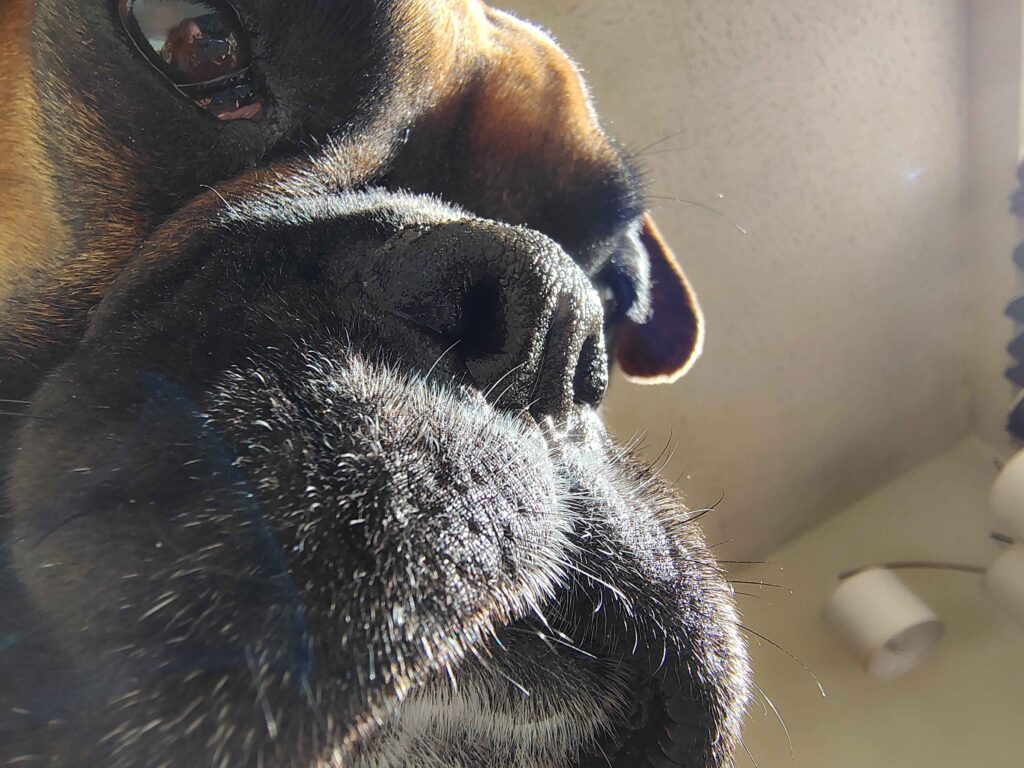
Tanuki's fuzzy muzzle

Thanksgiving is a useful moment to reflect on things we should be grateful for. I certainly have many! I’m particularly grateful for my family and friends, who have rallied around me and supported me through both good and difficult times. But there’s one special individual I’m particularly grateful for this year: Tanuki.

Tanuki is my son’s emotional support animal. Previously in my blog, I’ve written about boxer dogs in general and about Tanuki several times. In particular, I wrote a long piece about getting some extra Tanuki time when my son was in the hospital. She’s an incredibly important part of all of our lives.

A couple of weeks ago, she started to seem under the weather. At first, she would eat grass and sometimes didn’t want breakfast. She also seemed subdued and lacked energy. Normally, she is incredibly eager to eat her breakfast and loves to play. After a week, we were concerned enough that, after consulting her vet, we scheduled an ultrasound for as soon as we could get her in.

She got worse. She started vomiting and had diarrhea. She refused her meals for a whole day and quit drinking. I arrived in the evening to visit and noticed that her collar felt loose. I could see that she was dehydrated. We decided to rush her into the animal hospital emergency room.

A brief digression: Tanuki, like all boxer dogs, is a little weird. Unusually, although extremely devoted to her family, she does not trust strangers and does not really like to be touched by anyone. When she was a puppy, she really only tolerated being stroked between her shoulders and pelvis. If you reached a hand toward her head, or touched near her tail, she’d bite ya. Not hard, but enough to tell you that she really did not want to be touched. She has become a lot more tolerant with family and will (generally) let us touch her. But woe to the person who tries to “pat” her. When Philip visited recently, he forgot and went to pat her vigorously, like he would with his own dog — or like I would have done with any of our previous boxers. She whirled around and went after him to make it clear that his liberties with her person were not to be repeated. And Tanuki’s distrust of strangers goes double for veterinarians and their assistants. She does not suffer lightly being inspected or poked or prodded.

When we arrived at the hospital, an attendant came out. He carefully did not look at her, sat on a chair, turned his back, and let Tanuki approach him from behind. Then he invited us to lead her back and get her on the scale. At his direction, after he got her weight, we passed off the leash to him and retreated back to the lobby. We waited anxiously while they did their intake and, eventually, the vet came to speak with us. She said she had arrived to find Tanuki curled up in the lap of the attendant (who had gotten “Dad’s” seal of approval). But that Tanuki had given her the “stink eye”.

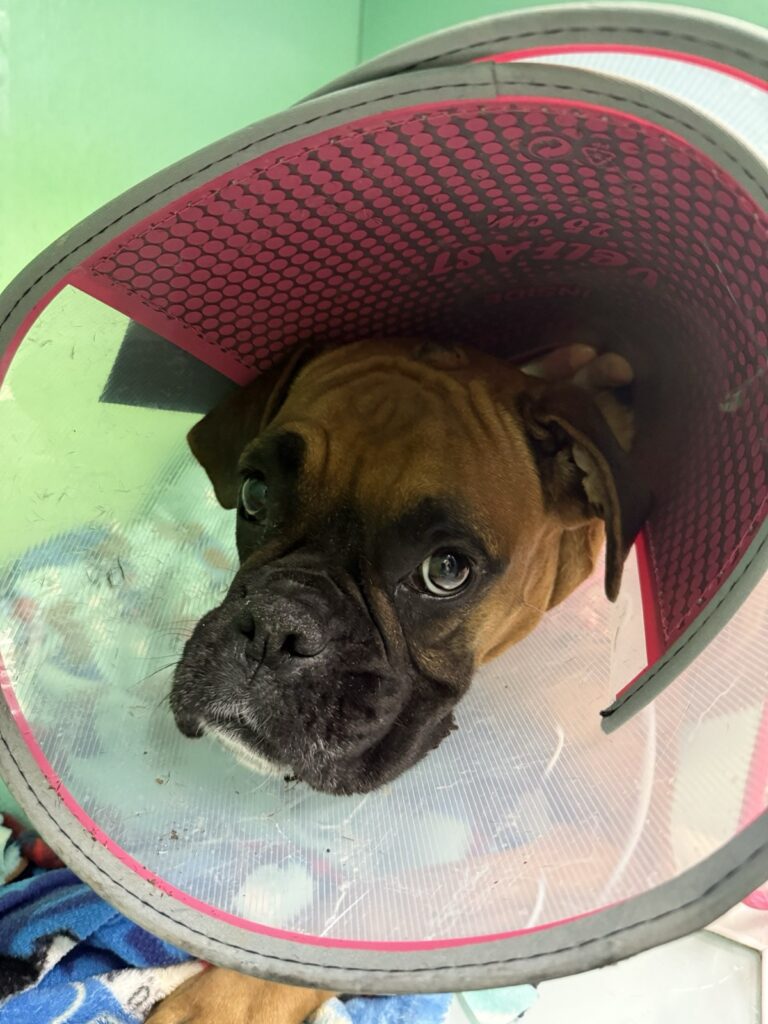
Tanuki in two cones of shame

They had to put her in two cones to evaluate and treat her. The vet diagnosed Acute Hemorrhagic Diarrhea Syndrome (AHDS). She was significantly dehydrated, which was the most serious risk. They said they would keep her overnight, give her IV fluids, start antibiotics, and then perform the ultrasound the next day to check for more serious complications.

We went home: alone, sad, and worried. But relieved that she would get care overnight.

The next day, they performed the ultrasound. It was negative. No pancreatitis, obstructions, or foreign objects. They said they’d keep her for another night — or until she started eating and drinking again.

Overnight, we got word that she was eating again!

Finally, the next afternoon, she was discharged. We all went together to pick her up in the car and bring her back home.

I was encouraged to see that the assistant who brought her out (a different person) seemed to have been able to get the leash and slip lead on her without a problem. So maybe Tanuki has learned to trust the veterinarians a bit more.

We’re still working our way through her post-hospitalization treatment. She had four prescriptions initially. Now we just need to finish the course of antibiotics and transition her back to her regular food. But she seems fine: her appetite is good and she seems to have fully bounced back. She’s full of energy and as playful as ever.

I’m so relieved and thankful my son has her in his life. I enjoy seeing her every day my own self too, of course. She’s so full of enthusiasm and excitement. But he really needs the emotional support and it would have been devastating — for him and for all of us — to lose her so young. She’s barely three.

Boxers, like all large, highly-inbred dogs, never last very long. My family had three boxer dogs when I was growing up and I had two of my own. Most lasted around 10 years. My big boy, Plato, got canine lymphoma and died way too early at six. It nearly broke my heart.

Boxer dogs are like meteors. They don’t last very long, but they burn bright — so very blindingly bright. I’m thankful for every day of my life that I get to spend with boxer dogs. They’re the best.

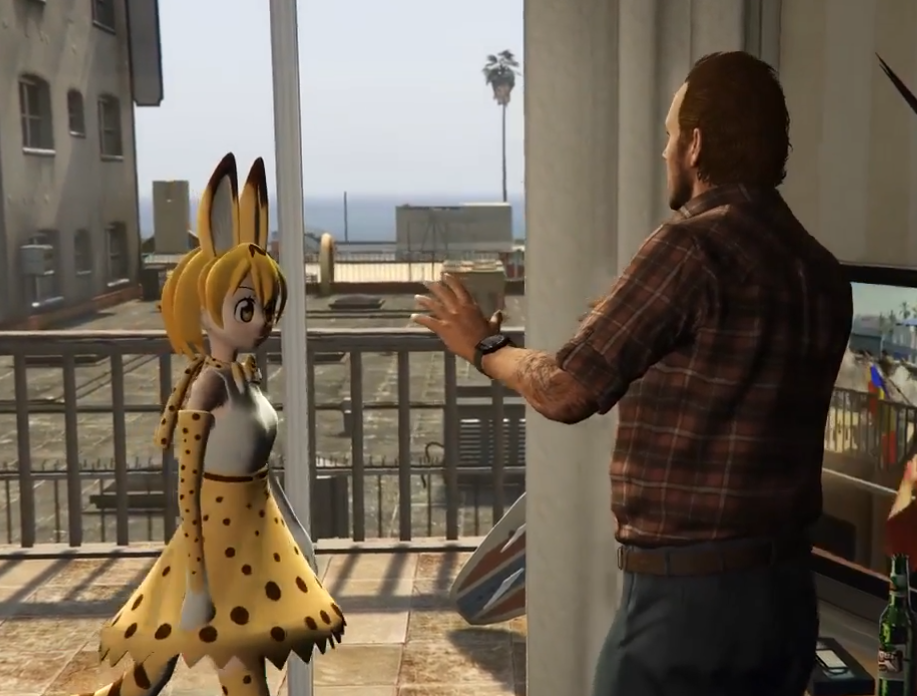
An interesting article in the NYT reviews the new Grand Theft Auto (gift link). I didn’t originally read the article because the only GTA thing I’ve ever had even the tiniest interest in was when someone replaced one of the models with Serval-chan. But my brother’s wife said the article was good, so I went ahead and read it.

It’s excellent. There’s a lot of thoughtful commentary about how the franchise has evolved with the times. It includes some background on how the game is made with deep dives into some of the particular features that give the system an almost unmatched verisimilitude for the current zeitgeist.

It also has a lot of quotable quotes, like:

Rockstar seems to have decided, in the main, that lampooning the particulars of Trump’s America through exaggeration is like bolding 72-point type.

and

[…] A.I. advocates have posted footage from their own enormous “open world” games generated by prompting Claude. The games look stupid, like something a dog would make.

Nailed it.

I’m reminded every day (while walking a dog) how dogs live in a radically different world than humans. The things a dog cares about are completely different than a person. Dogs can see a sign, but they can’t read the words. Dogs can see people, but they can’t infer their relationships. Or social class. The lack of understanding really resonates with something I’ve been thinking for a long time related to AI.

My doctoral research in science education was about expert performance. One of the distinguishing characteristics of expert versus novice performance on problem solving is the ability to recognize deep structure. Novices tend to focus on surface features of problems. In physics, for example, a novice classifies pulley problems together whereas an expert would classify them by which law of thermodynamics you needed to use to solve them.

Being able to solve novel problems is one thing that AI does very poorly. If it’s seen an identical problem before, it can probably solve it. Or when the problem space is domain-limited, like mathematics, it can do well. But, although it has a lot of context through training, it is without understanding. It can’t analyze a novel problem to recognize the deep structure and apply the correct model to solve it. Because it doesn’t actually understand anything.

Of course, experts also can’t solve problems outside of their area of expertise. Or, minimally, they do no better than a novice.

Once you see this pattern — novices fixating on surface features — you see it everywhere. When teaching, I tried to never give students examples because they would try to copy the surface features of the examples rather than trying to think for themselves. A lot educational resources made by university faculty replicate the surface features of the educational resources they were exposed to as students, because they never studied pedagogy.

A significant part of why I retired from university teaching was that students were no longer willing to even look for examples but, instead, to just ask AI to do it for them. It was incredibly discouraging to look at a student paper that was mostly written by AI and wonder what kind of feedback was worth giving. Why bother even reading something that a student couldn’t be bothered to write?

Anyway, it was a good article And there were a bunch more interesting quotes in the article. Recommended.

a stylish hip flask

The past few days have felt unreasonably busy. It feels like work! It reminds me of before I retired when I was literally busy all day every day. My blog archive is full of posts like this one that describe feeling constantly overwhelmed trying to manage multiple projects on top of my regular job. But it turns out that retirement is pretty much the same.

I’ve written already about how my regular days are generally surprisingly busy anyway. On top of that this week, I took my son’s dog for a few hours while he had an appointment. Moreover, his dog has been having a digestive upset which is requiring treatment. Finally, we also had to take my mother to the emergency room that kept us up until 3am one night this week. Thankfully everyone is okay: the dog is responding to treatment and my mom seems alright.

I’ve been spending a lot of extra time on SFWA. I attended the Writing Date, in part to get some writing done, but also to promote the Board Kaffeeklatsches I’ve been running afterwards. In addition, we’re rolling out a major update to the SFWA website and I’ve been spending a lot of time wearing my Infosys Committee hat, trying to help track down bugs and support the work. (Note, as the cobbler’s children run barefoot, we haven’t gotten around to updating our own page yet. 🙂 I’m also involved in interviewing for a staff position: I’ve been spending a lot of time reviewing resumes and this week we interviewed four candidates.

In addition to the Writing Date, I also ran my own weekly writing group, Straw Dog Writes, and attended “Bearded Writers.” It was nice to get some writing done! I’m working on a new story that is a follow on to Bearly Believable. And I have a few other stories I can work on when I’m stuck on that one. Plus my regular Wandering Shop Stories writing. (I also finally got the pitch I’d written to propose a round-up about Wandering Shop Stories resubmitted after the first try didn’t get a response).

Finally, we’ve been having a car problem. We had a tire with a slow leak a few weeks ago. After checking, we decided to buy new tires (since the old ones were wearing out and winter is coming). We got the new tires installed and one went flat again. We took it back and the shop found that it was leaking along the bead — the rims were old and rusty. So they cleaned it good and remounted the tire. Then it went flat again. This time, they realized that it was actually leaking through the rim. There is a weld seam that appears to be rusting through. We swapped out that rim for the one with the spare. But then another one started to leak. So we bit the bullet and decided to buy new rims. But the tire place was having trouble finding new rims, so we contacted our regular mechanic and, after a significant back and forth among both parties arranged to order the rims from him then take them to the tire shop. Now we’ve provided boat payments to both our regular mechanic and the tire shop. We’re still having an issue with the GPMS sensors, so the saga isn’t over. But, to keep our sixteen year old car on the road, it’s probably all still worth it. Eventually, we’ll have to replace this car, but that day is not today. (Knock wood!)

I also did a few other fun things. On Tuesday, I attended a Zoom panel discussion by UMass faculty reflecting on the election. This was pretty interesting. Then, on Thursday, I actually went to a seminar in meatspace about What Makes The Lord of The Rings Great. This was really interesting and will have some impacts on my writing.

The weekend promises to be still busy. On Sunday, we have the SFWA Annual Meeting. But maybe next week things will settle down. Maybe. I can hope, anyway.

Michael Drout speaking at UMass Amherst with "Tolkien = Great" written on the whiteboard behind him.

Michael Drout, a prominent Tolkien scholar, gave a talk at UMass Amherst (in part to promote his book The Tower and the Ruin) about what makes the Lord of The Rings (LoTR) “great”.

Like all great English literature presentations, the author brought no visual aids. (This is not quite true, as someone had written “Tolkien = Great” on the whiteboard.) He stood at the front of the room with a copy of his manuscript — which he did not read from — and spoke passionately about his subject. The talk was only sparsely attended, but was excellent and well received.

He began with some evidence that LoTR is great. He cited the enthusiasm of people who can’t wait to read it to their children. And who re-read what is really a very lengthy work over and over again — many people annually. He also argued that book cosplay began with LoTR, tho I don’t really know how true that is.

He admitted that the phenomenon is somewhat weird. People cite LoTR as being more like an experience than a book. It was not considered a serious scholarly topic of study until it became a mass-market cultural product — which is also weird.

Rather than devoting any time to outlining the plot or characters, he described several other features of the books that, to his mind, distinguish the Lord of The Rings and makes it great.

He identified two particular emotional states that combine to make it great: experientiality and heimweh. The story is told through the viewpoints of the least knowledgeable characters, principally the hobbits and — during the run across Rohan — Gimli. This allows the author to give information in a natural way such that the reader learns along with the protagonist. This creates cognitive alignment between the reader and the character. He joked that maybe it is all about what we learned along the way. Tolkien also used repeated interlaced periods of stress and relief throughout the story, such as engagements with enemies (weak attack, strong attack, rescue) and illness and recovery (Rivendell, Lothlorien, Ithilien), that are used as motifs, but then violated at key moments (e.g. Cirith Ungol), to heighten drama and communicate to the reader the gravity of the moment. These motifs are then restored by the end.

When struggling for a word to capture a particular emotional resonance he (of course) turned to German and adopted the term “heimweh” to capture the feeling characters express of longing for their home, or for the past. Tolkien described this feeling “a sadness that was yet blessed and without bitterness.” Google Translate would have you believe that the word just means “homesickness”. This sense of dislocation and longing runs throughout the Lord of The Rings: when Frodo looks back toward Hobbiton and wonders if he will ever look upon the valley again. Or the Elves that departing Middle Earth. Some might call it nostalgia, but Drout assures us they are simply wrong.

He offered a number of minor digressions. He talked about the heterotextuality (a term which he did not invent, in spite of what ChatGPT may tell you). He made a brief mention of elvish racism (basically everything bad that happens to the elves — i.e. everything in the Silmarilion, is due to intra-elvish racism. Or is that inter-elvish racism? I’m not sure.) He further discussed worldbuilding (which he called subcreation), one of Tolkien’s other works, On Fairy Stories, that he persuasively argues that nobody understands (not even him) — and The Black Bull of Norway (a traditional fairy tale, which he warns us to never read because it’s awful.)

He wrapped up with a long personal anecdote to introduce the struggle he had to identify an organizing theme or message for his book. He had begun with “consolation” but decided — rather at the last minute — that this was wrong. And he settled on eucatastrophe — the idea of an unexpected turn to a happy ending. The idea is that the book helps us imagine such a world: the grief and sorrow show us how successes are possible. When I’ve tried to write stories like that, people complain that it sounds like deus ex machina. But I guess that’s why I’m not a great writer.

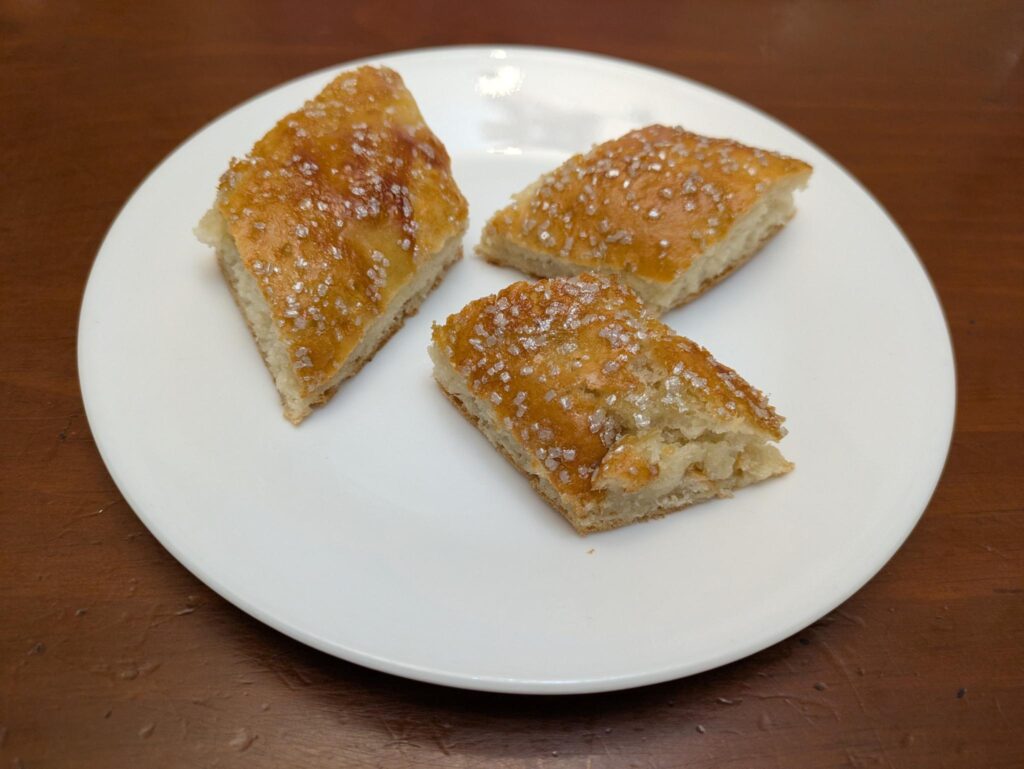
This morning, I had a hankering for scones, so I made a batch. The recipe I use is quite simple.

I almost certainly first heard of scones from reading The Hobbit. I was in fourth grade and I had never seen the word before. I asked my mom, who said she had seen a recipe for them — probably in The Joy of Cooking. I persuaded her to make some for me. We still have her copy somewhere in the house, but I have to admit that I didn’t think very much of them. I probably liked them about as much as Gollum liked lembas bread. It was very disappointing.

Years later, I looked at recipes online — a luxury that didn’t exist in my childhood — and found there were a lot of different examples. The one we had used was similar to biscuits — it used baking powder to get the dough to rise. But I saw that some recipes just suggested using yeast. That sounded better to me. In fact, they looked a lot like the recipe I used for pizza crust. So I experimented a bit and came up with a recipe that works very satisfactorily for me.

Dissolve fast-rising yeast in a half-cup of warm water (or more, depending on how many you want to make). Add a tablespoon or two of sugar and a little salt (1/2 teaspoon or so). Note: this is way more sugar than I would use in pizza dough, but it’s nice if the scones are a little sweet. Mix in flour until you have a ball of dough. Let rise for 30-40 minutes, then butter your hands excessively, and spread the dough out in the bottom of a cast iron skillet. Let rise again for 15-20 minutes. Brush the surface liberally with egg white and sprinkle excessively with sparkle sugar. Bake at 350º until golden brown. Cut diagonally into pieces.

Scones are rather plain, on their own, but are an excellent vehicle for toppings. I like to eat scones with clotted cream or Devonshire cream, although butter will do in a pinch. Honey is particularly good, but jam or jelly are fine.

Just make sure you have a lot of people to help you eat them. They’re pretty dangerous.

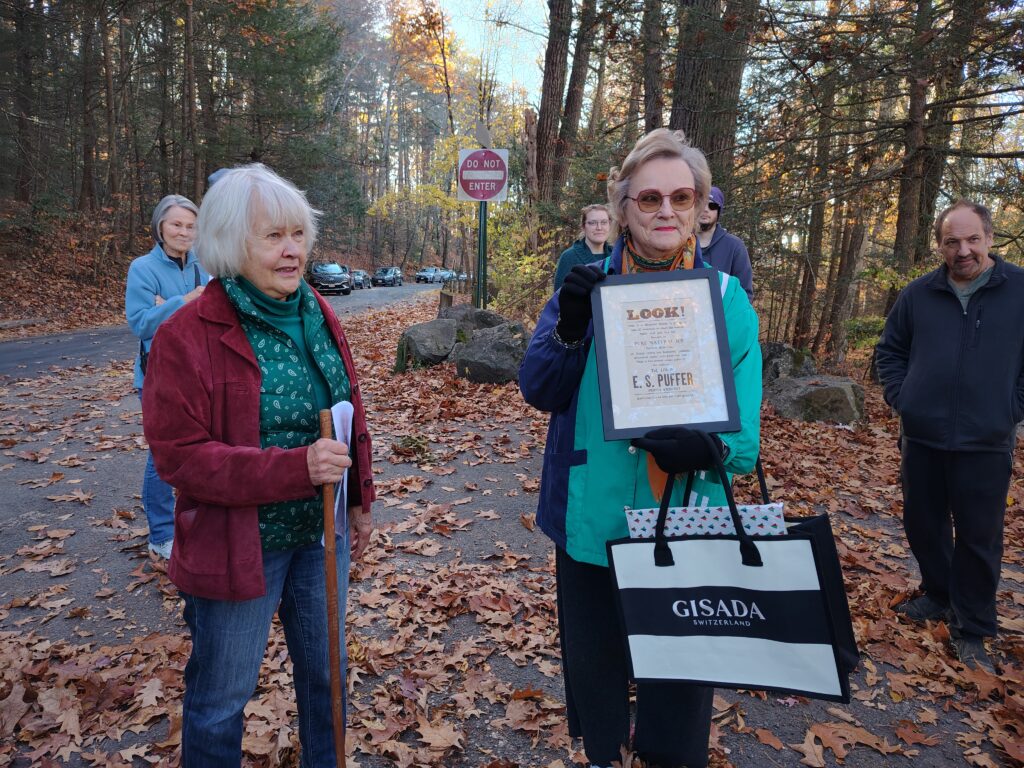
Meg Gage (left) and Barbara Puffer (right) holding an advertisement for the Golden Gate Ice Company that operated at Puffers Pond.

After going on a tour of the Lower Mill River History Trail two weeks ago, this week I returned to hike up the other way. Once again, the tour was led by the indefatigable Bryan Harvey. It was another fascinating dive into the lost industrial history of North Amherst.

The Mill River History Trail is a project of the District One Neighborhood Association (DONA) in Amherst. (Meg Gage, pictured not holding the sign, is president of DONA.) DONA has received two small infusions of the Community Preservation Act funds to carry out the project. There are plans to put up some interpretative signs and make some improvements to improve the ability to view the remains, and create some public displays of artifacts, documents, and images.

We started in the same place and, this time, walked upstream along Cushman Brook through the other half of Factory Hollow. Barbara Puffer (pictured at left holding an advertisement from the ice business her grandfather ran at Puffers Pond) explained that it’s pronounced “Factory Hallah”.

Above Puffers Pond, there was a whole series of additional dams. The river flows through a fairly narrow gorge which is currently a series of rapids. But in multiple places you can see the stone work for mill wheels, raceways, and the abutments for dams.

stonework for the Roberts Lower Mill

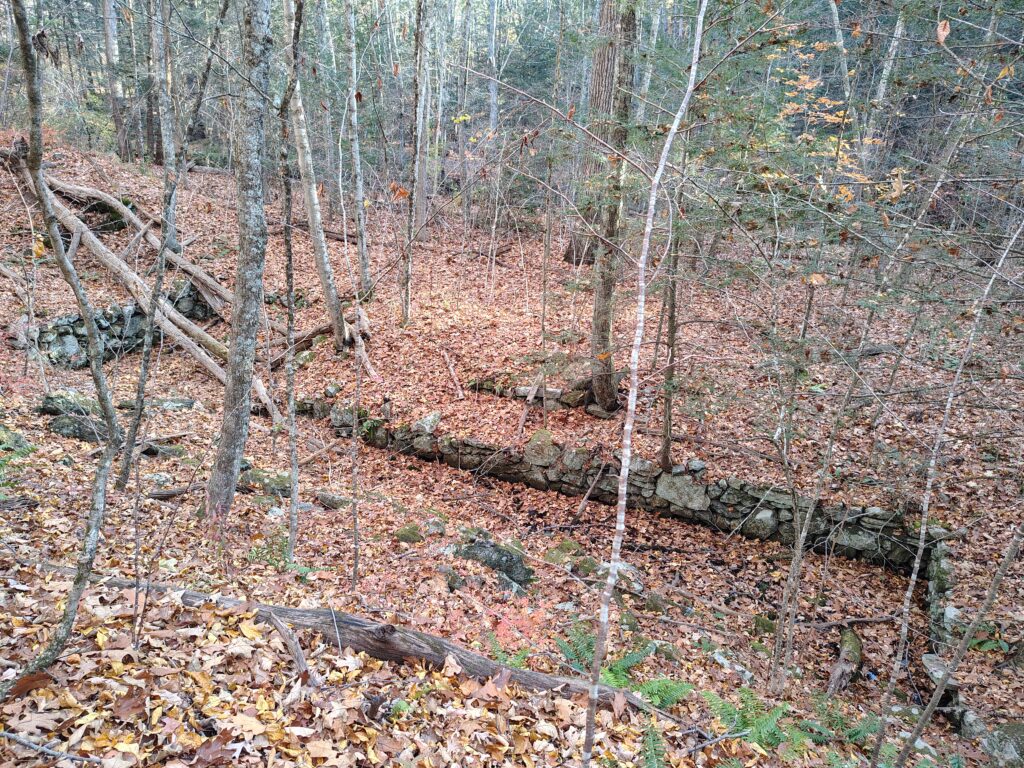
The first dam was for the Roberts Lower Mill. The abutments for the dam are visible under a pedestrian bridge that crosses the river. The current trail probably runs through where the mill building actually stood. There is stonework visible (pictured right) that was where the mill wheel rotated and you can see some indications where the flume and tailrace were. Wikipedia has a pretty good page that describes the operation of watermills that explain some of the terminology. There are indications the mills mostly began with water wheels, but some converted to use turbines. It would be interesting to see what the actual designs were.

Above that was the Roberts’ Upper Mill where, again, the abutments are visible as well as stonework for mill wheel and raceway.

A railroad track crosses the Cushman Brook where the gorge is quite deep. The trail here is impractical to follow for anyone but mountain goats, so the tour returned to State Street and hiked up past the tracks.

Just beyond there is some old housing that may have been originally constructed for mill workers with the foundations of a mill just behind. This area was among the most densely occupied of the mill sites, with four or five different mills in just a few hundred yards. Little remains but foundations and stonework.

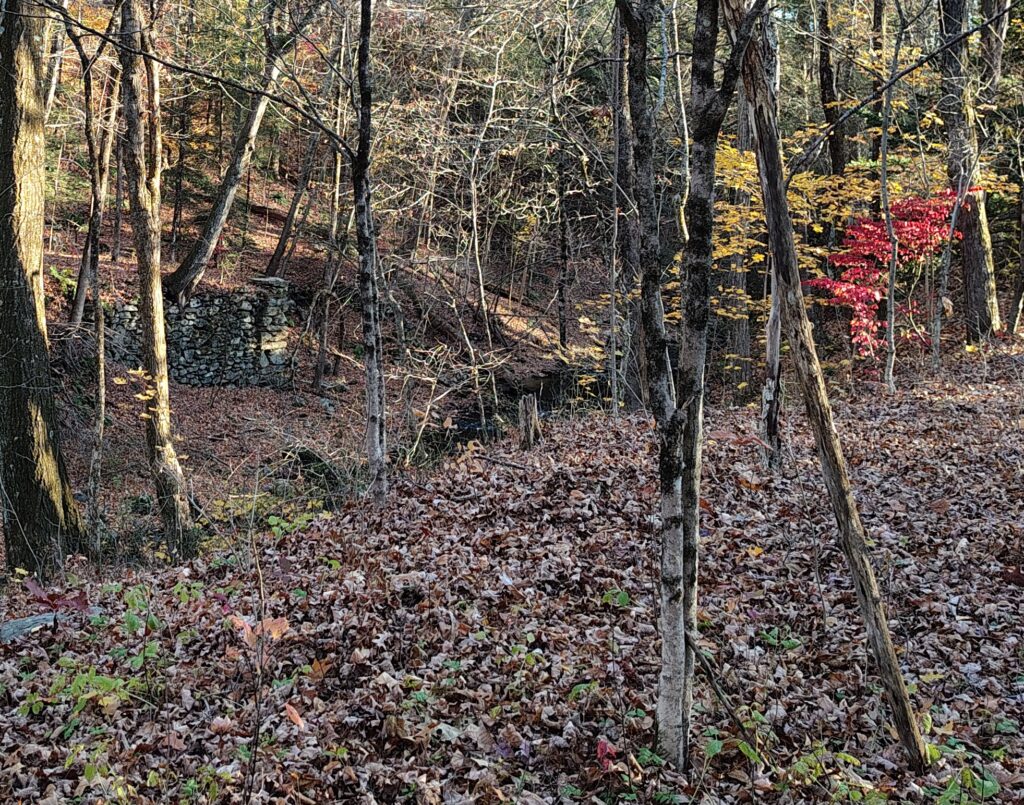
At left, a stone foundation is visible on the side of Cushman Brook.

On the other side of Cushman Brook, you can see the foundations of the Barnard Forge (pictured left). It operated from 1830-1860. It manufactured “frogs” for railroad switches and the forge had planned on being in place when the railway expanded from Amherst Center north. A bank panic caused a recession in the 1850s that caused the forge to fail in 1860. The railway eventually reached the area just six years later. The building and site were reused for cotton batting and, later, wool fulling.

State Street ends at Bridge Street. At this intersection, the first mill was sited in 1727. The site was occupied a series of mills that lasted into 1920s. We followed a trail along Bridge Street to the current bridge (constructed in 1972) where you can see the footings of the previous Old Bridge and Silver Bridge and the foundations of the last mill at the site. There is also just barely visible the brick “steam house” constructed over the lip of the gorge that housed the steam engine that drove the mill after it was converted from water power. We didn’t talk about this, but I wonder the extent to which the conversion to fossil fuels (steam and, later, electricity) allowed mills to no longer be sited near water power.

We crossed Bridge Street briefly to look down at the footings of the Silver Bridge and to see the abutments of a final dam that had created Cushman Pond which, at one time, was quite large, perhaps 60% of the size of the Puffers Pond.

On the walk back, Bryan didn’t stop periodically as he had previously. Due to my lung condition, I couldn’t walk fast enough to keep up with the group and fell farther and farther behind. I could sort of hear some of what was said for a few minutes, and it sounded like a lot of it was a reprise of contextual information he’d provided in the tour of the Lower Mill River, so I didn’t feel like I was missing that much. When we reached my car, rather than going to the conclusion of the tour, I just got in and drove home.

Upon reflection, I realized that they’ve really missed an opportunity to brand the tours, though. Clearly it should be called, “Grist for the Mill: Another Dam Hike with Bryan Harvey.” Once again, it was interesting, entertaining, and informative. Well worth the time and cost of admission.