Author of LGBTQIA+ speculative fiction and poetry in English and Esperanto. Teacher of scientific writing. Lover of natural history. SFWA Secretary. (he/him)
On January 31, 2026, I gave a reading from A Familiar Problem as part of the Straw Dog Writers Guild January Showcase. Authors who published a book in 2025 were eligible and a dozen were drawn from a hat. I got to read third.
As I arrived, the traffic in downtown Northampton was terrible. I had left plenty of time because I know that parking can often be hard to find, but just getting to the venue was a challenge. Luckily I found a parking place without difficulty and arrived in good order.
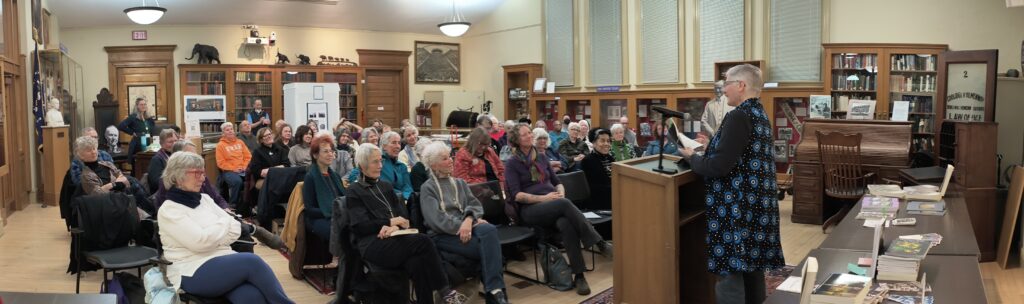
There was a sizeable audience. The Straw Dog Writers Guild tends older, female, and queer. I think there were two other men besides me. But I’ve been involved with Straw Dog long enough that I’m nearly a fixture, so I always feel welcome.
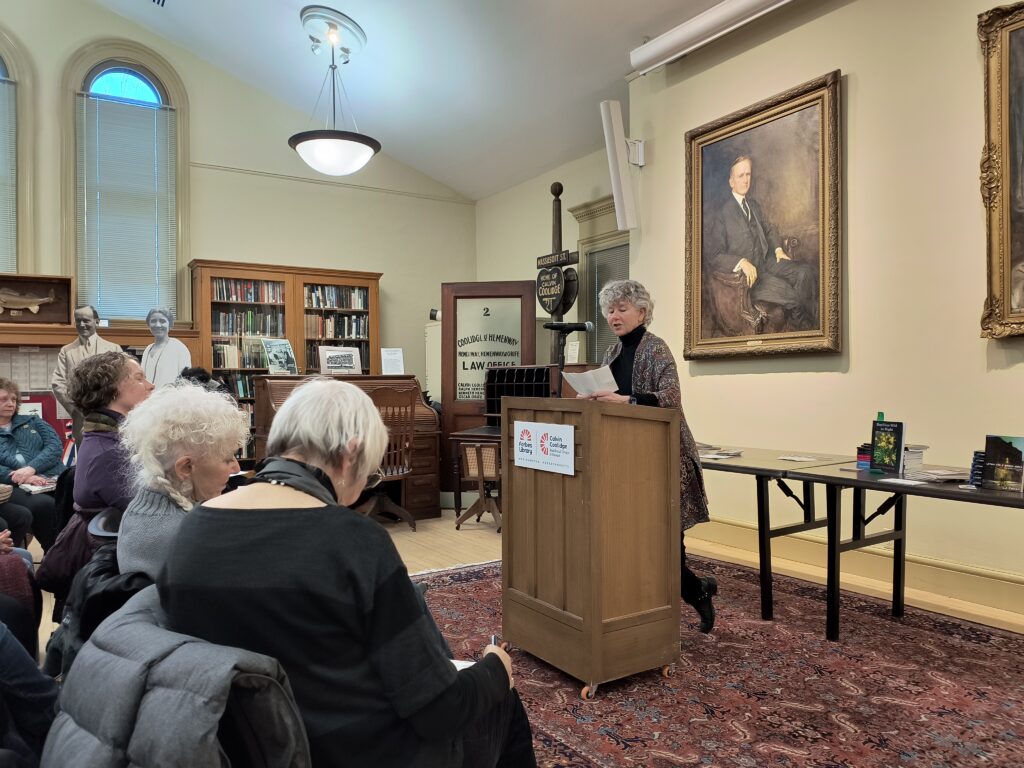
The reading was held in the Calvin Coolidge Memorial Museum in the Forbes Library in Northampton. The wood paneling and large portraits of the former President and his wife made for an elegant backdrop to the reading.
Lindsay Rockwell (pictured to the left) led the organizing for the event and welcomed the audience. I’ve served with Lindsay for several years on the Program Committee and she did a fantastic job bringing everyone together.
Andrea Hairston served as emcee. She introduced each author and brought an enthusiastic energy to the role.
Most of the readings were of poetry or memoir. My offering of my weird speculative fiction was accepted with good humor, although someone always comments how weird my writing is. And I don’t even read any of the REALLY WEIRD bits.
One of the readers, LJ Cohen (pictured at the top), also write speculative fiction. I know her from Mastodon and we’ve met a couple of times at conventions (Arisia and Readercon). I decided to buy a copy of her book and got her to sign it.
After the reading concluded, I was able to pitch my books. I even sold a couple.
After I left, I saw why the traffic had been so congested: there were ice sculptures all over town, beautifully illuminated in the dark. It was a nice way to end the day as I headed home.
The Straw Dog Writers Guild arranged a table at the Northampton Antiquarian Book, Ephemera, and Book Arts Fair where authors could sell and sign books. I attended and had a two-hour shift at the Straw Dog table. Although I didn’t sell any books, I met some new people, reconnected with others, and had a great time.
The event was held at the Northampton Center for the Arts. It’s a fantastic building with many interesting spaces. The Straw Dog table was right in front of a counter that would have been great as a bar for a reception. Unfortunately they weren’t serving.
Most of the vendors were dealers in antiquarian and rare books, but there were a few literary organizations and specialty presses. As a group of current authors, Straw Dog was not a particularly good fit and few of the visitors seemed that interested in current work. It reminded me a bit of Boskone, where many attendees want to see books by Heinlein and Asimov, rather than new authors they’ve never heard of. And, at this event, what they really wanted were signed first editions.
I arrived very early, in hopes of getting a parking space and was rewarded by getting the very last one. I suspect that not arranging for vendors to be able to unload and park at a distance to let attendees use the limited parking probably limited the number of visitors a lot. But, at least, I didn’t have to schlep my books a vast distance when it came time for my shift.
I used the two hours before my shift started to wander through the whole space and see everything. There was a lot of really cool stuff. I love old books. The fact of the matter is, however, that I would be a very poor caretaker of them, so I never buy anything like that for myself. But it’s fun to look.
In addition to books, there were other interesting things. One artist had a book made with interesting handmade papers. There were various kinds of manuscripts (old property deeds and log books). One was printing with old type that had been recovered by the Yiddish Book Center. It was all fascinating.
When my shift started, I set up my books. I only brought a few copies, since I wasn’t expecting strong sales. But I also had a sign-up sheet for my mailing list; and cards to give away for myself, A Familiar Problem, and my proposed Amherst Book Festival. Plus some Airship Pirate stickers.
I spent the most time talking to the author next to me at the table. She was easy to talk to and we swapped stories while we waited for people to stop by. We would trade off talking to people that expressed interest in our books. I ended up buying a copy of the book she was promoting, Jingle These Bells, an inclusive holiday-themed romance anthology. Her story sounded fun.
On November 9, I got to host James Cambias doing a presentation about Worldbuilding for the Straw Dog Writers Guild. He wanted to do a face-to-face presentation, so I reserved the newly built North Amherst Library Community Room. It’s a great venue with a large-screen display, four tables, and maybe 30 chairs.
Unfortunately, not many people came. He pointed out that if the number of presenters outnumbered the audience, we were obliged to take the presentation to bar and we avoded that, but only barely.
But it was a fantastic presentation and I’m sorry more people didn’t attend.
Here’s the little introduction I wrote:
Hello. I’m Steven D. Brewer and I would like to welcome you to Worldbuilding 101 with James Cambias presented by the Straw Dog Writers Guild.
Straw Dog is a non-profit volunteer organization dedicated to the craft and transformative power of writing, designed to serve writers throughout the region by promoting individual growth, community outreach and enrichment, and community building.
Our mission is to support the writing community by strengthening, engaging, and connecting writers at all levels of development.
Some upcoming events
Tonight: Everyone Reads Second Sundays Open Mic
Wednesdays: Straw Dog Writes
Nov 13: A Writer’s Night with Linda Cardillo at Longmeadow Adult Center
I first saw James Cambias at a reading with Elizabeth Bear and Max Gladstone at the Odyssey Book Shop in South Hadley. Since then, we’ve crossed paths at science fiction conventions in Boston, like Arisia, Boskone, and Readeron, where we’ve done readings and served on panels together.
Born in New Orleans, educated at the University of Chicago, James has been a professional science fiction writer since 2000. Among his novels are A Darkling Sea, Corsair, Arkad’s World, The Godel Operation, The Scarab Mission and his most recent, The Miranda Conspiracy. He also designs roleplaying games, and is an advisor to the Center for the Study of Space Crime, Piracy, and Governance.
This afternoon, he’s presenting Worldbuilding 101: In science fiction and fantasy, the strength and depth of the author’s world building can make the difference between a forgettable story and a classic. He will breakdown how to make convincing and interesting worlds for your stories, while still respecting realism and scientific accuracy.
And, with that, please welcome James Cambias for Worldbuilding 101.
James provided a brief preamble: Worldbuilding is a form of storytelling, in itself: An act of literary creation. That said, story considerations should remain paramount. When building a world, the purpose is to support the story. And he offered his own test:
The Cambias Test: Any alternate world needs to support adventures/stories that you can’t do here.
In other words, if your story can take place in the regular or historical world just do it. Don’t go to a bunch of extra work: just do the work that is necessary. Sometimes you have a setting that already exists (like shared worlds — I write stories set on the Truck Stop at the Center of the Galaxy) and you can just look up the necessary information, but he encouraged the audience to fit the story to the world.
He challenged the audience to consider what motives and conflicts that the setting supports. He cited Aristotle who proposed desire, fear, and honor (or, as we might say conviction, today). This reminded me a bit of the four F’s of animal behavior: Feeding, Fleeing, Fighting, and Reproducing. In science fiction, survival is clearly one motive.
He proposed to look for “signature events”, that is things that happen there that don’t happen on Earth. The terminator on Mercury moves at walking speed. For sandboxes and shared worlds: what are some signature events there that nobody has done. Find a new angle. Take it seriously or don’t do it. And for the real world, take it seriously — Do the research! You can often use the results to add details that will contribute to the verisimilitude of the story.
He then let the audience in an exercise in worldbuilding, to design a world and its alien inhabitants. He offered a worksheet that indexes planet size against temperature to help determine the characteristics the world will have. What kind of planet do we want? How habitable? Can humans live there?
He began with the star in terms of size and brightness (luminosity, which describes the brightness as compared with the sun). Large stars frequently don’t last long enough for the establishment of a stable biosphere within its solar system.
He then moved to the planet. It’s characteristics include distance from the the star, the size and density, which together determine the gravity.
Running short on the time, he touched on life. Isaac Asimov wrote an influential article, Not as We Know It: The Chemistry of Life that provides a good introduction to what is required for life: a liquid, a solvent, and some kind of information molecule. (Personally, I would approach defining life differently, not in molecular terms.)
Aliens don’t have to be from the planet the story is set on. They can play a variety of roles: as people, a threat — as individuals or a society — as victims, or a mystery. And can transform: from a mystery to a threat to people.
Aliens can be of a variety of types. Talking beasts, super brains, an elder race, warriors, hive minds, or weird things. These often come with implied roles: for example, talking beasts are generally threats and weird things are generally mysteries.
It was a fantastic presentation and got me to think a lot about my own writing. In my writing, I’ve generally felt that aliens are extremely unlikely to have a compatible biology to our own. So the idea of “away parties” visiting alien worlds and talking to aliens… I just don’t see it happening.
There’s a small chance my new book, A Familiar Problem, will be out by then. But I will also have copies of my other books, as well as stickers and ‘zines.
Etymologically, November was originally the ninth month of the year before the Romans messed everything up by adding January and February. But nov- is also the root for “new” in Esperanto, so let’s go with that. Because I’ve got some new stuff coming up.
Although I still don’t have a new release date, A Familiar Problem is moving forward again. I’ve approved the illustration for the cover and, behind the scenes, the wheels and gears are (hopefully) grinding forward.
Once again, I’m planning to do WritingMonth during November. I did this also last year and wrote 23,100 words toward The Ground Never Lies. This year, I’m planning to work on the sequel to A Familiar Problem. I’ve got some notes and a rough outline, so its a project I think I can make some good progress towards. I do have a lot of other obligations, so I don’t know how work I’ll be able to get done, but it’s nice to have a goal.
On November 2nd, I’m scheduled to attend the SFWA Winter Worlds of Giving Kickoff Event. And afterwards, I will probably attend the SFWA Writing Date, which I haven’t been doing as much as I should.
On November 8, I am scheduled to sell books at the Mill District Holiday Arts Market. And the next day, November 9, I am hosting James Cambias for Worldbuilding 101, a face-to-face Straw Dog Writers Guild event at the North Amherst Library Community Room.
On November 15-16, I am attending SFWA Quasar where I will be on a panel on Sunday “Science Fact in Science Fiction: Getting It Right in SFF”. This is the first year that Quasar has been offered, so it’s new for everyone.
Finally, over the weekend of Nov 29-Dec 1, I will attending LOSCon 51 in Los Angeles. I am listed as a participant, but I haven’t yet seen the final schedule. I haven’t attending LOSCon before, so it will totally new for me.
At WriteAngles, I met a science fiction author who is a newcomer to the Pioneer Valley. He asked if I was aware of any local meetups related to science fiction authorship and if I knew anything about SFWA. Below is my reply, slightly edited.
Unfortunately, I’m not aware of any good, local meetups specifically around science fiction, in spite of the number of authors that are here, with one exception: James Cambias (copied on this message) has an email list by which he occasionally organizes informal get-togethers at local breweries, wineries, or cideries. Perhaps he would add you to the list.
James is also going to be offering a workshop on Worldbuilding for Straw Dog Writers Guild at the North Amherst Library Community Room on November 9: https://strawdogwriters.org/event/worldbuilding-101 This would also be a good opportunity to meet him. And if you know other people who might be interested, please let them know as well.
Note that I also run a writing group, Straw Dog Writes (SDW), that meets online Wednesdays at 7pm via Zoom. We do introductions and chat for 15 minutes then write for 45 minutes, and repeat until 9pm. There are a few of us who are doing science fiction, but we also get poets, essayists, memoirists, etc. Let me know if you’d like to attend and I’ll send you the link.
When I was at Readercon, I spoke with another author in Northampton who expressed interest in trying to organize a speculative fiction meetup for the Pioneer Valley, so I think there’s more interest if we want to try to set something up. We could certainly organize something — perhaps monthly. I could participate if it were online, but probably couldn’t if it was face-to-face, due to my health circumstances. But I’d be happy just to know it was happening and would be happy to help organize/facilitate, if that would be helpful.
Regarding SFWA, the next big thing is Quasar, which is going to be an online event on Nov 15-16. https://membership.sfwa.org/event-6301796 The preliminary program is up and it looks pretty good. SFWA runs a “Writing Date” on Sundays that is just like SDW, except more well attended. (It was what I modeled SDW on.) And there are a number of committees that offer various kinds of ongoing meetups and programming. https://events.sfwa.org/upcoming-events/
The best way to stay current with SFWA is to get added to the Discord server. Email discord@sfwa.org for more info.
As I was writing this, I realized I was rather plugged into what’s going on in the SFF world — It’s like I’m some kind of socialist butterfly. Who would have thought!
I attended the Straw Dog Writers Guild annual conference, Write Angles, as a participant. I had a good time! They had invited me to serve on a science fiction panel. In addition, I attended several other panels during the conference and had the opportunity to meet a lot of people I had only met previously via zoom. Plus, I met even several new people (somewhat unusually for me). Overall, it was an outstanding conference experience.
The opening/keynote speaker was Franny Choi. She primarily asked us to consider what literature is for, especially in the face of the terrible events happening in the world around us: What use is poetry in a time of genocide? It challenged me to think about why I write escapist fluff and gave me a context for several good conversations throughout the day.
The science fiction panel, Writing the Future, was focused on near-term science fiction. I’ve written a few short stories like that, although most of my science fiction is set in some distant future — and I write as much or more fantasy than scifi. The panel was organized and moderated by Mark Schlack and included an outstanding and diverse group of writers: Allegra Hyde, Marisa Williams, and Andrea Hairston. We discussed the challenges of writing near-term science fiction and trying to go beyond dystopian fiction toward writing something more useful and optimistic. There were several interesting and thoughtful questions, including one person who said they had misread the topic and were hoping we were going to discuss the future of science fiction writing. That would be an interesting topic too.
I particularly enjoyed a workshop by Tolley Jones, a columnist for our local paper, on intersectionality. She described a technique she calls “writing from the middle” for moving from a personal experience to an essay that puts the experience in a context that others can understand and appreciate. After an introduction, she had us do a couple of writing exercises and share the results with a peer. Afterwards, she invited us to identify other kinds of identities (e.g. gender, race, class, religion, etc., etc.) and consider how our piece related to people with other identities or backgrounds. And if it wasn’t, why was that? It was a provocative question that got me thinking. She ended with a few concrete suggestions: Tell your story before you conclude anything. Don’t speak about others’ stories without input from that community. Be brave. Tell the truth. Consider your audience, but don’t protect them — don’t minimize your story to make it palatable.
After lunch, I attended a panel with three agents. Up to now, I haven’t tried to query for agents to publish my work and have been working with a small press. For my current work-in-progress, I’ve been planning to start querying to see if I can interest an agent in trying to find a publisher. I took a lot of notes. But was overall a little creeped out by the experience. When I described it to Phil, he immediately said it reminded him of how he discovered that Human Resources is not your friend. Yeah. Exactly. It’s not to say that you shouldn’t have an agent or try to get one. But remember to set boundaries and respect that it’s a business relationship — and primarily a relationship between your book — not you — and the publisher.
I ended up slipping out a little early and didn’t stay for the last session. It was such a beautiful a day, it seemed a shame to spend it all indoors. But I will definitely want to attend again next year.
I attended a craft workshop organized by the Straw Dog Writers’ Guild about translating poetry by Jesse Lee Kercheval. She’s Zona Gale Professor of English Emerit at the University of Wisconsin Madison. The workshop had to be rescheduled when she had computer difficulties several weeks ago, but it was still pretty well attended for a Zoom event on a rainy Saturday morning.
She talked a bit about her path to translating poetry. She grew up speaking French, but learned English in her childhood. For the past 15 years, she’s been going to Uruguay and learning about the language and literature of the region. She’s published both original poetry and poetry in translation.
She brought several examples to show the kinds of choices translators make when trying to share a poem from one language to another. They were fascinating and gave the audience the opportunity to discover how choices throw cultural and linguistics aspect of both the original and target languages into relief.
One poem, translated by her and by another poet was particularly fascinating to me, as I could see how the other poet created a more masculine take on the poem showing cultural differences in how men and women speak. It reminded me of how in Japanese, men use a much rougher, more clipped, kind of speech.
Another poem showed the challenges — and limitations — of trying to bring a cultural construct from one language into another without intersecting with different cultural biases in the target language. The word “barrio” has different cultural connotations in the two communities: do you try to translate it or leave it in? Even the title of the poem, which was purely metaphorical: do you translate it literally? Or try to capture a corresponding metaphorical meaning in English? Choices!
For many, many years, (more than 30!) I have been writing poetry in Esperanto and trying to translate it into English. I’ve also done some limited translation of English poetry into Esperanto. And as an undergraduate, I studied Spanish for many years. So this was just a perfect fit for my interests and needs. I’ve been thinking about making a new chapbook of Esperanto haiku and now I’m even more excited to get started.
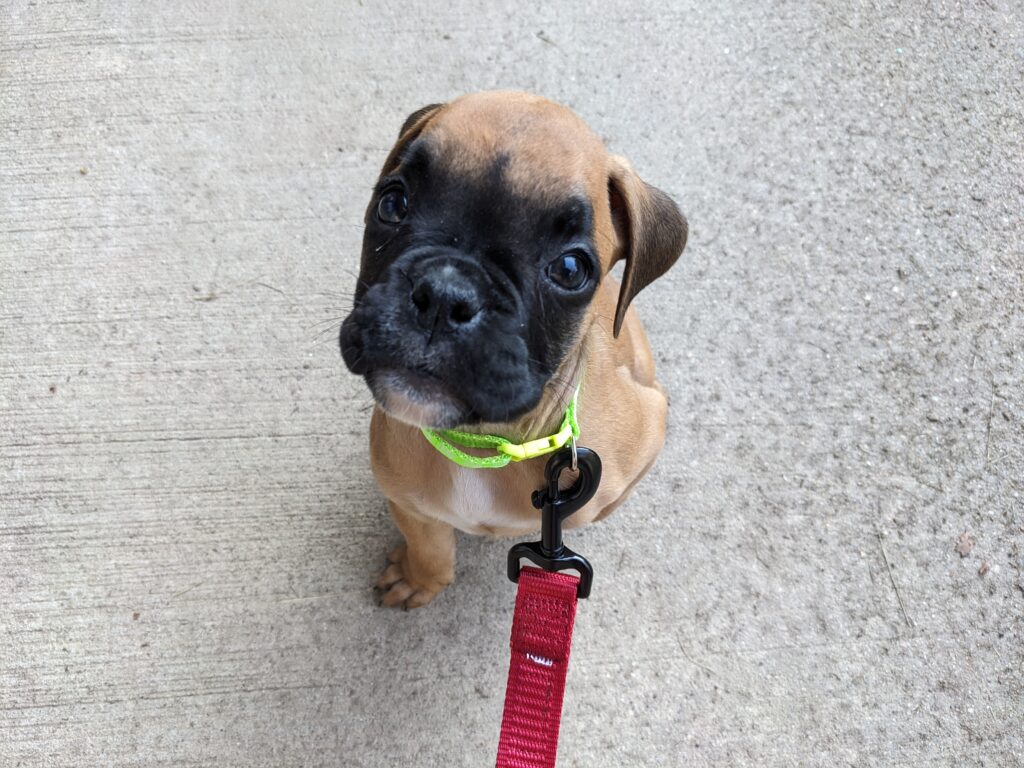
One year ago this week, I ran the first session of Straw Dog Writes for the Straw Dog Writers’ Guild. And we’ve met basically every week since. I’m satisfied that it’s been time well spent. (It was also the week when my son’s boxer puppy, Tanuki, pictured above, came home for the first time.)
Two years ago, I helped the Program Committee conduct a survey of the membership to assess whether there were unmet needs among the community. One of the needs we identified was that members were looking for more opportunities to socialize and write together. There were also a substantial number of members who lived too far away, had health issues, or didn’t want to drive in the dark during the winter, that were interested in more opportunities for remote interaction.
I proposed Straw Dog Writes modeled on the SFWA “Writing Date”, which meets weekly via Zoom to socialize for 15 minutes, write for 45, then repeat. With the support of the Program Committee, I worked with the organization to set up the resources and agreed to coordinate and run the program.
In the past year, more than 50 people have attended at least once. During the winter, usually there were usually four or five participants ― occasionally as many as ten. Attendance was understandably lower during the summer. About half were pre-existing members and another half were new members who joined to participate. Participants tended to be evenly divided among writing fiction, poetry, and memoirs. One current participant is working on a graphic novel.
I tried to persuade the administrative assistant to create a webpage to advertise the program, but she refused, saying that she thought the website had “too many pages” already. That was a significant disappointment to me, as it made doing publicity significantly more difficult, since there’s no landing page — just individual calendar entries. That’s why there’s no link to the program on this page: there’s no place to link to.
I had originally hoped to recruit guest hosts to actually run the sessions, in part because it might be a useful hook to draw more participants. I did get a few members of the Program Committee to guest host and it was fun. I reached out to a woman who coordinates one of the other regional writing groups that offers paid consulting to see if maybe their instructors/consultants would like the opportunity to promote their programming to my participants. But she didn’t seem interested. Maybe I can do a better job of finding more guest hosts this year.
Most people who attend indicate they get a fair amount of writing done. I know I do. When I’m writing, I usually get more than a thousand words written. Once I got nearly 2000 words and one of these days I hope to reach it. But I sometimes use the time for outlining or revising, rather than just writing. (And occasionally even grading.) In any case, I’m happy to keep doing it just for myself, if no-one else. But everyone’s welcome. Join me!
This fall, I’ve launched a new program at the Straw Dog Writers Guild: Straw Dog Writes. Modeled on the Science Fiction and Fantasy Writers Association Writing Date, I offer a Zoom session where Straw Dog members can come for some light socializing and two 45-minute writing sessions. I’ve found this as a really useful way to enforce a little productivity and networking. I’ll be offering these at least through mid-December and then we’ll decide whether to continue the program into the new year.
Recently on Mastodon there have been several interesting daily prompts for writers: #WritersCoffeeClub, #WordWeavers, and #PennedPossibilities. During the academic year, when my professional responsibilities give me limited time for writing, these are a fun way to reflect on my writing and let me feel like I’m still engaged.
I also write a lot short fragments on Mastodon, some of which find their ways into finished works. I credit writing the fragments with helping me improve my sense of story structure: writing a complete story in 500 characters really forces you to cut the story down to its essential elements. It reminds me of when I was a graduate student and writing haiku was a way to keep doing Esperanto in a small way. I have a lot of fun with the fragments and they often give me ideas for larger stories. I often post mine using the hashtag #vss365.
In mid-September, I delivered the final manuscripts for the Better Angels anthology: Tour de Force. It’s like a TRIPLE entendre. We spent a long time workshopping titles. I had been inclined toward “The Better Angels and Sixteen Seriously Sweet and Significantly Sanguinary Stories Set on the Truck Stop at the Center of the Galaxy.” My publisher said, “Oh, great. Well, at least with that title we won’t need to worry about cover art.” The anthology should be out by mid-December.
I’m also working on the fix-up edition of Revin’s Heart. This will include the seven novelettes, but also three side-stories that tell stories where Revin isn’t present: Where There’s a Will (about how Will and Grip meet and fall in love), Curtain’s Rise (how Will and the Baron originally met), and Riva’s Escape (Revin’s transition). I’m currently writing pieces that will bridge between the novelettes. It’s giving me a chance to expand on things that readers have asked about, or expressed interest in.
I’ll be appearing in a local holiday market on November 18 at the Mill District in Amherst. I’ll have not only my own books, but also a selection of other books suitable as gifts. There are discussions about a winter market I may also attend. Stay tuned.
I’m hoping to appear at several upcoming conventions. But the current surge in COVID cases requires that I be cautious.
I had planned to attend LOSCon, but it’s looking less and less likely that I’ll be able to attend. The aren’t committed to masking and I had applied to be a participant, but they haven’t gotten back to me. time is getting short to buy plane tickets and secure housing.
I’ve applied to be a participant at Arisia (which is close by) and they’ve already committed to requiring masks. So, with any luck at all, I’ll be able to attend.
I’m hoping to attend Boskone this year. Last year, I was hospitalized and wasn’t able to make it. But, hopefully, this year will be different. I still haven’t heard that they’re requiring masks, however.
I will plan to apply to be a participant at Baycon. It’s fun to attend a conference that so many of my fellow Water Dragon authors can attend.
I’ve signed up to volunteer for Readercon. I will also apply to be a participant. I applied last year, but wasn’t accepted. Maybe by volunteering, I’ll get greater consideration.
I’ve already signed up to attend WorldCon in Glasgow in 2024. I’ve just filled out the survey to agree to be considered for participation. I had a great time at the WorldCon in Chicago and I’m super excited about going to Scotland.