an istvan bierfaristo mug

After reading Riva’s Escape (a side story of Revin’s Heart), one of my beta readers commented about how they appreciated the way my writing recognized the value and significance of work. In the scene, Revin (who has just transitioned) is pressed into service working in the kitchen of a restaurant washing dishes. This got me thinking about how my own experience with work has impacted how I write about it.

I started working on a farm before I was legally old enough to work. At age 15, a friend and I were hired to bale straw. We rode on a wagon behind a tractor grabbing bales of straw that emerged from the baler — a complicated machine that was powered by a shaft from the tractor. We would take turns carrying the bales back and stacking them up until the wagon was full. It was hot, dirty, and dusty. Looking back, my current lung condition probably wasn’t helped by breathing all the dust. We would often work until it was starting to get dark. I remember coming home in the gathering dark, taking a shower with the dirt sluicing off me, closing my eyes, and feeling like I was still bumping along on the wagon. Years later, I tried bailing hay. As an adult, I was hired to work by myself on the wagon (ie, working twice as hard) and lifting bales that weighed twice as much. I lasted one day.

I spent two summers as a high school student working as an animal caretaker in a toxicology laboratory. It was a bleak, proletarian existence. You were required to punch a time clock within seven minutes (five minutes before the hour or two minutes after) to punch in, then punch out before legally required breaks and lunch, punch back in afterwards, and then punch out at the end of the day. I was on the “large animal” team that cared primarily for beagles. Other teams did mice, rats, rabbits, and monkeys. The entire windowless facility had tan walls, gray floors, and unfinished ceilings with black-painted duct-work, pipes, and wiring. The animal rooms had two banks of stacked cages with a big floor sink at the end. I would go into a room, clean and fill all the water dishes, then pull the trays under the cages one after another, wash them in the sink, then replace them. Finally, I would recheck the water dishes and clean/refill any that were empty. (Some dogs, desperate for stimulation, would dig in their water dish as soon as you filled it.) It became so routine that I could daydream during the process to the extent that, when I got my schedule out after leaving a room, I sometimes had to check to see if I had just finished a room or just arrived.

I worked for a year as a busboy at chain seafood restaurant. There, I had perhaps the worst boss I ever had as an employee. In the restaurant, there was a lounge attached to the restaurant with an entrance for patrons and a passage containing the busboy station near the ice and soft drink dispensers for waitstaff. The boss would walk through those entrances in a big circle and every time she came around, I was doing the wrong thing. “Why are you bussing tables! The floor is dirty! Sweep the floor!” So I’d carry my tub to the dishwasher, get the sweeper and start sweeping the floor and she would return, “Why are you sweeping the floor! There are tables that need to be bussed!” She was pure evil.

I worked for a while as a gas-station attendant. When I was in middle-school, they had kids take the “differential aptitude test” — one of the many standardized tests used for nefarious purposes by educators — that included a component that was supposed to help you identify potential career options. I knew that I wanted to be a field biologist, so I tried to pick options that I thought would be aligned with that goal: Yes, I liked working outside. Yes, I liked working with numbers, etc, etc. Eventually, the computer spat out an answer: it said I should be a gas-station attendant. So, when I actually worked as one years later it was a more than a little ironic. I actually liked it quite a bit, though it was not a particularly good choice as a career, with poor pay and limited options for advancement.

I had a lot of different jobs over the years. I was a dishwasher in a college cafeteria. I worked as an archeological faunal analyst. I was a Spanish-speaking bilingual teacher’s aide for a migrant worker education program. I was a substitute teacher for a time. (That was horrible.) I did scientific field work in many different contexts: catching birds, lizards, mongooses, etc. For several years, I was an “edutainer” traveling to elementary schools to teach about science. I visited hundreds of schools in a dozen different states.

Eventually, I returned to graduate school. I pursued a PhD in Science Education. (I also got a Masters in Earth Science studying wetlands hydrology). While I was doctoral student, I got tasked with setting up a computer lab and then the Internet happened. These experiences led directly to my career as a faculty member serving as the Director of a computer center at an R1 institution. In this role, I performed a vast number of teaching, research, and service activities. (My curriculum vitae is more than 20 pages long.)

These work experiences have all informed my writing in multiple contexts.

I find that “work” is actually a somewhat loaded and conflicted word. On the one hand, it can mean the drudgery you are required to perform. But it can also have the connotation of your calling, your “life’s work,” which for many people becomes nearly their identity. Some people detest work while others strive for the ideal of “do what you love and you’ll never work a day in your life.” I have deep respect for the work that people do in all walks of life. And I was pleased that this was reflected in my writing to the extent that someone noticed it.

a rocky outcrop covered with mosses, ferns, and lichens

Relatively soon after I moved to the Pioneer Valley, my father gifted me a membership to the Trustees of Reservations and encouraged me to visit Bartholomew’s Cobble. It’s a bit of drive, in the extreme south-west corner of the state. But it’s an amazing place with the highest plant diversity of any site in New England. This spring, I visited again to see the spring wildflowers.

A friend and I made a road trip out of the adventure. We masked up (due to my health issues) and drove on back roads so we could keep the windows down. We drove first to Westfield and stopped at Skyline Trading Company for lunch. Then we took a new (to me) route through the back roads, criss-crossing over the Connecticut border to get there.

I’ve always been fascinated by plants. As a child, I frequently went with my father to natural areas where he introduced me to plant identification. As an undergraduate, I took a lot of botany classes: plant morphology and structure, spring flora, and plant systematics. And, as a graduate student, I studied wetlands hydrology, for which plant identification was essential.

Bartholomew’s Cobble is a promontory of quartzite and marble situated by a bend of the Housatonic river. This creates four distinct zones: cool dry, cool wet, warm wet, and warm dry. Plus the marble limestone, relatively rare in Massachusetts, creates regions with higher pH which adds to the range of available microhabitats. This produces the high plant diversity at the site.

We arrived in mid afternoon and, after paying the admission fee, set out walking. There are several trails through the reservation, but the one I always take is the half-mile Ledges trail. It simply follows a route around the promontory and takes you through each of the habitats. You start at the cool-dry quadrant, then pass into the cool-wet segment along the river, then turn west into the warm-wet, then warm-dry, and then finally return to the parking area.

a rocky outcrop with wake robins and dutchman's breeches underneath.

The progression of spring wildflowers was markedly different between the cool and warm sides. In the cooler areas, spring had only just started to arrive. There weren’t many flowers or fiddleheads. But mosses, lichens, and older growth were apparent. The warmer sides had many of the classic early spring wildflowers: triliums, dutchman’s breeches, trout lilies, spring beauties, etc., etc. It was lovely.

My friend is a molecular biologist who was intrigued by the variety of plants. Like me, he teaches the writing class at the University. He was fascinated by the number and variety of plants and began thinking about adapting his version of the course to have students look at plant diversity in the fall. It’s a lot easier than it used to be.

I spent years and years studying plant identification. Nowadays, I find that although I can still recognize a lot of familiar plants, there are vastly more I never learned. I even wrote a haiku (published in Ideoj Ĝermas) about the experience of seeing the plants that bloom after your spring flora class is over.

Also identifications have changed. A lot of the nomenclature I learned has been replaced, as molecular systematics has reorganized the phylogeny of plants.

Nowadays, you don’t need to learn plant identification at all. People can use apps to identify plants. I’ve used LeafSnap and, more recently, iNaturalist, that also keeps a record of plants you’ve observed and has experts that help confirm identifications. This can allow students — even with little experience with plant diversity — to make observations about plant species and distribution.

I’ve visited Bartholomew’s Cobble perhaps five times over the past thirty years. Maybe someday, I’ll walk some of the other trails.

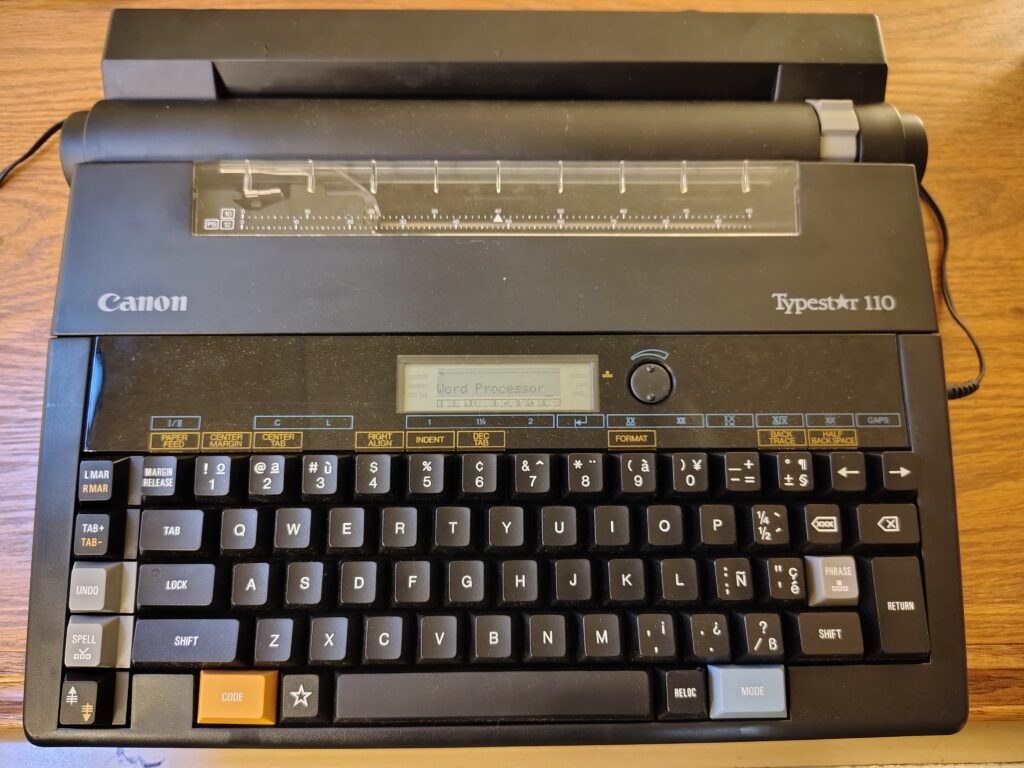
odd typewriter word processor hybrid manufactured by Canon in the early 1980s. It has a lcd display where someone has typed "word processor."

I use a text editor for pretty much all of my draft writing. I can date this pretty much to 1993, when Microsoft Word 6.0 was released. It really sucked and, after many years of using a word processor, I quit using one for writing.

I did most of my early writing by hand or using a typewriter. I took “secretarial typing” in high school — they changed the name that year to “business typing” which was perceived as less sexist. I was the only boy in the class. There was a “personal typing” class that required students to learn to type 45 words per minute. But in secretarial typing, you needed to learn touch typing (to not look at the keyboard) and type 60 words per minute. It was perhaps the single most useful class I ever took in my life.

I also learned to use DEC computers with a paper terminal in high school. Mostly, I was programming in BASIC. There was rather crude text editing, but I could see the potential for writing text. There was a text formatting program called RUNOFF that I experimented with a little bit, but it was too complicated for my purposes and so I never actually used it for anything. But I could see the potential.

When I went to college, my family purchased a Smith Corona electric typewriter for me as a gift for going to college.

As an undergraduate, I learned to use a word processing system — maybe ALL-IN_1 — on the VAX computer at Alma College. It used a “gold key” to access formatting commands and you could do a lot of amazing things. I had been using my typewriter to write papers, but quickly switched to writing everything using the word processor.

Around that time, a friend kept asking to borrow my typewriter. I didn’t mind since it wasn’t like I used it anymore: once you got used to using the word processor, the idea of going back to using a typewriter was a monstrous impossibility. I kept suggesting that he learn to use the word processor, but he always claimed to not have time. So I finally said I would type his paper for him using the word processor.

There was a central terminal room, but we went to a small computer lab in the life science building. I logged in and quickly typed his paper. Then I printed it using the dot-matrix printer in the lab. He looked at it skeptically, then said, “Yeah. OK. But it has a widow.”

“Let’s fix that,” I said. I typed a few keystrokes and printed again. When I handed him the output, his eyes got bigger and bigger and bigger.

“You can print it again?” he breathed.

He got an account the next morning.

I had other computers along the way (including the odd typewriter/wordprocessor hybrid pictured above) but when I started graduate school, I bought a Powerbook 100 and a copy of Microsoft Word 5.1. It was amazing. It was perhaps the best word processing system I ever used. I used it to write all my papers as a graduate student, including my gigantic 200 page dissertation that had 88 figures and 15 tables.

Then Word 6.0 came out and it was garbage. It was clunky and unstable. It frequently crashed and you lost what you’d been working on. Its documents frequently became corrupted and were unrecoverable. I kept using my old copy of Word for a while, but it was clear its days were numbered. So I switched to doing all of my draft writing using a text editor — so at least I wouldn’t lose my writing.

On a Mac, the best GUI text editor for a long time was BBEdit. I used that for a number of years, then (when it quit being shareware) I switched to TextWrangler.

Note: I’m leaving out the whole chapter where I learned Unix and the vi editor. I used vi a lot for programming, but there wasn’t a native vi for classic MacOS, so it wasn’t something that was convenient to use for local files until MacOS X came out. So, although I use vi a lot, I never used it much for writing.

When I began teaching the writing class, at first I chose different packages for Macs and PCs. Then I started using Linux myself and started looking for applications that would work identically on all three platforms. Eventually, I settled on Atom, which was released in 2015 and I started using that.

Atom was an adequate text editor. It was built on Electron, which made it a bit bloated and clunky. But it worked exactly the same on all three platforms. It was also highly configurable and had a lot of community add-ons to provide additional functionality.

In 2018, Microslop purchased Github, and in 2022 killed off development of Atom — probably to force people to use their proprietary development environment. But, because Atom was Free Software, the developers promptly forked it and renamed it Pulsar. It works exactly like Atom did and I still use it today.

I had very little success persuading students to use a text editor to write. And I didn’t see many other people using text editors either until this year. Suddenly EVERYONE seems to be using text editors to write. Weird. I guess everything old is new again.

A bunch of people seem to be using Obsidian. Tobias Buckell described building a whole writing environment based on Obsidian. Other people are using Notion and NotebookLM and there are a bunch of others.

I’ll keep using Pulsar, at least until I finish teaching the writing class. Then, maybe, I’ll look at others to see if I can find something I like better. But I’ll still want something that is Free Software and cross platform.

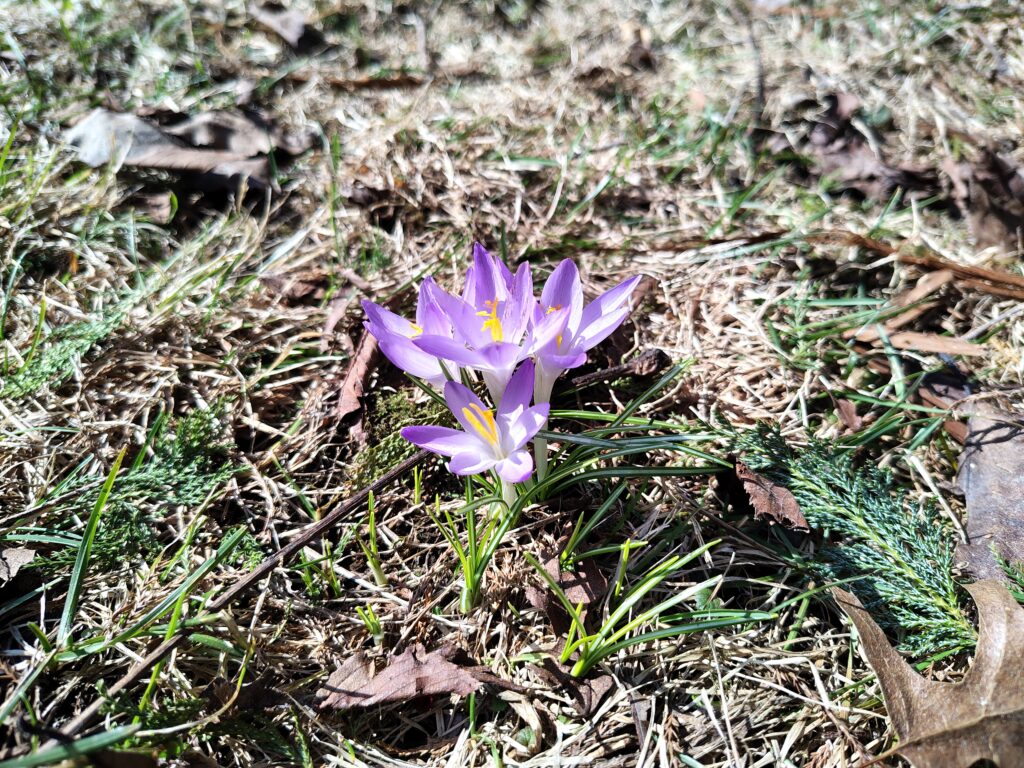
crocuses

When I was the Director of the Biology Computer Resource Center, Spring Break was just a chance to get caught up with software and hardware updates. Since then, I’ve used it to accomplish significant bits of writing. This year, however, I really needed the break. And I took full advantage.

I used my time for self-care. I slept a lot. I got in a lot of walking. I hung out with a friend on the patio. It took some time, but I finally started to feel like myself again.

For the first time since December, I felt like I could write some fiction. I wrote a short story, A Persistent Curse, and submitted it for publication.

With his paws on the back of the sofa, Makul poked his nose through the curtains and looked out. A misty drizzle was falling — it always rained when the curse was bad. The raindrops passed through an assemblage of shadowy spirits clustered just outside the window trying to get in. 

Makul waited, watching, until she came around the corner: a short, wizened crone with a dowager’s hump who shuffled along with a stick to hold her up. She gathered her black shawl around her shoulders as she hobbled around the corner and into the shade from the lone cloud that hovered over the apartment building. Her mouth made a hard line when she looked at the building and saw the swarm of spirits jostling around the first-floor apartment of her grandson.

Tiom da fantomoj!” she muttered. “The curse is bad this morning.”

It was rejected. But at least I feel like I have some creative energy again. It was a long dry spell.

I’m still getting some extra Tanuki time. But little by little, things are returning to baseline.

I remind myself that it’s my last Spring Break. This is my last semester as an active faculty member. I’m trying to be particularly cognizant of the milestones and rhythm of academic life as I experience them for the last time.

In any event, today is the last day. Tomorrow, the students come back and on Tuesday I’ll start teaching again. I have a fair amount of grading I’ve been putting off — and my regular service commitments this week: Faculty Senate and Rules Committee.

Once more unto the breach, dear friends!

Geyser

Since December, I’ve basically not written any fiction. I’ve written a few blog posts and managed to keep up with my class — checking my students’ writing and making comments on their papers. But I’ve barely been able to write fiction.

I learned long ago that my creative output is unpredictable. And I generally don’t really worry about it. I know that it will bounce back in time. But it’s still no less frustrating when I try to do some creative writing and the words just aren’t there.

I did manage to write a haiku today. And tonight, I did got a few manuscripts that had been previously rejected back out to calls for submission.

It’s been a discouraging year.

I understand why so many people drop out of trying to get their work published. It’s easy to get depressed and lose hope when your work gets rejected over and over and over again. But this is not my first rodeo.

I know that at some point, the words will come. And, like a geyser, they’ll come pouring forth so fast I’ll be hard pressed to get them down as they come spraying out.

Until then, I just need to hang on.

a stylish hip flask

It’s become nearly impossible to avoid “AI” which is increasing shoehorned into every corner of our lives. I’ve lived through a bunch of the tech bubbles and this is by far the biggest and most intrusive. The tech-bros are convinced that robot slaves will print money for them so they can do away with all of these inconvenient human resources, impoverish them, and make them traffic their children for sex. Or, maybe, that’s just what they want you to think — to keep the bezzle going. But the fact of the matter is that today it’s nearly impossible to do anything using technology that hasn’t been tainted by so-called AI.

It seems apparent to me that the techbros have been intentionally enshittifying tools (like search) to force people to become dependent on AI. I suspect they are also using the huge pools of venture capital at their disposal to literally pay companies (cough Mozilla cough) to put AI into everything so that it becomes impossible to avoid.

It’s becoming harder and harder to define exactly what is AI. Some people distinguish between analytical and generative AI. Or what the model is trained with. Or where the model is run. I’m quite sure that almost no-one, outside of narrow specialists really has a good understanding. I think it’s all worth avoiding.

As an author, I strive very hard to stay away from AI. I don’t use any of the AI chatbots. I’ve used ChatGPT exactly one time. I want my writing to be unequivocally my own. I certify as such when I submit a manuscript. Toward that end, I don’t use computer operating systems with AI installed (I use Pop!_OS and an older version of the MacOS.) I have managed to retain the Google Assistant, turning off Gemini whenever they turn it on. I use the NoAI Duck Duck Go search engine. I have all of the AI bullshit turned off in Firefox. I do most of my writing in a text editor that doesn’t have AI (although there are AI plugins you can install). I’m using the wp-disable-ai plugin for WordPress to remove the interface elements that are based on generative AI. I turn off the AI Companion in Zoom. etc, etc, etc.

That said, I also use tools where it is nigh-on impossible to completely avoid AI, like Google Docs. Or Google Image Search. Or Google Maps. As Philip Brewer commented to me:

You know, it’s just about impossible to do anything on the internet and not end up using LLMs. If I use Google to check and see if there’s already a company with the same name I’m thinking to use as the name of a nefarious company in my story, Google is going to give me an AI-fied version of the search. If I read that, and then (depending on the result) either go with my fictional company name or else change it to some other fictional name, is my work now a work that used an LLM?

I don’t avoid AI only because of my authorship. I also want to make sure I’m using my brain and not becoming dependent on machines to think for me. I suspect people will discover that it is exactly like with GPS systems: There is “concrete evidence supporting the abstract contention that the rising technical order of GPS systems is dissipating human mental order in those who come to increasingly use and depend on it.” (From J. Robbins, “GPS navigation…but what is it doing to us?,” 2010 IEEE International Symposium on Technology and Society, Wollongong, NSW, Australia, 2010, pp. 309-318, doi: 10.1109/ISTAS.2010.5514623 — see A. Hutchinson, “Global Impositioning Systems: Is GPS technology actually harming our sense of direction?” The Walrus, Oct. 14, 2009. http://www.journals.uchicago.edu/doi/abs/10.1086/432651). This is not to say that I never use GPS systems, but I try to minimize my use — using them only when absolutely necessary — because becoming dependent on them causes the parts of your brain that do that work to atrophy. Literally.

I also avoid the commercial AI systems because their creators and operators are manifestly untrustworthy. You can’t know whether the results they’re presenting to you have some hidden bias. Or an overt bias. Sometimes that bias may be as simple as, “This restaurant paid us more money to have them show up in your Google Map results.” But there are a lot of other far more subtle potential biases that might be intentionally programmed in for political or ideological purposes. I would much rather be able to inspect the underlying data directly and make my own decisions. Search engines allowed us to do that. AI summaries do not.

People are going to need to come to their own decisions about what kinds of AI use are acceptable and unacceptable. I recognize that I tend toward one extreme. But others may reasonably tend toward another. Context is important.

It is not just a slippery slope. I remember many years ago, I went bicycling with my brother on the KalHaven rail trail, that runs from Kalamazoo to South Haven, on the Lake Michigan shoreline. We rode out, making good time, and feeling great. Then we turned around and the ride back was a terrible slog. It felt like we were riding into a strong headwind. Upon reflection, we realized that although the rail trail looked perfectly flat, it was not level. The rail trail is all downhill from Kalamazoo to the lake. And all uphill going back. You’d never know that standing on any particular point — you can’t see the slope. I think AI is like that: it’s a continuum and it’s going to become harder and harder to know exactly where you are on the slope. Unless you have a GPS.

Note: WordPress would lurve for me to use an AI assistant to generate an image for this post. I considered doing that — just for the lulz. But, no. It’s my own, original artwork. Made by me: a human being.

It was a slow year for me. Although I wrote a lot and submitted a lot of stories, the only work I published this year that is eligible for awards is my novel A Familiar Problem.

Brewer, S.D. 2025. A Familiar Problem. Water Dragon Publishing, San Jose. 202pp.

I had another story accepted for publication last spring, for which I’ve signed a contract, but it’s not going to appear until sometime in 2026.

cover for A Familiar Problem

On December 10, 2025, A Familiar Problem is finally available for purchase. It’s been a long, weird road to publication. But I’m very grateful it is finally available and I hope people enjoy it.

In May, 2022, I had an idea for a story. I sketched out a rough outline and then, in just a couple of hours, wrote the first chapter. It was a simple idea: A young man who is supposed to get his magical familiar, instead is captured as the familiar of a powerful demon that intends to train him up to enter him in an illegal familiar-fighting contest.

Over May and June, I wrote the rest of the novel. With a rough draft, I passed it it along to my beta readers. They offered a lot of helpful comments about story structure and pacing.

I had an epiphany while revising. I had originally drafted the story to end at a particular point when the main conflict of the story was resolved. But, while I was revising, I kept thinking of fun, funny things that the characters could do after the end. Eventually, I realized that, as I was the author, I could just keep writing more. In the end I wrote two more fun-filled chapters and created a far more satisfying ending.

During July, I fleshed out the rough draft: I added richer descriptions and worked to make sure that the timeline was consistent. My records indicate I submitted the manuscript for the first time on August 1st. I got five rejections before it caught the attention of an editor and was accepted for publication.

It’s a somewhat strange book. Like all of my writing, it doesn’t fit cleanly into a single genre I had tried to pitch it to one publisher as a “cozy fantasy.” They rejected it saying

We were concerned about the overt themes of sexual abuse and sexual coercion. […] While we recognise that abuse can be a theme in cosy fantasy, a synopsis whereby the protagonist ultimately marries into their abusive situation is more fitting for dark fantasy than cosy.

Currently, I’m calling it a “cozy, dark fantasy.” It does have dark elements but, overall, it’s a story about a young man who discovers that it can be better to want what you have than to have what you want. It’s also about finding the middle way when presented with a seemingly binary choice.

I was super excited to have my first novel published. I scheduled myself to hit the convention circuit during 2025 to promote the book. Then the problems started.

The book was originally scheduled to be released in December 2024. But the release date got pushed back to mid-January ― after Arisia. Then the cover artist artist got sick. Boskone happened. Then the editor ended up in the hospital. The book wasn’t available for Watch City. Or the Nebulas. Or Readercon. Or Worldcon. Finally, in late August, the book production began moving again.

I had hoped it would available for the Northampton Book Festival. Or LOSCon. And, finally, on the morning of the last day of LOSCon, I was able to actually put my hands on a paper copy of the book.

On December 10, 2025, A Familiar Problem hits shelves. Or would, if any brick-and-mortar stores were carrying it. But you can find it online at all of the major book sellers. I hope you’ll buy a copy.

rosary

People crave and need attachment. Increasingly people are turning to AI rather than people. One company had created a pre-AI chatbot with scripted responses that was highly effective at fostering engagement. But when they saw how people used it, they began to have serious reservations.

Not only did people crave A.I. intimacy, but the most engaged chatters were using Kuki to enact their every fantasy. At first, this was fodder for wry musings at the office. […] Soon, however, we were seeing users return daily to re-enact variations of multihour rape and murder scenarios.

I realized as I read this that my fiction writing is similarly very much about enacting my fantasies — or, at least, fixing them in tangible form — though perhaps not every single one.

When I was young, I would lose myself in fantasies every night before going to sleep. And at any time during the day, might find myself woolgathering, imagining all sorts of fantastic things.

I fantasized about all sorts of stuff. Some fantasies were pretty ordinary: I remember at point having fantasies about building a large enough model airplane that I could fly in it. But a lot of fantasies were pretty weird and highly sexualized. I started having these sexualized fantasies at a very young age: 6 or 7 or 8. These were a staple of my life throughout my youth.

When I was a doctoral student, I suddenly lost my ability to fantasize. I realized eventually it was because I was confronted with a problem I didn’t know how to resolve. My dissertation was like a mountain range. I spent a year going back and forth in front of the mountain range, looking for a pass through the mountains. Eventually, I realized there was no pass, and so I started climbing up one mountain and then the next and then another. In the middle, I couldn’t see any end: there were mountains in every direction as far as I could see.

During this time. I was caught on the horns of a dilemma: I couldn’t engage in a fantasy that didn’t involve either having finished my dissertation — and I didn’t know how that could happen — or having given up. And I wasn’t going to do that! So I was stuck. It was horrible and I remember worrying at the time that the effect would be permanent.

Eventually, years after I finished, I gradually began to be able to fantasize again.

During the pandemic, I found myself constantly tormented by negative thoughts. I called it the Hamster Wheel of Doom: one negative thought led to another and another and eventually back to the first. I rediscovered finding refuge in fantasies. And I began writing fiction primarily as a way to fix one part of the fantasy so I could move onto the next part.

As I read that article, however, I began to wonder how different my indulging in my fantasies to write is different from using one of these chatbots. Like them, I’m just playing with my ideas. The only difference is that I play all the parts myself, rather than having some kind of assistive support. But is it really all that different? I dunno.

Minimally, I’m not sharing my fantasies with some faceless corporation. I’m sharing them with the public. And on my own terms. So there’s that.

And maybe not every one of my fantasies.

apple

On November 9, I got to host James Cambias doing a presentation about Worldbuilding for the Straw Dog Writers Guild. He wanted to do a face-to-face presentation, so I reserved the newly built North Amherst Library Community Room. It’s a great venue with a large-screen display, four tables, and maybe 30 chairs.

Unfortunately, not many people came. He pointed out that if the number of presenters outnumbered the audience, we were obliged to take the presentation to bar and we avoded that, but only barely.

But it was a fantastic presentation and I’m sorry more people didn’t attend.

Here’s the little introduction I wrote:

Hello. I’m Steven D. Brewer and I would like to welcome you to Worldbuilding 101 with James Cambias presented by the Straw Dog Writers Guild.

Straw Dog is a non-profit volunteer organization dedicated to the craft and transformative power of writing, designed to serve writers throughout the region by promoting individual growth, community outreach and enrichment, and community building.

Our mission is to support the writing community by strengthening, engaging, and connecting writers at all levels of development.

Some upcoming events

Tonight: Everyone Reads Second Sundays Open Mic

Wednesdays: Straw Dog Writes

Nov 13: A Writer’s Night with Linda Cardillo at Longmeadow Adult Center

I first saw James Cambias at a reading with Elizabeth Bear and Max Gladstone at the Odyssey Book Shop in South Hadley. Since then, we’ve crossed paths at science fiction conventions in Boston, like Arisia, Boskone, and Readeron, where we’ve done readings and served on panels together.

Born in New Orleans, educated at the University of Chicago, James has been a professional science fiction writer since 2000. Among his novels are A Darkling Sea, Corsair, Arkad’s World, The Godel Operation, The Scarab Mission and his most recent, The Miranda Conspiracy. He also designs roleplaying games, and is an advisor to the Center for the Study of Space Crime, Piracy, and Governance.

This afternoon, he’s presenting Worldbuilding 101: In science fiction and fantasy, the strength and depth of the author’s world building can make the difference between a forgettable story and a classic. He will breakdown how to make convincing and interesting worlds for your stories, while still respecting realism and scientific accuracy.

And, with that, please welcome James Cambias for Worldbuilding 101.

James provided a brief preamble: Worldbuilding is a form of storytelling, in itself: An act of literary creation. That said, story considerations should remain paramount. When building a world, the purpose is to support the story. And he offered his own test:

The Cambias Test: Any alternate world needs to support adventures/stories that you can’t do here.

In other words, if your story can take place in the regular or historical world just do it. Don’t go to a bunch of extra work: just do the work that is necessary. Sometimes you have a setting that already exists (like shared worlds — I write stories set on the Truck Stop at the Center of the Galaxy) and you can just look up the necessary information, but he encouraged the audience to fit the story to the world.

He challenged the audience to consider what motives and conflicts that the setting supports. He cited Aristotle who proposed desire, fear, and honor (or, as we might say conviction, today). This reminded me a bit of the four F’s of animal behavior: Feeding, Fleeing, Fighting, and Reproducing. In science fiction, survival is clearly one motive.

He proposed to look for “signature events”, that is things that happen there that don’t happen on Earth. The terminator on Mercury moves at walking speed. For sandboxes and shared worlds: what are some signature events there that nobody has done. Find a new angle. Take it seriously or don’t do it. And for the real world, take it seriously — Do the research! You can often use the results to add details that will contribute to the verisimilitude of the story.

He then let the audience in an exercise in worldbuilding, to design a world and its alien inhabitants. He offered a worksheet that indexes planet size against temperature to help determine the characteristics the world will have. What kind of planet do we want? How habitable? Can humans live there?

He began with the star in terms of size and brightness (luminosity, which describes the brightness as compared with the sun). Large stars frequently don’t last long enough for the establishment of a stable biosphere within its solar system.

He then moved to the planet. It’s characteristics include distance from the the star, the size and density, which together determine the gravity.

Running short on the time, he touched on life. Isaac Asimov wrote an influential article, Not as We Know It: The Chemistry of Life that provides a good introduction to what is required for life: a liquid, a solvent, and some kind of information molecule. (Personally, I would approach defining life differently, not in molecular terms.)

Aliens don’t have to be from the planet the story is set on. They can play a variety of roles: as people, a threat — as individuals or a society — as victims, or a mystery. And can transform: from a mystery to a threat to people.

Aliens can be of a variety of types. Talking beasts, super brains, an elder race, warriors, hive minds, or weird things. These often come with implied roles: for example, talking beasts are generally threats and weird things are generally mysteries.

It was a fantastic presentation and got me to think a lot about my own writing. In my writing, I’ve generally felt that aliens are extremely unlikely to have a compatible biology to our own. So the idea of “away parties” visiting alien worlds and talking to aliens… I just don’t see it happening.