Author of LGBTQIA+ speculative fiction and poetry in English and Esperanto. Emeritus teacher of scientific writing. Lover of natural history. SFWA Secretary. (he/him)
I’m having a little FOMO. I decided to skip Worldcon this year. I had originally intended to go. That was why I had signed for LOSCon last year. But I had a somewhat mixed experience last year, so instead I decided to just stay home. I’m not really having much FOMO because I really don’t like going to conventions all that much in the first place. But a little.
Last year I did everything. I did Arisia, Boskone, Watch City, Nebulas, Readercon, Worldcon, and LOSCon. I had signed up for everything since I had a new book coming out! But then my book didn’t come out in December. Or January. Or February. Or May. Or July. Or August. In November, we finally got copies while I was at LOSCon. And I probably should have signed up to do everything again this year to promote my new book. But I couldn’t.
Part of it is traveling. Since I have to use a portable oxygen concentrator to fly, it’s pretty inconvenient. It’s really helpful to have someone to travel with me but I wasn’t sure I could get anyone to go. Often my son has traveled with me, but the semester is about to start. And I really didn’t want to travel by myself.
A lot of people love going to conventions for the parties. Unfortunately, due to my health issues, I can’t really attend parties anymore. I need to wear an N95 mask and I especially try to avoid crowded spaces that have poor ventilation. So I can’t do the parties.
Note: It’s worth pointing out that I hate parties and I would never go to them anyway if I could possibly avoid it. I can’t stand parties and I would rather eat shards of broken glass that go to one. But now I *can’t* so it’s OK.
As an aside, I saw that COVID is high in California anyway, so I’m feeling like I dodged a bullet. Last year, pretty much everyone who worked at my publisher’s dealer table got COVID, flu or both. I didn’t — because I wore a mask the whole time.
I enjoy serving on panels at conventions. I think I’m not bad at it. I used to worry about what I was going to stay, but I’ve discovered that if you stick a mic in front of me, I can babble endlessly. People generally seem to think I have something useful to offer.
I liked selling books in the bookstore I was really surprised to find I was pretty good at that. But after the unpleasant run-in with the other author last year, I was reluctant to do that again.
A final factor that played into my decision was that this is my last week of employment. Monday, August 31, is my very last day. As it turned out, getting all of the paperwork organized and submitted has been unexpectedly complicated. You would think a giant university would know how to manage something like that, that obviously happens literally every day. But they don’t. Which day is my “date of retirement”? My last day of employment? Or the first day after? They don’t know. (It turns out it’s my last day of employment.) I’m glad to not be trying to resolve these issues remotely from California.
In the end, I’m guess glad I didn’t go to Worldcon. I do have a little FOMO. I will miss seeing my SFWA folks and a lot of the other authors I’ve worked with. But I’m glad to miss the travel and the stress.
I do plan to go next year, when it is in Montreal, because I can just drive there. I’ll see you all then!
At Worldcon, I got the chance to chat with Roxana Arama, the editor of Planetside (formerly the SFWA Blog). We had a great conversation and she encouraged me to write a pitch for an article.
Upon reflection, I decided to pitch an article about hand-selling books for authors as a kind of Bookselling 101. Since I had time in August (and was likely to have less time once the academic year started), I went ahead and drafted the article even before my pitch was accepted, figuring I would post it to my blog if it didn’t get accepted.
My pitch was accepted, but with a modification: They wanted a Bookselling 201 article and were most interested in having my expand on the aspect about pitching and hand-selling books. I made the necessary revisions and the article, How to Hand-Sell Books for Fun and Profit, is now live at Planetside.
I thought it would be fun to share the rest of the Bookselling 101 article I wrote here.
Where to Sell
There are a large number of opportunities where you might be able to sell your books directly to an audience. Perhaps the most important are the national and international conventions, like Worldcon, Dragoncon, and Comicon. Regional and local conventions are also worth attending. Additionally, there are often a vast number of local events that will welcome an author selling their books, including festivals, artisan markets, and holiday markets.
Conventions usually have a “dealer room” where most of the bookselling happens. Dealers pay a charge to have a space in a room with other dealers where they can sell their wares. For an individual author — especially a beginning author — the charges for a table may be higher than are warranted. But there are sometimes ways to share the cost. It may be that your publisher will already have a table. Or will pay to have the table, if you volunteer to help staff it to sell your books and others from the publisher. Some groups, like Broad Universe and Small Publishing in a Big Universe (SPBU), offer tables that multiple authors may join and share. Many conventions also offer other opportunities for individual authors to sell their books, in an “author’s alley” or via book-signing events.
Your Personal Brand
Presenting yourself and your books effectively makes a good first impression. Branding works. Many authors use some props to create a distinctive author appearance: a distinctive hat, like Tobias Buckell’s beret, or a T-shirt with a graphic design that evokes or aligns with your brand. A tablecloth and tablerunner, or banner, with branding are worth having to give your bookselling operation a polished, professional appearance.
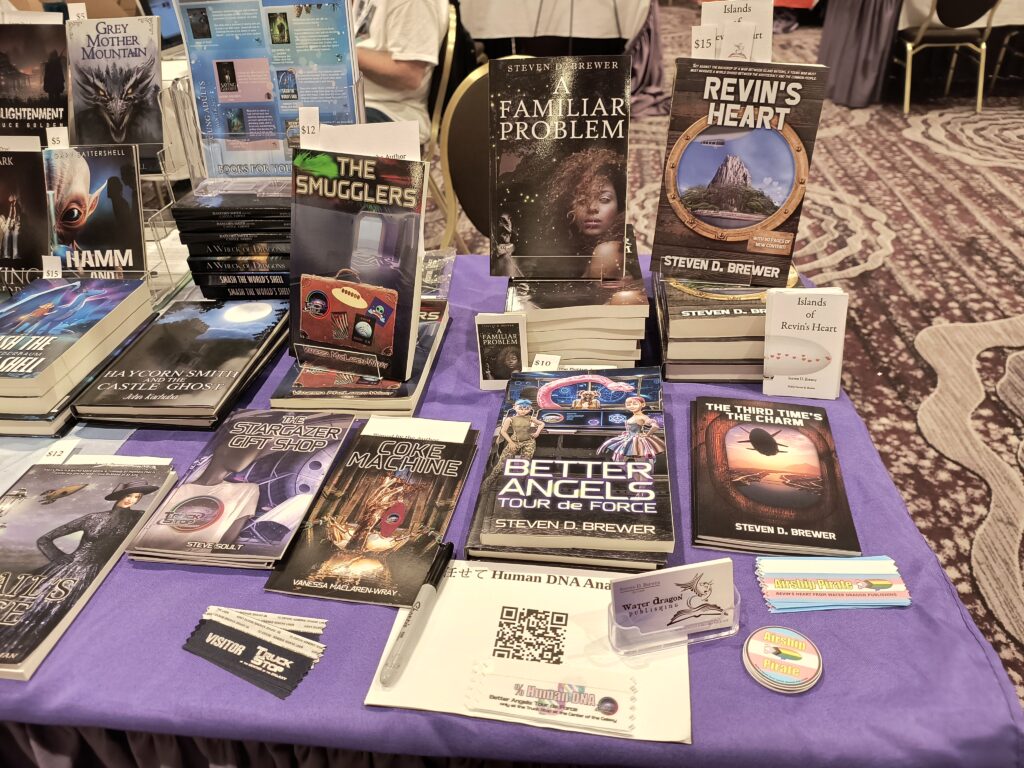
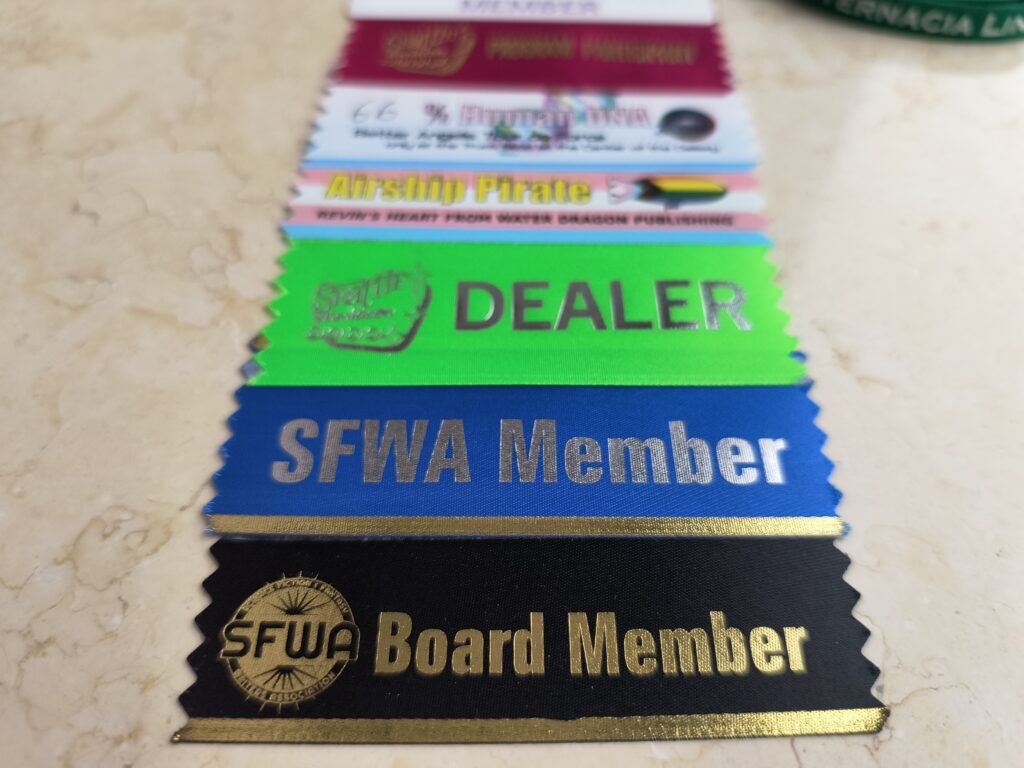
Branded giveaways are useful to remind people about your books after they’ve walked away from your table. A business card, with a QR code linking to your website, is a no brainer here. But there are a lot of other easy and fun possibilities. Bookmarks are an obvious choice. Stickers can be good, although they’re more expensive and some venues ban the distribution of stickers. Some conferences use badge ribbons and, if you can think of a catchy hook, they have the added advantage that other attendees may see other people wearing the ribbon and will come to your dealer table because they want to get one of their own.
If people purchase several books, it’s convenient to be able to offer a bag to help them carry their books away. Be aware that in some localities, disposable plastic bags are outlawed, so paper bags are safer. The bag is another opportunity for branding: A rubber stamp works well, but stickers or labels can do in a pinch. Alternatively, you can purchase some branded reusable bags to sell.
Practical Concerns
Books are heavy, so a collapsible cart or wagon can be invaluable for moving your books and other materials during load-in and load-out. Stout cardboard boxes are ideal for protecting your books. But high quality reusable grocery bags with a flat bottom are convenient too and have the added advantage of handles. Book stands are also useful for standing up just a few books to highlight. (They’re also useful for when you’re a participant at a panel, to show your books while you present!)
It’s fun and easy to also sell books at outdoor festivals and markets, but you need some additional resources. You will probably want a collapsible 10×10 foot tent. Some are much easier than others to transport and setup by single person, so consider those factors when making your selection. Also, be sure to get some weights so that your tent doesn’t blow away in the wind. (Ask me how I know this…) You’ll need a table and some folding chairs. Usually tables and chairs are provided in dealer rooms, but for most festivals, you’re on your own. An 8-foot folding table works well. But two smaller tables — or just an additional table — can provide some flexibility.
Hand Selling Books
The most important thing I’ve learned about bookselling is that a concise, polished pitch for your book greatly increases your chances for making a sale. My article at Planetside, How to Hand Sell Books for Fun and Profit, goes into more detail about this.
Financial Concerns
Before selling anything you should make sure you have your financial ducks in a row. If you are selling on behalf of another organization, like your publisher or SPBU, they may have taken care of these details beforehand. Otherwise, you should consider setting up a separate bank account for you to keep the finances of your bookselling operation separate from other activities.
Honestly, if you’re a professional author, you should already have a separate bank account for business income and expenses. But, if you’ve resisted that up to now, stop resisting — you really need that, if you’re going to be a book seller.
Before you start selling, you will probably need a Tax ID number in order to collect and report sales tax. The rules and the amounts can vary widely depending on the locale. The rules for this vary from state-to-state or even city-to-city, so be sure to check the laws carefully in your locality.
You will need to accept payments. There are a few payment processors that offer inexpensive integrated systems you can use as a Point-of-Sale terminal. Many cell phones now can accept NFC (tap) payments with one of these using a card or phone or smart watch. There are also inexpensive devices that can accept tap payments, but allow someone to also insert a chipped card. These systems generally impose a 3-4% charge, which you will need to price your products appropriately to cover.
Different events bring people with different preferences for how they want to pay. Most transactions are usually via credit cards but, at some events, many people will want to pay cash. An envelope containing small bills is useful and that can also hold the cash collected. I usually start with $100 in one, fives, and tens to make change. I can then easily calculate the additional cash collected by the end of the event, to confirm it matches the transactions recorded in the payment processing system. Some events and populations prefer yet other payment systems, like venmo or paypal. It’s useful to be able to accept payments using whatever system the customer prefers.
I’ve generally found it convenient to price products at even dollar amounts that include the taxes and payment processor charges. Remember that, if you price something at $11, you will need a large number of ones and fives to make change, if you have many cash sales.
I’ve found that printing price tags on florescent card stock is useful. I have a template with prices along the edges that I can cut in half and then cut between the tags. These are easy to tuck in between the pages of books, so they stick up and are highly visible. You can use the different colors of tags to indicate various things: e.g. price range or genre. People like to know how much things cost. If you don’t have price tags, people will need to ask you, which will deter sales.
So, that’s it. That’s pretty much everything I know about selling books. Yep, that’s pretty much it. Oh, except you need some books to sell. You should probably go write some books now.
As I reflect on my year of writing in 2025, it was a somewhat discouraging year. I did quite a bit of fiction writing, but almost none of it got published. I wrote 26,000 words of short fiction and did 20 submissions. Zip.
I also worked on longer fiction. I finished the 19,000 word manuscript for Ecorozire! the third novella sequel of Revin’s Heart. It’s not clear when they might ever see the light of day. I also finished a 43,000 word rough draft of my new novel The Ground Never Lies. It still needs a lot of work and fleshing out, but I haven’t managed to get to revising it.
The high point was that my first novel, A Familiar Problem finally came out. I wrote it in 2022 and it was rejected five times before being accepted for publication. I signed the contract in 2024 and the original scheduled publication date was December 2024. But it was delayed, first until January and then June. And it finally came out December 10, 2025. I had planned to use 2025 to promote it and scheduled myself to appear in conventions. But, over and over again, I was going without the new book to promote. This was rather discouraging.
I also had the discouraging interaction at Worldcon that left a rather bad taste in my mouth. I ended up having to interact with the other author again at LOSCon. If I hadn’t already made the arrangements to travel to Los Angeles, I probably would have canceled going. We got through it, but it really raised the tension — at least for me. I otherwise had a good time. I had many other positive interactions and, uncharacteristically for me, I managed to meet a lot of new people. And it was fun to unbox A Familiar Problem. Having a new book come out counts for a lot.
So, not everything this year was discouraging.
I did write a lot of blog posts — more than 80. Most are about stuff I was doing. A few were about news or writing. I wrote an Awards Eligibility post. OK. That was a little discouraging.
I also wrote an article about bookselling for SFWA Planetside that is scheduled to appear in January. I have a companion blog post that I will release at the same time.
I was re-elected to a full term as Secretary of SFWA. The difference between service last year and this year is striking. When I joined the Board, SFWA had lost essentially all of its leadership and staff. With fresh leadership, we hired new staff who hit the ground running and really engineered a transformation. The Board has been able to return to developing strategy. Whereas, last year was all frenetic activity, this year has been more relaxed. That’s not to say there haven’t been moments of controversy and high drama (like yesterday). But, no matter how bad it’s been, it’s been better than last year.
My service to the Straw Dog Writers Guild continues. I run Straw Dog Writes and serve on the program committee. I ran the online meetup nearly every week for the second — going on third — year. The regular group is small, but lively, with a mix of less frequent participants. On behalf of the program committee, I invited and hosted several talks during the year. I also served on a committee to review candidates to potentially update the website. I was excited and encouraged to draft the recommendation that was taken to the Board but, unfortunately, nothing ever came of it. Maybe that was another discouraging thing.
Wandering Shop Stories is an ongoing pleasure. We have 168 followers on Mastodon and 69 on Bluesky. Asakiyume frequently boosts and offers thoughtful comments on contributions. We’ve held genuinely enjoyable quarterly meetings aligned with the major solar events (solstices and equinoxen). And we’ve brought on one or two new curators. I write to the prompt most days, although occasionally I use snippets of works-in-progress or even bits of published works. It’s a great creative warm-up exercise in the morning. And reading the contributions by other authors and interacting with the small community that has sprung up around the project is always a treat.
I also participate in a number of other writing prompts on Mastodon and Bluesky, including #WritersCoffeeClub, #WordWeavers, #PennedPossibilities, #ScribesAndMakers, #Writephant, #LesFicFri, #WIPSnips, and probably others. The community of writers on Mastodon is particularly strong and supportive.
The year was also the middle half of my phased retirement. It’s weird to think I’ll teach Writing in Biology just once more this spring. I’ve been teaching this particular class since 2002 and am ready to be done. It’s been hard to keep it fresh and, honestly, seeing the end of the road ahead, I haven’t tried very hard. I realized recently that, when I fully retire in August, I will have spent 30 years — basically half my life — employed by the University. That seems like something that calls for further reflection — and should probably be the subject of its own post.
Two of the writing prompts I follow on Mastodon ask, “How was this month for you, writing-wise?” It was pretty good.
I had a couple of distractions: I went to Worldcon and Philip Brewer came to visit. Those each took about a week away from my writing. But otherwise, I got a lot done.
I’ve just about finished writing a new novelette called Bearly Believable. For several years, I’ve been writing little story fragments about a bear who acts as the fire-safety coordinator at a park. They’ve been among my most popular story fragments (which isn’t saying much, honestly). I think this is the very first one:
I wrote dozens of little scenarios about the bear as I fleshed him out in my mind. He changed a bit along the way and developed a backstory, which is what this story is really all about. Along the way, he was joined by a owl named Forrest who terrorizes litterbugs. And a little girl named Brunhilde who asks him thoughtful questions.
There’s a lot of world building embedded in the story. It has bits about the ecology of terraforming, lifestyles in a replicator-based society, and issues of freedom for non-human biological androids. At the same time, as with all of my writing, it’s silly fluff. I really don’t write anything to be deep.
It’s been fun to write. I just have a few bits to polish off over the next day or two. I would like to get it finished before the semester begins on Tuesday. If I quit writing this post and start working on that, there’s a good chance I’ll make it and finish writing for the month in style.
I have selected my theme for my writing course for the fall of 2025. Each semester I’ve taught the class since 2002, I’ve tried to pick a different theme for my students to research and write about. I can’t say that I’ve never repeated themes, but I always try to think up something different. This semester, I intend for my students to study the biology of Canis familiaris, the dog.
I’ve always tried to select something I don’t know much about. It allows the students to be the experts. And it prevents me from becoming too directive (which happens all too often when I already too much about the subject). It also keeps the course fresh for me and has let me learn a vast amount of biology over the years.
Some themes have worked better than others. Students tend to be strongly biased toward animals, so although I’ve been very pleased with the semesters we studied plants or fungi, students were often less satisfied. I’ve generally shied away from vertebrates, simply because there are a lot of practical and regulatory complications for conducting research on them. So we’ve studied planarians, tardigrades, terrestrial gastropods, worms, millipedes, wood lice, spiders, and many types of insects, which has usually made students happy. (They didn’t like the semester we studied cockroaches, tho. Go figure.) But dogs will be something new.
My thinking was undoubtedly influenced by the excellent panel on dogs I participated on at Worldcon. There’s a wonderfully rich literature about dogs that students can dig into. The real question will be, what kinds of research projects can students propose and conduct? My course asks students to write a proposal — preferably about something they could actually do — and then to select a proposal to actually undertake as a research project.
I encourage students to follow their interests. If they’re genuinely interested in some topic that we can’t actually do, they’re welcome to write it up as a proposal. I often use the example of studying the biology of Mars. We don’t have the resources or time to visit Mars to conduct a project. But that shouldn’t stop them from proposing that, if that’s really what they want to do. It’s typically more fun to pitch something we can actually do. And it’s fun when your idea gets chosen by the class for a whole course research project.
I don’t require that the whole course pick just one project. Each group can choose to do their own proposal or any of the other proposals. Or something different altogether, if something more interesting has occurred to them. But it does sometimes happen organically, that one proposal rises to the top and everyone coordinates to conduct 8 or 9 projects all centered around a single proposal.
I wonder what kinds of projects the students will propose. I think there’s a lot we can do. We could observe dogs at local dog parks. Or simply by walking downtown. Some students will undoubtedly have pets. Or we could look for evidence of dogs in the environment.
Before we write proposals, I have the students perform a “METHODS Project” where they make a multi-panel figure that relates to the theme to get them thinking about the kinds of data they might collect. This year, I’ll ask them to collect photographic evidence of the presence of a dog in the local environment. The challenge for this project is how to collect data that is replicable: Can they think of something to photograph that another student can reliably also document? I can think of a few ideas, but it’s tricky. I’ll enjoy seeing what they come up with.
I’m always happy when I come up with an idea that I’m excited about and that I think the students will also enjoy. I think this is going to be a winner. Now I just need to come up with one more idea for next semester, which will be the very last time I ever teach this class.
In 2022, I was hospitalized with pneumonia and learned that I have a chronic lung condition that puts me at heightened risk from respiratory infections. Even before, during the pandemic, my family was being very cautious due to my 90-year-old mother living with us. The net result has been that, for us, the pandemic never ended.
For several years, I only attended events where everyone was masked. I attended Arisia, Boskone, Readercon, and Worldon in Chicago, while masks were required. But, as events — one-by-one — dropped masking requirements, I have gradually begun attending events where masks aren’t required. This year, I attended Worldcon in Seattle.
I mask everyplace I go indoors, except for my own house. Or inside my own hotel room. It really kinda sucks. No dining in restaurants, no bars, no nothing. (Unless it’s outdoors.)
At Worldcon, a small percentage of people — perhaps 10% — were masked. The numbers were a bit higher in the science panels I attended. At SEATAC, perhaps as many as 5% of people were masked. At DFW, I saw thousands of people during our two-hour layover as we transited between terminals and only saw one other person wearing a mask.
Masks are really not that uncomfortable. They don’t interfere with your breathing at all. When you wear them for hours, however — especially when it’s hot and humid — the increased humidity on your face is irritating. And if I have to do any serious exertion, my mask will become soaked with sweat, which is even worse. It also causes my glasses to be less stable, especially if I’m looking down. I’ve had my glasses literally fall off my face. And don’t get me started about when I use the Portable Oxygen Concentrator (which I need in order to fly) and have to run the oxygen tubes behind my ears too.
Wearing a mask is stigmatizing. People can’t hear you as well and can’t see your facial expressions, which makes you more difficult to understand. It’s isolating because you can’t respond as effectively to social cues. It’s especially bad when you’re one of the only ones masking. It makes you stand out in a bad way.
The modern Summit Convention Center in Seattle has very high ceilings and, reportedly, very high quality air filtration. But I still masked everywhere.
Even masked, I avoided crowded events. If there were a lot of people in a room, I don’t go in. Or I got out.
One of the main reasons people go to Worldcon is to attend parties in hotel rooms and suites. These rooms generally have very poor ventilation. There were a lot of parties on the same floor as our hotel room. We could hear the sounds of merry making in our room every night. SFWA held two breakfasts in their suite. I attended the first for about 10 minutes, when the room completely filled up with unmasked people and so I left.
The net result is that I can only get about half of the experience of going to a convention.
When I returned home, I watched the #disease-self-reporting channel of the Worldcon Discord as reports of cases came in. On my publisher’s Discord, people who had worked in the dealer’s room began reporting positive results too. Every time I saw another report, I would have psychosomatic symptoms. Is my throat scratchy? Why did I just cough?
I finally ran a test this morning, four day after departing the convention. Negative.
It appears I’ve dodged the bullets again. But that’s literally what it is: dodging the bullets. It’s constant and it’s exhausting.
The 2025 Worldcon in Seattle was generally good. I served on a lot of panels, had a good reading, and (for me) met a lot of people. But I had one unpleasant experience that left a bad taste in my mouth and left me feeling rather mixed on the whole convention.
I had a reading. At first, I realized they had scheduled my reading for Sunday when would have already left. But they were graciously able to reschedule it earlier in the Con. It was, in fact, in the second reading slot for the convention. I worried that it might not get any attendees. After Boskone, I said I would be happy if my reading had any attendees. But there were six people, two of whom came specifically to see me. I joked afterward that it had a non-zero number of attendees and some of them were not even related to me by blood.
I also served on seven panels at Worldcon. Seven is rather a lot, but I like to be busy. I moderated one panel and was a panelist on the others. Many people came up afterward to praise my performance both as panelist and moderator — and to express interest in my books. And some even came to the dealer room later to find me and buy copies.
The panel I moderated, An Hour of the Strange, Unusual, Creepy, went very well. One of the participants had emailed everyone within a day or two of the panel being proposed to start organizing it and asked everyone to introduce themselves and describe what they wanted to do talk about. I responded to the email and then, a day or two, followed up gently with the email I normally sent to panels that I’m going to moderate that introduces me as the moderator with my usual information requests, that includes how to pronounce names and solicits questions that will allow each panelist to make the points they want to make about the topic. A few days before the panel, I sent the list of questions I’d come up with. Our presentation went well and I think everyone was able to participate well and say what they wanted to say. The guy who’d tried to take over as organizer apologized after the panel for jumping the gun. He said he’d served on another panel where the moderator never reached out or did anything (which has happened to me too). I said it was no problem. I was pleased that everyone seemed happy with the result.
Most of my other panels were about biology. On Life as we know it, I got to serve with Frank Wu again. We were on a similar panel at Boskone. In the lead up to the panel, I pointed out a couple of new unusual life forms that I had heard about that Frank hadn’t yet seen. He was super excited about them and I think I earned a lot of points with him. In both Can biological research ever be independant? and Human evolution and our influence on it were well-stocked with real expertise and I felt like I could play effectively off points other people were making to add useful information and nuance.
I was on two ‘non biology’ panels. One was about self-publishing for poets, which went well where I got to show off my Esperanto books and the ‘zines I’ve made. The other was about Makerspaces. One of the participants didn’t show up for that one and so it was a little thin. But we had a good time playing off the audience’s questions and letting them to contribute useful information.
My favorite panel was Biology and Evolution of the Dog that had a perfect mix of expertise and personalities. The moderator was a PhD Doctor of Veterinary Medicine who had been deeply involved with sequencing projects. There was an evolutionary biologist and a dog training expert. And me. Since everyone else could play to their expertise, I could just be the weird author and talk about boxer dogs and my story with a character who is a NeoBoxer.
The panel got off to a rough start when it turned out that there was no projector to share the slide presentation the moderator had constructed. I suggested that we could run a zoom session that the participants could join and the moderator could share the presentation that way. In the 15 minutes before the start, I set a zoom session, everyone joined, and it worked. (Mostly. The convention center was experiencing some network issues and the moderator got dropped from the zoom session a couple of times. But we rolled with it, reorganized a couple of the points, and got through everything.)
I also had several SFWA events. I attended a board meeting, served at the SFWA “fan table” a couple of times, and attended a breakfast (for a few minutes: it was tightly packed in a small, poorly ventilated room so I left once it got busy to reduce my exposure to COVID). They had a networking reception that I unfortunately couldn’t attend, because I was on a panel at the same time. But I got to introduce myself as the Secretary to a bunch of SFWA folks, including John Scalzi, while I was serving at the fan table and selling books.
I was too busy to spend a lot of time selling books in the dealer room, but I was there much of my free time. We had brought some books (my own and others from my publisher) and dropped them off before the dealer room opened. I managed to sell most of the books I’d brought and ended up bringing home only a handful. I didn’t manage to sell any of my Esperanto chapbooks, which kind of surprised me. But not that much.
Everything went very well with one exception. One of the other authors with my publisher decided to try to chastise me on two separate occasions for things they misunderstood about what I was doing. In both cases, I felt that they were very aggressive and kind of an asshole about it. I reported the conflicts to my publisher and said that, as things stand, I will not work with this person going forward. But it made me somewhat upset and rather colored the whole Worldcon experience for me.
I should recognize my son Daniel for coming along with me. He was a boon companion and made sure I got at least one good meal each day. Plus he helped me schlep the books all the way there. I really enjoy having him come along with me for many reasons but also because, honestly, I don’t quite trust myself to manage all of the travel details anymore, and so having second set of eyes on everything is reassuring.
We checked out of the hotel around 6am Sunday morning and spent the whole day traveling home: light rail to the airport then two 3-4 hour flights with a long layover in DFW. We finally got home around 1am. I’m rather glad I’m not traveling again until November for LOSCon.
My son, Daniel, and I brought ~90lbs of books (two full checked-bags) for Water Dragon Publishing to sell in the Dealer Room at Worldcon in Seattle. So we took the books to the Dealer Room during the set-up time to drop the books off. There was a little old man wearing a convention center staff uniform standing at the door to prevent unauthorized entry.
He peered at our badges and said, “You’re ‘members.’ Members aren’t allowed in until 2pm when the Dealer Room opens.”
We had been listed as dealer-room staff by Water Dragon, so we should have been able to get into the Dealer Room but, due to a snafu, we ended up with “member” badges that didn’t list our role as dealers.
While we were standing there another person came up and then another with the same issue. The guard kept saying the same thing, “Your badge has to say ‘artist’ or ‘dealer.’ I can’t let anyone in unless their badge says ‘artist’ or ‘dealer.'”
One woman was quite irate, “Can I speak to Amy? Can you get Amy? I need to drop off these books.”
He replied, “Your badge says ‘member’. Members aren’t allowed in until 2pm when the Dealer room opens.”
The woman became nearly apoplectic with rage when Amy happened to come by. She listened to us and then promptly directed us to bring in our stuff and drop it off.
When I was leaving, I thanked the guard for his service. He said, “I just can only let people in if their badge says ‘artist’ or ‘dealer.'”
“Yep. It’s waaaay above your pay grade,” I said. “Thanks again.”
Privately, Daniel commented to me, “I’ve never seen someone go full NPC before.”
I commented that he didn’t have much experience with the military because that’s what they train you do to: follow orders.
Later, I was on a panel where someone with a dealer badge said, “Where do you get those name placards?”
“They’re in your participant packet,” someone said.
“Participant packet?”
“Yeah. That white envelope you got when you got your badge.”
“I didn’t get one!”
When I got my badge, I just said my name and gave them my ID and assumed they had everything cross correlated regarding the various roles people had. But evidently their system only tracked one role. So you were either a member or artist or dealer. That’s just my hypothesis.
Later in that day, I was able to get a dealer ribbon that now gives me access to the dealer room during set-up time. So it’s all good.
This year, I decided to try to attend the Business Meetings of the World Science Fiction Society (WSFS) to learn more about the organization. I’ve served in numerous other governance roles, so my perspectives here are largely trying to make sense of these new experiences in those contexts. Here are some preliminary observations.
One caveat about my comments. These are simply my personal observations and should be taken with a grain of salt. If anyone has corrections or suggestions, I would welcome comments to help me learn more.
Worldcon, the World Science Fiction Convention (which I’m attending this year) is governed by the World Science Fiction Society. WSFS is basically an entirely volunteer organization that is constituted of the local group that is organizing to put on the Convention each year.
The business meetings use the Lumi virtual meeting platform. Another organization I belong to (the MTA) has used the same platform for their annual meeting. This platform works pretty well. It uses Zoom at the backend, but runs in a browser window, so it is a bit clunky. In practice, however, it works pretty well to provide access to the documents, let you see who is speaking, and offer a seamless voting interface.
Outside of Lumi, they also set up a Discord server for chat while the meetings are going on, with separate channels for on-topic and off-topic discussion. And the obligate channel for pictures of pets, of course.
There are five meetings scheduled: A preliminary meeting, three business meetings, and an in-person site-selection meeting to be held during Worldcon. Unfortunately, I was unable to attend the preliminary meeting. But I did attend the first Business Meeting and it was rather like being thrown into the deep end.
The first business meeting was conducted entirely in executive session. The public agenda was “Report from the Investigation Committee on the 2023 Hugo Awards.” Since the meeting was held in executive session, I can’t discuss the content of the proceedings. But that’s not my goal in this post.
The Presiding Officer is supported by three additional roles. A Parliamentarian advises on points of order, a Timekeeper keeps track of time used for debate for and against motions, and an assistant Presiding Officer manages the on-screen presentation. This allows the Presiding Officer to focus on running the meeting without having to refer to external documents or deal with the technology. As someone who’s served as Presiding Officer for many years (of the UMass Amherst Faculty Senate) it looked like the system worked pretty well.
The meetings are highly structured using Robert’s Rules, with very strict time limits established for debate for each of the topics. When the Presiding Officer presented a motion with the proposed time limits, they asked the body if they could be accepted without objection. With more than a hundred attendees, basically nothing could accepted without objection. The net result was that we then had to have a formulaic vote on each of the time limits. They all passed handily, of course. So objecting (as is typical) just wasted 10 or 15 minutes of time in the meeting. That’s the goal of Robert’s Rules: to allow the meeting to move forward expeditiously while giving people who object the opportunity to make their objection known, even if that objection is not shared by the majority.
One of my goals in attending the meetings is to get a sense of the key players. Some of the people I’ve heard of before. But many are new to me. You can pretty quickly get a sense for who are the people that respect the process and try to make the best of use time. And those who are there to try to derail the proceedings and gum up the works. It’s the same in every organization.
One of the most peculiar aspects of WSFS is that the organization only “exists” during Worldcon. Each year, people buy a membership in WSFS (as part of attending Worldcon or separately) and there are business meetings in the weeks leading up to the convention. The membership gives you the right to attend the business meetings, to vote in Hugo Awards, and to vote for the following years’ site selections. But there is no leadership or on-going meetings during the rest of the year. Several times (both in the meeting and on the Internet generally) I’ve seen people use this as an excuse for why problems can’t be addressed or solved.
There are typically thousands of attendees at Worldcon (~8,000 in Glasgow in 2024) and even more people who purchase memberships to be able to vote (a total of 10,000 memberships). But there are only about 150 people attending the business meetings. It’s time consuming to learn enough about any organization to understand how it works and participate meaningfully.
I currently have no plans to try to get more involved in the governance of WSFS. I’m already serving as Secretary of SFWA and that’s plenty of service, thank you very much. But I’m always interested to see other models and there are enough connections between SFWA and WSFS that learning more about the organization and the key players seems useful.
The final(ish) Schedule for Worldcon has come out and I am on the program! My experience with Worldcons seems to be either feast or famine. I had eight appearances as a participant in Chicago, for my first Worldcon, and then was totally declined as a participant for Glasgow. This year, I’m excited to moderate one panel, appear in six more, and I also have a reading. Here is my schedule in chronological order.
A Familiar Problem. Becoming a powerful demon’s familiar might just be the best thing ever. But what’s the catch? Rory Soletsa is supposed to find his magical familiar, but he doesn’t want something trite, like a cat; or stupid, like a bird; or ugly, like a toad. Amazed when he is captured and becomes the familiar to a powerful demon who presents as a voluptuous, beautiful woman, Rory discovers how much more powerful his magic is with her. And he’s ecstatic when the demon tells him she will train him in advanced offensive and defensive magic. But just what is she training him for?
Note: This session has been rescheduled from Sunday.
Let’s face it, we conduct science in an inherently for-profit environment, which leads to all sorts of biases. How do we work around these built-in barriers to create truly independent science? Without breaking too many laws, of course.
From chapbooks to zines, poetry has a rich history of self-publishing. Whether your goal is merely to get your poems into more hands or to craft an online presence as a poet, this workshop will help you learn how to market, sell, and self-publish your poetry. From blogging to Instagram to Amazon, we’ll dive into the important details of crafting a bestselling poetry collection. Learn how to format poetry, how to find the best distribution sites for poetry books, and how to market a collection from advertising to book reviews.
Nothing in fantasy or sci fi is original (no, don’t rage-quit); it is all amalgamations of things we have seen or heard of. So would we recognize life that is truly alien?
Just because we’re at the top of the food chain doesn’t mean that humans are done evolving. Can we predict what is in the future for our bodies? Which creators’ visions are realistic?
Human’s best friend, best creation, and best companion: What was the evolutionary path of the household dog? Was humanity the worst thing to happen to wolves?
A makerspace is shared workshop or group of workshops where people can use the tools and facilities to work on their own projects. Some are membership-based, and some are in public libraries. Assume that any major city will have at least one. Our panelists will discuss their involvement with makerspaces, what they recommend, and how the user can get the best experience from a makerspace.