
apple

On November 9, I got to host James Cambias doing a presentation about Worldbuilding for the Straw Dog Writers Guild. He wanted to do a face-to-face presentation, so I reserved the newly built North Amherst Library Community Room. It’s a great venue with a large-screen display, four tables, and maybe 30 chairs.

Unfortunately, not many people came. He pointed out that if the number of presenters outnumbered the audience, we were obliged to take the presentation to bar and we avoded that, but only barely.

But it was a fantastic presentation and I’m sorry more people didn’t attend.

Here’s the little introduction I wrote:

Hello. I’m Steven D. Brewer and I would like to welcome you to Worldbuilding 101 with James Cambias presented by the Straw Dog Writers Guild.

Straw Dog is a non-profit volunteer organization dedicated to the craft and transformative power of writing, designed to serve writers throughout the region by promoting individual growth, community outreach and enrichment, and community building.

Our mission is to support the writing community by strengthening, engaging, and connecting writers at all levels of development.

Some upcoming events

Tonight: Everyone Reads Second Sundays Open Mic

Wednesdays: Straw Dog Writes

Nov 13: A Writer’s Night with Linda Cardillo at Longmeadow Adult Center

I first saw James Cambias at a reading with Elizabeth Bear and Max Gladstone at the Odyssey Book Shop in South Hadley. Since then, we’ve crossed paths at science fiction conventions in Boston, like Arisia, Boskone, and Readeron, where we’ve done readings and served on panels together.

Born in New Orleans, educated at the University of Chicago, James has been a professional science fiction writer since 2000. Among his novels are A Darkling Sea, Corsair, Arkad’s World, The Godel Operation, The Scarab Mission and his most recent, The Miranda Conspiracy. He also designs roleplaying games, and is an advisor to the Center for the Study of Space Crime, Piracy, and Governance.

This afternoon, he’s presenting Worldbuilding 101: In science fiction and fantasy, the strength and depth of the author’s world building can make the difference between a forgettable story and a classic. He will breakdown how to make convincing and interesting worlds for your stories, while still respecting realism and scientific accuracy.

And, with that, please welcome James Cambias for Worldbuilding 101.

James provided a brief preamble: Worldbuilding is a form of storytelling, in itself: An act of literary creation. That said, story considerations should remain paramount. When building a world, the purpose is to support the story. And he offered his own test:

The Cambias Test: Any alternate world needs to support adventures/stories that you can’t do here.

In other words, if your story can take place in the regular or historical world just do it. Don’t go to a bunch of extra work: just do the work that is necessary. Sometimes you have a setting that already exists (like shared worlds — I write stories set on the Truck Stop at the Center of the Galaxy) and you can just look up the necessary information, but he encouraged the audience to fit the story to the world.

He challenged the audience to consider what motives and conflicts that the setting supports. He cited Aristotle who proposed desire, fear, and honor (or, as we might say conviction, today). This reminded me a bit of the four F’s of animal behavior: Feeding, Fleeing, Fighting, and Reproducing. In science fiction, survival is clearly one motive.

He proposed to look for “signature events”, that is things that happen there that don’t happen on Earth. The terminator on Mercury moves at walking speed. For sandboxes and shared worlds: what are some signature events there that nobody has done. Find a new angle. Take it seriously or don’t do it. And for the real world, take it seriously — Do the research! You can often use the results to add details that will contribute to the verisimilitude of the story.

He then let the audience in an exercise in worldbuilding, to design a world and its alien inhabitants. He offered a worksheet that indexes planet size against temperature to help determine the characteristics the world will have. What kind of planet do we want? How habitable? Can humans live there?

He began with the star in terms of size and brightness (luminosity, which describes the brightness as compared with the sun). Large stars frequently don’t last long enough for the establishment of a stable biosphere within its solar system.

He then moved to the planet. It’s characteristics include distance from the the star, the size and density, which together determine the gravity.

Running short on the time, he touched on life. Isaac Asimov wrote an influential article, Not as We Know It: The Chemistry of Life that provides a good introduction to what is required for life: a liquid, a solvent, and some kind of information molecule. (Personally, I would approach defining life differently, not in molecular terms.)

Aliens don’t have to be from the planet the story is set on. They can play a variety of roles: as people, a threat — as individuals or a society — as victims, or a mystery. And can transform: from a mystery to a threat to people.

Aliens can be of a variety of types. Talking beasts, super brains, an elder race, warriors, hive minds, or weird things. These often come with implied roles: for example, talking beasts are generally threats and weird things are generally mysteries.

It was a fantastic presentation and got me to think a lot about my own writing. In my writing, I’ve generally felt that aliens are extremely unlikely to have a compatible biology to our own. So the idea of “away parties” visiting alien worlds and talking to aliens… I just don’t see it happening.

extreme closeup of boxer dog

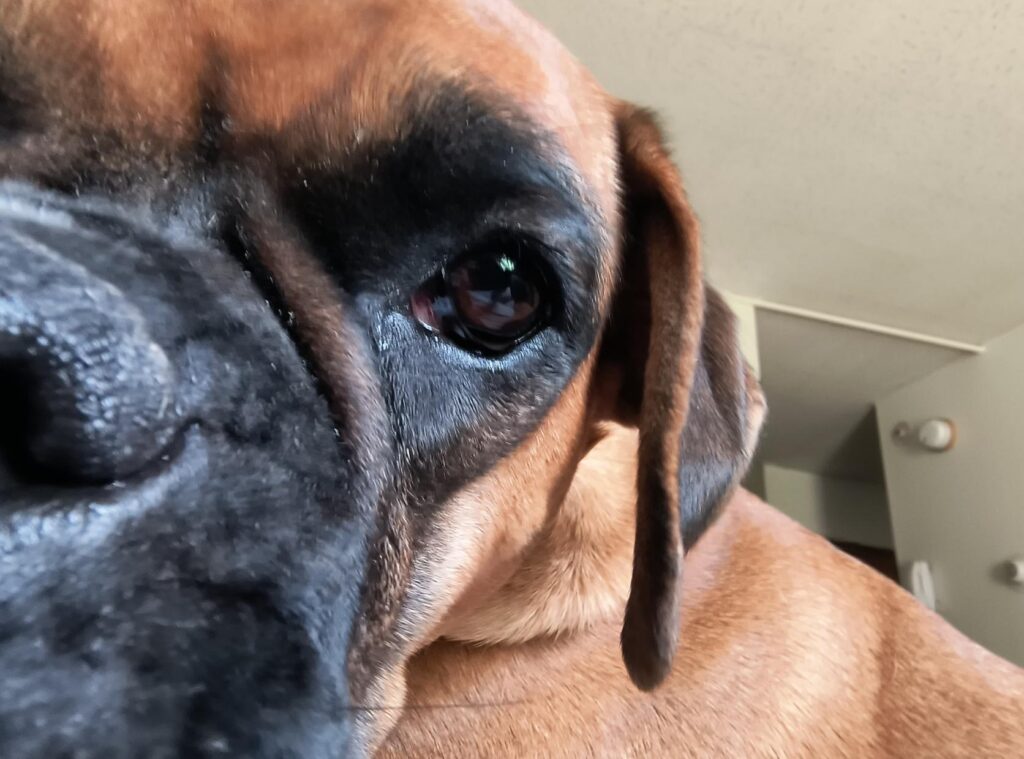
I have selected my theme for my writing course for the fall of 2025. Each semester I’ve taught the class since 2002, I’ve tried to pick a different theme for my students to research and write about. I can’t say that I’ve never repeated themes, but I always try to think up something different. This semester, I intend for my students to study the biology of Canis familiaris, the dog.

I’ve always tried to select something I don’t know much about. It allows the students to be the experts. And it prevents me from becoming too directive (which happens all too often when I already too much about the subject). It also keeps the course fresh for me and has let me learn a vast amount of biology over the years.

Some themes have worked better than others. Students tend to be strongly biased toward animals, so although I’ve been very pleased with the semesters we studied plants or fungi, students were often less satisfied. I’ve generally shied away from vertebrates, simply because there are a lot of practical and regulatory complications for conducting research on them. So we’ve studied planarians, tardigrades, terrestrial gastropods, worms, millipedes, wood lice, spiders, and many types of insects, which has usually made students happy. (They didn’t like the semester we studied cockroaches, tho. Go figure.) But dogs will be something new.

My thinking was undoubtedly influenced by the excellent panel on dogs I participated on at Worldcon. There’s a wonderfully rich literature about dogs that students can dig into. The real question will be, what kinds of research projects can students propose and conduct? My course asks students to write a proposal — preferably about something they could actually do — and then to select a proposal to actually undertake as a research project.

I encourage students to follow their interests. If they’re genuinely interested in some topic that we can’t actually do, they’re welcome to write it up as a proposal. I often use the example of studying the biology of Mars. We don’t have the resources or time to visit Mars to conduct a project. But that shouldn’t stop them from proposing that, if that’s really what they want to do. It’s typically more fun to pitch something we can actually do. And it’s fun when your idea gets chosen by the class for a whole course research project.

I don’t require that the whole course pick just one project. Each group can choose to do their own proposal or any of the other proposals. Or something different altogether, if something more interesting has occurred to them. But it does sometimes happen organically, that one proposal rises to the top and everyone coordinates to conduct 8 or 9 projects all centered around a single proposal.

I wonder what kinds of projects the students will propose. I think there’s a lot we can do. We could observe dogs at local dog parks. Or simply by walking downtown. Some students will undoubtedly have pets. Or we could look for evidence of dogs in the environment.

Before we write proposals, I have the students perform a “METHODS Project” where they make a multi-panel figure that relates to the theme to get them thinking about the kinds of data they might collect. This year, I’ll ask them to collect photographic evidence of the presence of a dog in the local environment. The challenge for this project is how to collect data that is replicable: Can they think of something to photograph that another student can reliably also document? I can think of a few ideas, but it’s tricky. I’ll enjoy seeing what they come up with.

I’m always happy when I come up with an idea that I’m excited about and that I think the students will also enjoy. I think this is going to be a winner. Now I just need to come up with one more idea for next semester, which will be the very last time I ever teach this class.

June was super busy, with the Nebula Conference and the two Pride bookselling events. July looks to be quieter. There are a bunch of events I could have attended, but I’m currently only scheduled to go to Readercon. Look for me in the dealer room where I will, again, be running the tables for Water Dragon and Small Publishing in a Big Universe.

If you’re an author planning to attend Readercon and you don’t have a place to sell books, there is probably still time to request a spot at the Small Publishing in a Big Universe table. It costs very little and gives you a place to tell people to buy your books. Plus you can stand behind the table yourself to meet with readers and sign copies. It doesn’t work so well for authors who are not in attendance but, if you’re there in person, you can really make a lot of sales that way.

I was so busy in June, I didn’t get much writing done at all. Some people can snatch moments here and there to write. For me that can work alright for the little story fragments that I write for #wss366, but it doesn’t work for making progress on my serious writing projects. I did, finally, get back to writing in the past week and wrote the final, climactic scene of one of the storylines in The Ground Never Lies. I had been putting it off for months. Now I only have one or two world-building scenes left to write and then I can try to merge the two storylines. After that, I hope to pass it off to my trusty beta readers to see if the whole thing hangs together. It will need a lot of revising, but July should be perfect for that.

In August, I will be attending Worldcon in Seattle. The schedule has not been finalized, but my draft schedule looks great. I’m currently scheduled for seven panels (serving as moderator on one) and a reading. The reading is from my forthcoming book A Familiar Problem which has been delayed since January. I’m really hopeful it will be out in time for Worldcon. (Of course, I also really hoped it would be out for Boskone and Watch City and the Nebula Conference and Readercon, but… Well… Sigh…)

I finally bought our plane tickets. The most convenient airport for us is Bradley, in between Hartford and Springfield. It’s nice because it’s a somewhat smaller airport and only half the distance to Boston. But Boston tends to have more direct flights. When I fly to Europe, I’ve usually flown out of Boston. I did a search and found that there were no non-stop flights to Seattle from Bradley. There were two from Boston. When I checked, however, they were operated by Alaska Airlines and the cost was nearly twice as much as having one stop. So, we’re flying out of Bradley.

After Worldcon, I will be busy with family and then getting ready for the fall. The fall… Sigh… I have to teach the writing class two more times (in Fall and Spring) and then I will finally be able to retire and be done with working. Then I can dedicate myself to writing full time. I’m really glad I did the phased retirement, but I’m looking forward to wrapping it up.

This semester, my writing students are studying lichens. Mostly not by choice, but because every semester I try to pick a different theme for my students to study and this semester seemed like a lichen kind of semester. To be fair, the students have been good sports, gamely looking at lichens and thinking deeply about how to study them.

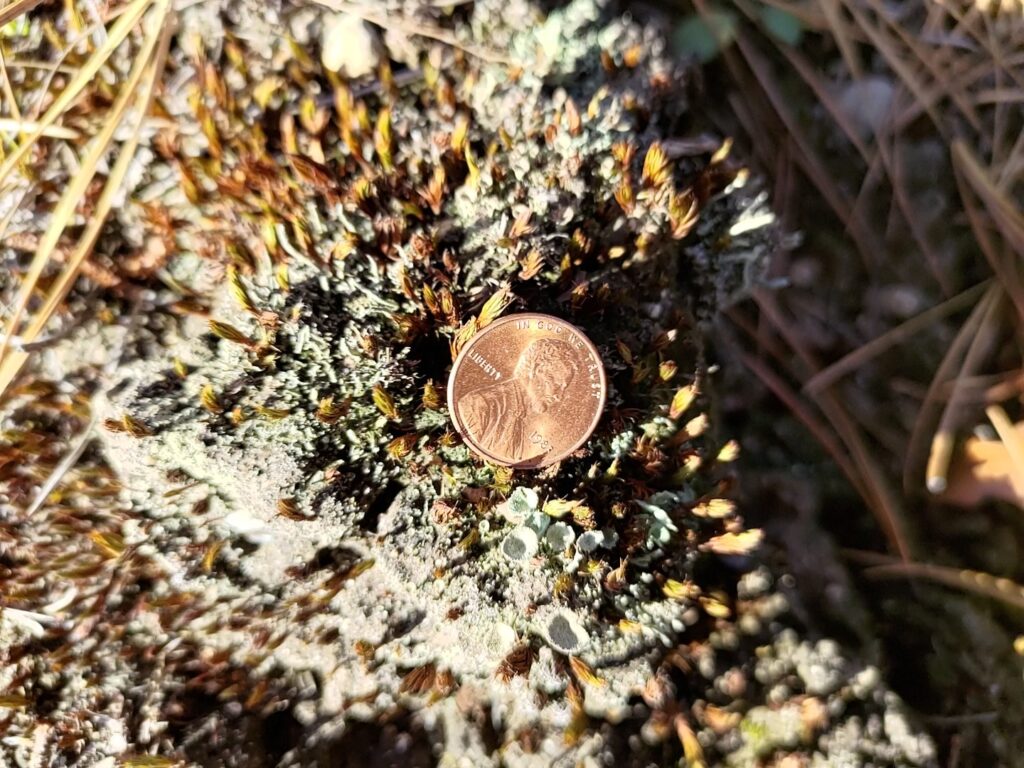
On campus, there are lichens pretty much everywhere: on trees, rocks, buildings, light poles, benches, etc. But mostly not on the ground. Lichens get excluded anyplace where plants can grow well, so you generally only see them on very poor soil. But there are a few places in the region like that. One of them is the Montague Plains.

The Montague Plains are a delta where water from the glaciers flowed into glacial Lake Hitchcock during the last ice age. When a stream flows into a body of water, it creates a triangular (delta) shaped structure with sorted sediments: the gravel drops out first and then the sand. The silt stays suspended, but settles out on lake bed during the winter, producing varved clays. So most of the the delta is just sandy. Very sandy soil is tough for plants to grow on. It tends to be very well drained (i.e. dry) and there’s little organic matter, so few nutrients. And nothing for fungi to grow on, so few mycorrhizal relationships to help plants.

Few plants grow there. Some sparse grasses and trees, mostly pitch pine and scrub oak. Moreover, there tend be frequent fires, which end up burning off most of the organic material that might otherwise accumulate in the soil. So this is a recipe for lichens to grow. You have to look under the grass, leaves, and pine needles to find them, but they’re there.

It’s probably too far for any of the students groups to study there this semester. But I thought I’d stop by to take a few pictures to share with them anyway. Moreover, I always like visiting places with interesting geomorphology and botany to help me write fiction.