
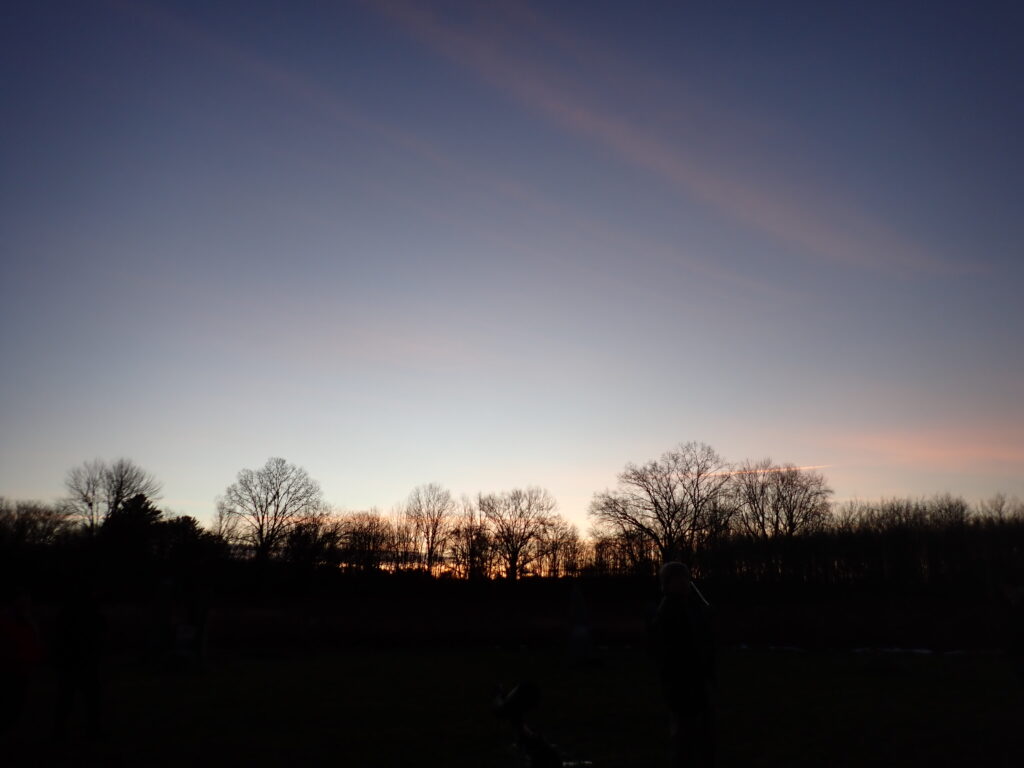
When I awoke before dawn on the solstice, I checked the weather (there is a weather station at the Computer Science building, about a quarter mile from my house). The temperature was already above 39°F and I thought, “Ya, know. I could get up, have a leisurely cup of coffee, and still go to watch the sunrise at the UMass Sunwheel.
Both my brother and I have always been intrigued by sun-aligned structures. I still recall getting up very early to drive from St. Louis to the Cahokia mounds to watch the 1991 winter solstice sunrise with him and his wife. I have previously visited a number of indigenous sun-aligned constructions when I was a young man. Serpent Mound in Ohio appears to have sun-aligned components. When my wife and I were in Mesa Verde, we visited the Sun Temple. And many others over the years.
The Sunwheel project had started in 1992-93, and was just getting sited when I arrived at UMass in 1996. I remember I took my young children to one of the solstice sunrise presentations there. But I hadn’t been to a sunrise for a long time.
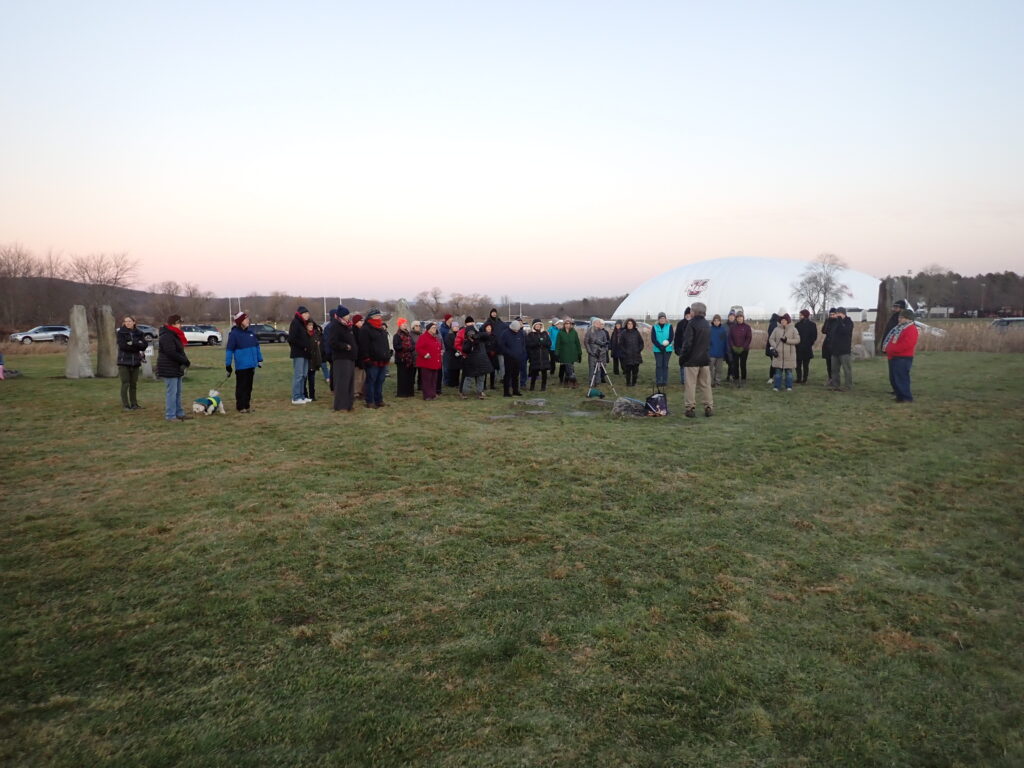

I arrived a few minutes before sunrise and joined a crowd of forty or fifty people who had come to watch the sunrise. I was pleased to see a colleague I knew from way back was there to do the presentation. He did a fantastic job of explaining how the axial tilt of the earth produces the change in apparent movement of the sun across the sky. And, combined with the elliptical orbit of the earth, results in the changes in times of sunrise and sunset around the solstice. As he joked, he wishes people a happy solstice and perihelion during the season. He introduced the Sunwheel and told us a bit about it’s history. He pointed out other standing stones that showed moonrise and moonset. For extra credit, he also explained how the precession of the orbit of the moon results in changes in where the moon rises and sets relative to the sun. He ended up, pointing out the stone that marks where the star Sirius sets, which the ancient Egyptians used to mark the flooding of the Nile.
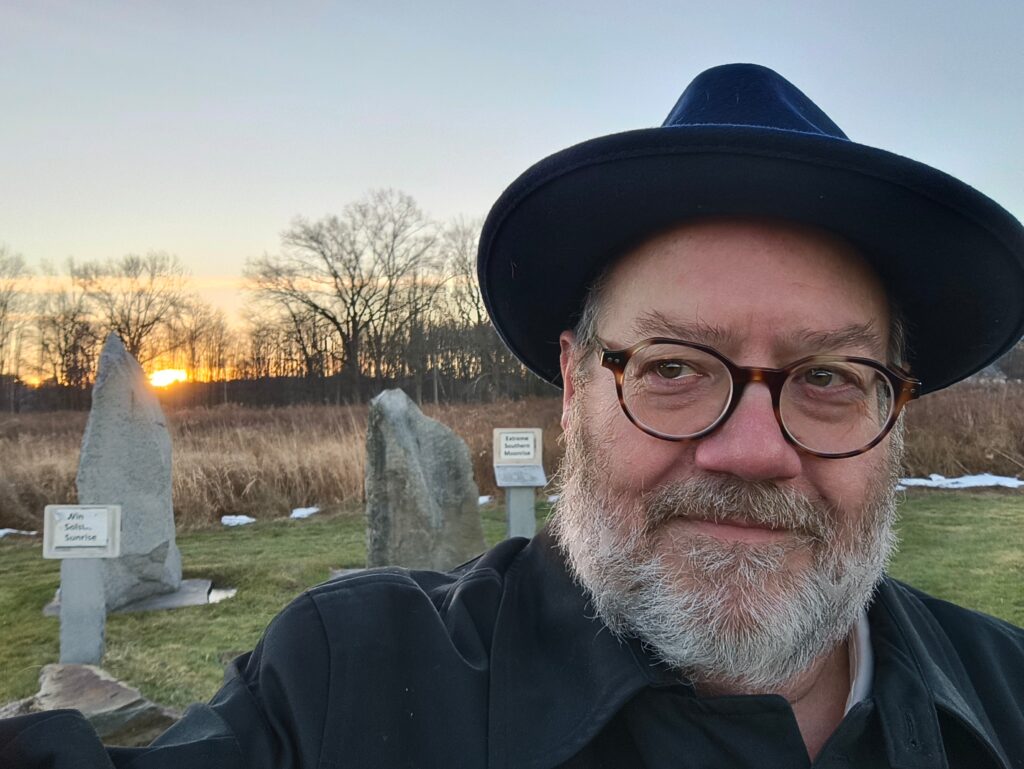
As he finished, the sun began to peek above the horizon. I took a few more pictures, chatted with a few people I knew, and then took my leave. It was a great start to the winter solstice, when the sun finally begins it slow passage back to the north.