
Writing takes both patience and persistence. Unfortunately, I’m rather lacking in both.

I want to be patient, but I am constantly chafing at the bit. But so much of writing is a waiting game. No matter how much you want to move quickly, there are limits all along the way, in writing, revising, and publishing.

I can only write so much at a time. I’ve known for a long time that my creative output is uneven. Some days, I can only write a few hundred words. Frequently, I find I need to find my way through a story by taking a break to turn things over in my mind before I can write productively again. But it’s hard to wait.

Revising requires leaving some time after writing before coming to look at the text again. If I try to revise something too soon, I can’t see the problems: I remember too clearly what I was trying to say and so I can’t see what I’m actually saying. But it’s hard to wait.

Publishing requires the most patience of all. Submitting work and waiting for a reply. Submitting work over and over again through rejections. And, when something is finally accepted, waiting while the work is edited, edited again, proofed, and then scheduled for release. It’s so hard to wait.

Through all the ups and downs you just have to keep going. The writing life is filled with disappointment. You constantly have to put yourself out there and, more often than not, there’s simply no reaction. Or you get get rejected. You submit manuscripts and they’re rejected. You offer a reading and nobody comes. You apply to appear at a convention and aren’t scheduled. You apply for a writing retreat and are passed over. The worst is when you just don’t hear anything. Sigh…

That said, now and then, all of the work really pays off. Recently, I took a few minutes to look at my very first book of haiku, Poŝtmarkoj el Esperantujo. Published in 2010, it’s fifteen years old now and it still holds up pretty well. All of the work it took to produce it has paid off for me in terms of having something that stands the test of time. I’m similarly proud of all of my books. If anything, they’ve just gotten better. Now if other people would just notice…

No matter. I can wait. I’ll just keep to my path writing and publishing books when I can.

First, some great news! On March 28, 2025, I learned that I have received one of the inaugural Delphi Awards from the University of Massachusetts Amherst for non-tenure-track (NTT) faculty. (Update: UMass Amherst Announcement and OFD Announcement.)

The UMass Amherst Delphi Leadership Award honors NTT faculty who have provided exceptional leadership and made innovative contributions in support of their non-tenure-track peers at UMass Amherst.

It comes with a modest monetary award, but I genuinely value the recognition more. Over my 30-year career, I spent a vast amount of time advocating for and working to improve working conditions for NTT faculty: I helped bargain the first promotional increment for NTT faculty, so-called “continuing appointment” which eliminated the need for fixed-term contracts after a probationary period, and the Professional Improvement Fellowship, which offers a sabbatical-like leave for NTT to work on a significant academic project. It’s nice when the quiet, patient work behind the scenes is recognized.

On April 5, 2025, I’m scheduled to sell books at the Amherst Global Village Festival on the Common in Amherst Massachusetts. I’ll bring my books of Esperanto haiku with English translation and my books of fiction, including Revin’s Heart and Better Angels: Tour de Force. I will also bring a selection of other books from Water Dragon Publishing.

The next day, on April 6, 2025, I’m hosting Michelle Trim via Zoom who will present Faking it and Breaking it: Generative AI and its Implications for Straw Writers Guild. Michelle co-chaired the UMass committee studying generative AI. I think she’ll have a lot of interesting insights to share.

On May 10, 2025, I will again be selling books, this time for Small Publishing in a Big Universe, at the Watch City Steampunk Festival. I had a great time last year doing this and I’m looking forward to going back again this year. There’s amazing cosplay and a lot of other really interesting vendors. If you’re anywhere near Waltham, it is definitely worth a visit.

In early June, I have signed up to attend the SFWA Nebula Conference. I have attended the Nebulas virtually before, but never in person. I’m looking forward to getting to know a lot of the people I’ve been working with as Secretary. And to give them a face to put with a name. I’ve proposed a few panels and maybe I’ll get to participate on one more panels during the conference. I’m also combining with the trip with some travel with my son and brother, so that will be nice too.

My next book, A Familiar Problem, is now scheduled to be released in June. Originally, it had been scheduled for January, but needed to be delayed by the publisher for several reasons. I’m looking forward to sharing it with everyone!

After that, there are a variety of other events coming up: Readercon, the Lambda Literary Writing Retreat, and Worldcon. But I’ll write about those next time.

When I was in grad school, circa 1994, I started writing haiku in Esperanto and exchanged them with my brother Phil. It was a way to practice Esperanto and have “a moment of zen” each day during a time when I was very busy.

At first, most of my haiku were “joke haiku”. I eventually learned that there is a name for joke haiku: senryu. But some of the haiku I wrote, even in those early days, were actually not bad. And doing something creative, however small, was meaningful to me.

A few years later, after I had secured a faculty appointment and moved to the Pioneer Valley, the Haiku Society of America met in Northampton. I attended out of curiosity, and was intrigued when my haiku were taken seriously. I realized that I didn’t have to treat writing haiku as a joke. And that there was a long history of haiku, going back hundreds of years. And a larger world of practice that included tanka, renga, haibun, and more.

Ten years later, I decided to self-publish a book of haiku in Esperanto with English translation: Poŝtmarkoj el Esperantujo. I decided to include artwork along with the haiku and developed a theme of imaginary postage stamps from Esperantujo — Esperanto Land, a fabled country that springs into existence around people when they speak together in Esperanto. I used photographs I’d taken, combined them with a frame that looked like perforations, and added a monetary symbol that used the unicode glyph for spesmiloj, a proposed universal currency.

It was my first attempt to lay out a book. It was a lot of work and it didn’t turn out quite perfectly. But it was pretty good. It was incredibly gratifying to receive the proof in the mail and actually hold it in my hands.

Due to the full color illustrations, it was pretty expensive. But I had a great time showing it to people and giving copies to family and friends. Since it was so expensive, I set the price to be effectively at cost. As costs increased, Amazon became unwilling to sell it (since they don’t make enough profit). So I eventually decided to make it available via Google Books for free. I can still order author’s copies, however, so if anyone really wants printed and signed copy on paper, let me know.

I published three more books of haiku. Premitaj Floroj (Pressed Flowers) used images from the UMass Herbarium. My best work, I think, was senokulvitre (without eyeglasses) for which I created a series of black-and-white illustrations with a narrow range of focus. I still use these images frequently to illustrate blog posts. In 2016, I published the last one, Ideoj Ĝermas (Ideas Germinate) that used creative-commons licensed imagery of seeds from a French museum. These are all still available for purchase.

I’ve written hundreds of haiku in the intervening ten years, but I haven’t published another book. I came up with a great idea for one. But collecting the imagery would be a lot of work and so I haven’t done it. I’m not sure the world needs another book of haiku in Esperanto. I’m not sure it ever did, honestly. It certainly didn’t appreciate them. But I had fun making them and that’s what really counts in the end.

Everyone I know is worried. They’re wondering what they can do, given the incoming federal administration that will put immense pressure on marginalized people and the norms and values of our country. There is no simple answer to this question. Recently I wrote about strategies my university is considering. These are all well-and-good, but what do they mean in terms of action? There’s a lot we can do.

My first suggestion is to do no harm. The biggest challenge to maintaining a fragile coalition is to avoid turning on one another. Our opponents will look for ways to divide us. They know, for example, that Israel/Palestine is a fracture plane in our coalition. They will use inflammatory language to try to get different sides to turn on each other to destroy our coalition. Does that mean we can do nothing? No: But we need to not attack one another for holding the “wrong” idea or for not supporting any one particular thing.

We should try to amplify voices calling for positive action. In 2016, the Straw Dog Writers’ Guild organized Voices for Resistance, a project that brought celebrated writers together to offer a reading on the theme of resistance. I was able to invite Kelly Link and was very gratified when she participated. With current events, our committee is discussing how to organize going forward.

Finally, we need to play the long game. We shouldn’t try to do everything. Pick a few things that are important and commit to working on them personally. There’s a lot we can do. But pace yourself! It’s going to be a long four years.

For myself, my primary goal is going to be to defend the LGBTQIA+ community. I don’t yet know exactly what I’m going to do, but I will continue being visible, writing fiction that features queer stories and characters, and offering myself up for panels that discuss issues of gender and sexual identity. Are those the most important concerns? There are going to be many, many fronts in this struggle. But these are the issues I’m going to focus on and, even if only from the sidelines, I will try to support people that choose other hills to die on.

Recently at the Faculty Senate, there were calls for the Chancellor to make public statements about what the University will do in response to changes implemented by the incoming Federal administration. A number of people were dissatisfied with his reply. They seem to want him to just come out and say, “We will break the law.” They don’t seem to understand that it would irresponsible and short-sighted make performative statements like that prospectively.

I was given the opportunity to attend a presentation by consultants advising about strategies the University should consider heading into the new year. Some key take-aways: We should avoid getting drawn into speculative debate about what might happen, redouble our efforts to maintain internal solidarity, and look to build external partnerships.

The incoming administration will make a lot of noise about things they want to do, but the actual changes they can make will be more limited. It’s distraction to spend a lot of time trying to respond to everything they throw up against the wall and instead, we should try to work in partnerships to find ways to ameliorate the worst effects of the things they can actually change.

We can expect to see concerted efforts to keep us divided and off balance. They will look for points of division among us and try to exploit them to get us to fight among ourselves. We need to resist the temptation and show solidarity around the things we can actually agree on, regardless of whatever points of division may exist.

Finally, we should look to partner with other organizations that we can ally with to maintain solidarity and support our goals: the Association of Public and Land-grant Universities (APLU), other universities, etc. There are a lot of things we can’t do as an organization. But we can ally ourselves with other groups that can.

It’s going to be a dark time for our country. The incoming administration is antithetical to many of the things we believe in, like the rule of law, equal rights, and social justice. We’re going to be challenged as never before to find ways to move forward even while the rest of the country goes backward. I see the same pressures being bought to bear on other organizations I belong to. But we should focus on what we can do.

Many years ago, I was a doctoral student in science education… (Pro-tip: Always call yourself a “doctoral student” rather than a “graduate student” because the University staff will treat you way better) Anyway, I was taking mostly Biology classes, but also some classes in the Geology Department.

Geology tends to be a much more blue-collar science than Biology. At least, this department was. And a number of the more blue-collar students pegged me as some egghead intellectual that was slumming in Geology and gave me the cold shoulder. One was a non-traditional student — my age or older — who had worked for years as a well-drilling operator and was going back to school to finish a bachelors degree.

One night, we were running a pump test out in the field. For this test, you run a pump for like 24 hours or longer to create a cone of depression in the water table and then, when you turn off the pump, you monitor how quickly the water table returns to baseline. This can yield useful information about the nature of the permeability of the soil, etc. Anyway, I was one of 6 or 7 students out in the middle of a field at night with a huge generator truck monitoring a pump from like 2-4am.

The guy was chain smoking and holding forth with the rest of the students. They were all traditional late teen or early 20’s undergrads and they looked up to him. He was joking with them and telling stories. Then he looked around at them and said, “If you don’t get a job before sundown… Anybody? Anybody?” There was silence. Into the silence, I said, “You get a goddamned job before sundown or we’re shippin’ ya off to military school with that GODDAMN FINKELSTEIN SHIT KID! SONOVABITCH!” It’s a quote from Cheech & Chong’s movie Up in Smoke.

The guy was stunned. He’d had me pegged for some goody two-shoes academic and had no idea that I was a former stoner and had come of age in a blue-collar environment. He was ecstatic to discover me as a fellow-thinker. “Right? Right?” he crowed. After that, I was officially OK and was welcomed into the bosom of the Geology student community.

I used to love to write in cafes or libraries or other public places. But after I was hospitalized during the pandemic, I could no longer go into public places where people are unmasked. So, for a long time, that meant staying in my office.

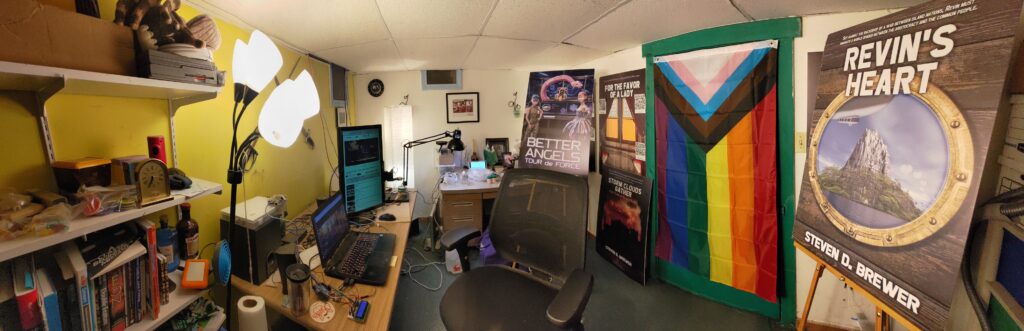
Don’t get me wrong. I love my office! I have a big laptop with a portrait monitor and a fridge that’s usually well stocked with cold water bottles and beer. It’s located in the basement of my house and is quiet when I want it to be quiet — but I also have big speakers I can turn on when I want to listen to kpop or jpop. And I have poster boards with the covers of my books which make a nice background when I’m in Zoom for class or Faculty Senate or Straw Dog Writes or whatever else I do.

In the past, when I was working full time, I was in my office for many of my waking hours. But this semester, I have started my new phased retirement. This means, that I don’t need to spent nearly as much time running class or having consultations with students.

During the winter, my office used to get pretty cold. I used to have to wear a sweater or fleece and use fingerless gloves to type. But, about a year ago, we got insulation installed in the basement that keeps the temperature nearly always in the 60s — very comfortable during summer or winter.

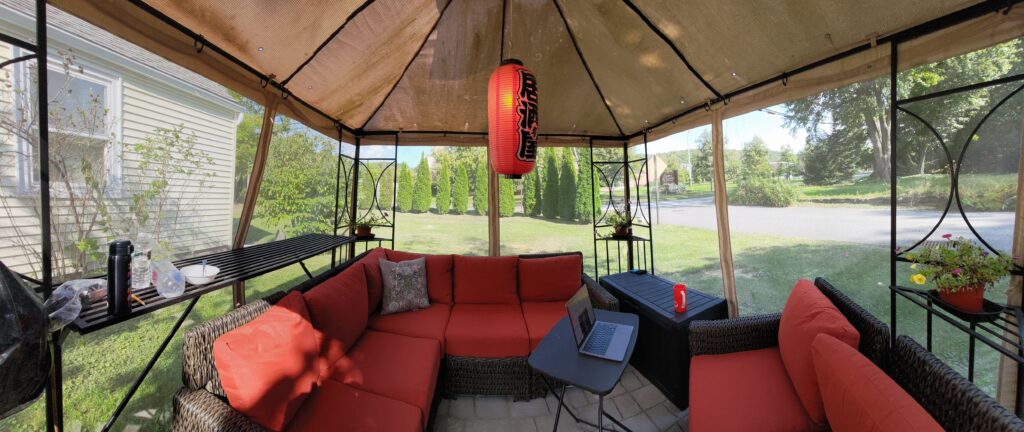
For a long time, we’ve had a little tent gazebo set up in the front yard. We used to have an old, weird picnic table under it, which was OK. But not really very comfortable. So I proposed getting more comfortable furniture. My wife, always practical, pointed out that, to do that, we’d need to have a patio for the furniture to sit on. So, this spring, we arranged to have a patio installed. And then I ordered the furniture and set it up.

It is glorious. Now, whenever the weather is nice, this is where you’ll find me writing. It’s not exactly quiet, as there is a busy road behind the arbor vitae. And sometimes the sun shines on my laptop screen. But I love it. It provides a nice environment for being able to write that is comfortable. I appreciate the fresh air and quiet stimulation of having people walk by on the sidewalk. And seeing the neighborhood children waiting for the school bus.

It’s also a nice place for me to meet with people. Due to my health issues, I can’t meet people in cafes or bars or restaurants anymore (although beergardens are OK) so it’s wonderful to have a comfortable place where people can come to hang out with me. It’s also a great place to have a beer or cocktail with friends.

It’s a bit of work to watch the weather and cover everything up whenever rain threatens. And, eventually, I’ll have to figure out what to do for the winter. I plan to move the cushions indoors and then cover up the furniture. Winters are long in New England and so I’m sure I’ll be looking out longingly all winter waiting for spring.

But, at least now — for the fall, while the weather is nice — this is where you can find me. Writing.

After 28 years of full-time employment, I am starting a new phase of life. This summer, for the first time since I started my career, I didn’t work over the summer. And this fall, I begin my “phased retirement” where I start working just half time. I’m excited to see what the new normal will be like.

Thirty five years ago, I began graduate school and have been working full time pretty much constantly since then. The last two years of graduate school, while I was working on my dissertation, I was also the full-time caregiver of my infant son, which was a fascinating experience but meant that I was busy nearly every waking minute.

I started my professional career in 1996 when I joined the faculty at UMass Amherst as Director of the Biology Computer Resource Center (BCRC). This meant that I was either running the BCRC and teaching a scientific writing class (during the academic year) or doing development and support during the summer (replacing hardware, updating software, building curriculum). I loved my work, but was constantly busy — I aimed for about 55 hours per week year round.

The year before the pandemic I was awarded a Professional Improvement Fellowship to develop a new honors course: Open Science Instrumentation and Data Collection, which let me bring together all of my skills. I proposed to mentor students coming up with a life science research question and developing an instrument that used a computing platform and sensors to collect and log data about their question. The fellowship offered me a semester off from my professional duties to create all of the instructional materials. It was glorious. But then the pandemic happened.

During the pandemic my department closed the BCRC and rewrote my job description as a teaching faculty member. I continued to teach the writing class and began my new honors class. Since I was no longer obligated to spend my time doing computer support and development, I decided to repurpose that time for writing fiction and have written two books, Revin’s Heart and Better Angels: Tour de Force (plus several short stories published in anthologies).

Last year, I proposed the idea of a phased retirement to the department. I offered to continue to teach my honors class. However, because the “credit” for teaching the honors class would go to the Honors College, my college (the College of Natural Science) was only willing to have me teach the writing class, for which they get “credit”. So that’s what we settled on. This week, I’m getting ready to teach the writing class beginning next week.

Last year, when it wasn’t clear which class I would be teaching, I began putting off doing a bunch of the work needed to teach the honors class. That class required me to maintain and update a lot of instructional materials that had complex dependencies because the technology moves so quickly. Each year, I had to stay current with changes to the operating systems, development environments, campus networking, and the software carpentry instructional materials (which I was using for teaching). I had created a long list of tasks that I would need to do before teaching this year. And when I ended up not teaching that class, I was able to just throw out that whole list. As I’m getting ready for the fall, I’m still taking pleasure in discarding the last vestiges knowing that I won’t ever have to do that work.

In the past, I basically didn’t have time to write fiction during the academic year. I could only write during intersession and summer. But I’m hopeful that, this year, I will find that I have enough time to continue to write fiction year round. It will be nice to have that become the new normal.

Worldcon in Glasgow wrapped up today. I didn’t attend any of the last day’s events. Of course, I didn’t end up attending Worldcon in person and only attended a few events remotely. I had signed up very early (I had a badge number in the 3000s as opposed to 15k or 16k by the end.) And I had purchased plane tickets and made hotel reservations before January. I signed up before they announced their “disease mitigation policy.” (Due to my chronic lung condition, I have to be very careful of respiratory infections that are likely to put me in the hospital.) I had been hopeful they would adopt a masks-required policy. But they didn’t. Even so, I planned to attend until I learned that I hadn’t been afforded a place on the program. At that point, I decided to cancel my plans to attend.

I was able to recover some of my sunk costs. I had (at significant expense) purchased fully-refundable airline tickets, so I was able (at some significant effort) to get the airline to refund them. The hotel had required us to basically pay for our stay upfront as a non-refundable deposit, so that was a huge loss. And, of course, I had purchased attending memberships for myself and my son, which were worthless. I offered my attending membership to someone on Mastodon who might want to attend in person, but no-one expressed interest. So I ended up using my membership to attend online. (Someone suggested that I could offer the memberships via other networks, but I said, “F— ’em. If they can’t bother to follow me on Mastodon, they deserve NOTHING.”)

I had been planning to travel to Glasgow with my son, my brother, and his wife. Instead, they flew here (as we had originally planned) and then we just hung out and spent the week together visiting. It was wonderful. I had just finished constructing a new patio with comfortable patio furniture, so we had a marvelous time.

I did attend a few events online. Although, to be honest, it made me feel bad every time since I had been so excited about attending and it was merely a reminder of what I was missing.

I did notice, however, that — in spite of the “disease mitigation policy” which said “We strongly recommend that every member wears a mask, particularly indoors or in crowded areas, such as the registration area and programme rooms” — the number of people actually masking was extremely low. I got several views of the audiences in presentations and counted masked and unmasked participants, and the ratio was between 1/5 and 1/10. So, if I had attended, I probably would have spent a lot of time having to cower in my room. Brrr.

Instead, I had a great time with my brother. My mom, who is over 90, lives with me and I always feel a little guilty that my brother doesn’t get to spend as much time with her. So it was great to have us all hang out together. And we’ve been going on fun adventures. We went to Hawley Bog together today. We’ll go to the Bridge of Flowers tomorrow. And we’ve visited a number of breweries — totally appropriate for Brewers.

In a couple of days, they’ll head home and then it will be time to start getting ready for classes to begin in the fall.

So, in the end, it was an expensive lesson. But it’s just money. We had a nice time anyway, even if I didn’t get to go to Glasgow or have the opportunity to promote my writing.

As July ends, I typically find myself consumed with regrets. With August imminent, I sulk as I see the end of summer approaching and recognize I need to start working to get ready for the fall. And I invariably feel like I didn’t accomplish enough during the summer. I didn’t relax enough, enjoy myself, write enough, travel enough, etc.

Enough. I need to let go of these regrets and just let myself enjoy the time that I have. So today, on the last day of July, I propose to do exactly that. It doesn’t matter if I don’t write. Or don’t organize my office. Or don’t register for some upcoming conference. I need to just not dwell on negative thoughts and let myself be happy.

Let the good times roll!