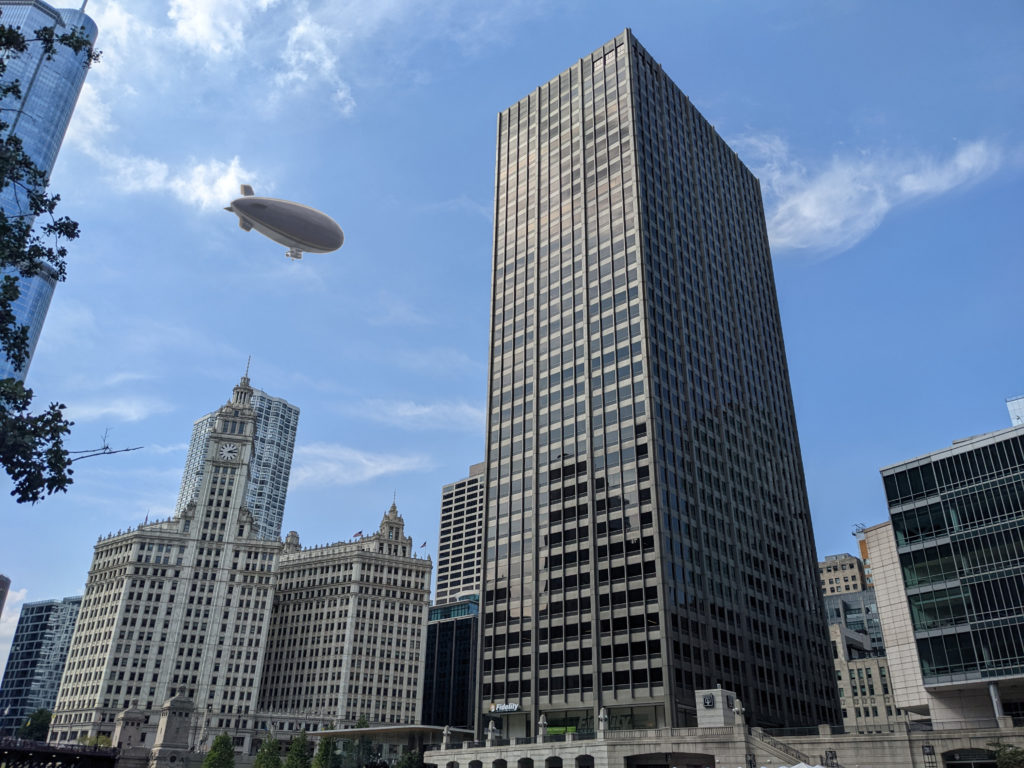
Attending conferences and conventions is nothing new to me, but when I signed up as a participant of Chicon8, my self-described “semi-benevolent” editor, Steven Radecki rubbed his hands saying, “I can’t wait to read the blog post you’re going to write after your first Worldcon.” Here ya go.
I’m a new author. At least, with respect to speculative fiction in English. I’ve written scientific publications, self-published books of haiku in Esperanto, and even won awards for haibun and speculative fiction in Esperanto. But getting my work published for the English market in speculative fiction is new. My first work, Revin’s Heart, a steampunky fantasy adventure with airships and pirates and a trans protagonist, was serialized by Water Dragon Publishing as seven novelettes and the fourth, Crossing the Streams, will be coming out soon. But I digress.
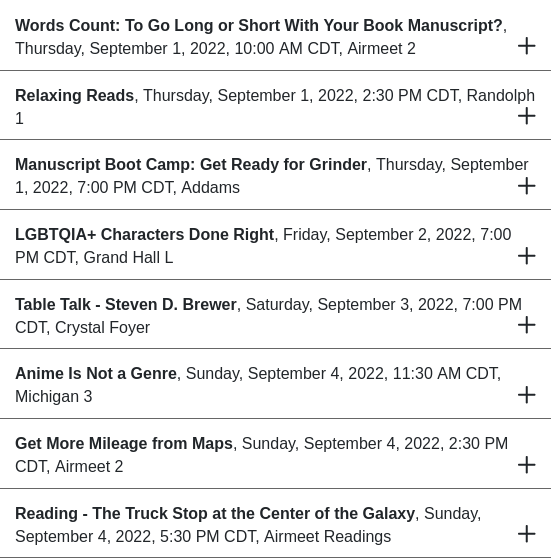
I signed up to participate in Worldcon and filled out an interest survey in Planorama—the online tool they used to identify panelists and moderators. I didn’t know exactly what to expect, but when I looked at my proposed schedule, they had put me in eight (8) separate program elements: I was the moderator of three panels, a participant in two, I had a “table talk” and a “reading”, plus I volunteered to help a fellow Water Dragon author run a workshop in manuscript formatting. I was floored. My first Worldcon? Eight things? What a debut!
As the convention approached, the attending authors lamented that our publisher wasn’t planning to have a dealer table at the convention to allow us to sell and sign books. So, wily devil that he is, our editor indicated that had a super-secret long-range plan to have the Small Publishing in a Big Universe podcast set up a “Marketplace” table where small-press and indie authors could, for a nominal fee, get space to display two or three books, and, for agreeing to help staff the table, arrange times to meet with readers and sign books. He had been planning to do this next year. But faced with multiple authors jumping up and down with excitement, did the eight months of work in three weeks to pull it off for us to do it this year.
Being unsure about expectations, I contacted the panels for which I was moderator very early to introduce myself and to ask for names (and pronunciations), brief biographies to use to introduce people, and ideas for questions or topics that they would like the opportunity to discuss. This was perhaps atypical (neither of the moderators of the panels I was in contacted me much before Worldcon and one only shortly before the panel.) But I was happy to be over-prepared, rather than trying to do it cold.
One thing that can’t be exaggerated is how terrifying it was to head to my first public event after the pandemic. I had not flown since the pandemic. So literally every step felt like a new and dangerous thing. I had decided to purchase first class tickets (which was not as much more expensive than I had feared), but it made flying almost like flying used to be: instead of having to deal with robots to check in, I got to talk to a person! They accepted my baggage (at least in O’Hare) without my having to drag it to some distant location to leave with the airport security-theatre fascists. My trip through security had a much shorter line than typical. My seat was wide enough for my seat. And right at the front, where I thought I was less likely to be exposed to plague-rats. They brought me beer for free — even before flight! And I got to get off the airplane first. And, finally, since I was carrying the majority of the books for the marketplace table, I could carry a whole suitcase with 45lbs of books for free (since you don’t have to pay extra for the first two checked bags).
Arriving at the hotel, I hooked up with Philip Brewer and we went down immediately to the registration table and got credentialed. Then we began exploring the vast space where events were scheduled. Since I was on the program for eight different things (plus the vendor table) my head was swimming trying to figure out where stuff was and how to get there. It was like one of those mechanical aptitude tests where you have to rotate things to figure out how they fit together. There were escalators going this way and that way, two different buildings on different sides of the street with both a tunnel and a skywalk connecting them.
We went to the Dealer Room and met the awesome and amazing Angela Jones-Parker who accepted the profuse thanks my publisher had asked me to express and promptly handed over Dealer ribbons to us to place immediately below my Airship Pirate ribbon. We found our table and coordinated with the legendary Vanessa MacLaren-Wray regarding the following morning: I said I would bring down the books and then rush back upstairs to meet my first panel.
The first full day of the convention, I moderated a virtual panel, a face-to-face panel, and then helped run a workshop. I’m not new to running meetings, but I wasn’t certain about expectations and norms for the Worldcon community. As soon as I had known who my panelists were, I reached out to them via email to coordinate and learn how to pronounce their names, to get a brief bio to introduce them, and to ask whether there were particular questions or topics they wanted to be sure to include. (The moderators of the panels I was on did not do that, but those panels turned out fine, as I’ll describe later.) The panelists were all very gentle with me and made the experience a genuine pleasure. The topic were all of intense interest to me and I learned a lot — but also felt like I had useful things to contribute.
The second day, I only had one face-to-face panel to moderate, but it was one I was most concerned about due to the topic area: “LGBTQIA+ Characters Done Right”. As someone who only recently came out as bisexual — and is aware that some parts of “the community” view bisexuals with suspicion — I was a bit worried. I’m relatively confident about the work I’m writing, but I’m still experiencing some imposter syndrome about it. And I was concerned, given the current tenor in the country, that we might even end up with hecklers. Finally, one of our panelists was a no-show and so there were only three of us trying to carry the whole panel. Happily, our other Water Dragon author in attendance, Jay Hartlove sat in the front row, maintained eye-contact with me, and would smile broadly, which helped sustain me while I struggled with the difficult subject. Once again, I felt like I learned a vast amount from my panelists who were very supportive and helpful.
On Saturday, I also only had a single scheduled event — my “table talk”. But earlier in the day, I attended the one panel discussion I wasn’t scheduled for: We Are Not a Metaphor: LGBTQIA+ Representation.” This overlapped quite a bit with the panel I had moderated, but brought a bunch interesting and different viewpoints. In the afternoon, Phil had wanted to introduce me to two of his Clarion instructors who were in attendance and we went to a biergarten on the Riverwalk. Finally, I attended my table talk but found no-one had signed up for it. I was getting ready to sit alone for 10 or 15 minutes to make sure no-one was planning to come without having signed up, but met Vanessa and her husband coming out of a nearby event and they sat with me to chat and keep me company while I waited.
There were some people doing cosplay the whole time which added greatly to the character of the convention. It was wonderful spending time in the Dealer Room because nearly everyone wandered by our table at some point. As the Masquerade Ball approached, the costumes got more elaborate. I liked the Tom Baker Dr. Who costume. And a guy dressed in a Gandalf costume was particularly convincing. An author wore a spectacular mermaid costume that had iridescent scales and was revealing in all the wrong places. I was so tired by 8pm, that I nearly skipped the Masquerade Ball, but managed to drag myself down there and was glad I did. But I was also glad to get back to my room and sleep because I was exhausted.
On my last full day, I had three events again: I served as a panelist on two panels and then participated in a joint reading for the Truck Stop at the Center of the Galaxy. One moderator had reached out a couple of days before Worldcon to touch base. The other reached out the morning of, but with good news: there was no need to meet in the dreaded Green Room which was on the other side of the planet from the room. In both cases, I was worried that I would struggle to find things to say or contribute, but I needn’t have worried. I think I was able to offer some useful and amusing bits without making anyone angry or upset. And the reading was a blast: I enjoyed reading from Better Angels and getting to see Vanessa perform reading Coke Machine in character was a joy.
It was amazing to attend the Hugo Award Ceremony. I was particularly pleased to see my former colleague (and neighbor) Suzanne Palmer receive the Hugo for best novelette. Hearing the eloquent acceptance speeches that authors write is always a pleasure.
I had to leave midway through Monday in order to be back in time to teach the following day. It was sad to say goodbye to Jay and Vanessa. Vanessa indicating she was pleased to meet Phil, the imaginary person I had talked about who I “pretended to speak Esperanto to.” She said who she really wanted to meet was my wife, to see this mythical woman who could supposedly put up with me. It’s nice to have friends, though with friends like that…
It was an amazing opportunity to debut for a new author like me and I’m endlessly grateful to the Chicon organizers. I got an opportunity to share my books in the Dealer Room (I made a decent number of sales and got to sign copies for people). I got to meet a lot of people and was introduced to people in a whole variety of contexts. (I even ran into a colleague from Comparative Literature at UMass who had no idea I was published author in speculative fiction — that was fun.) In trying to describe the experience to others, the best analogy I’ve come up with my doctoral defense. It was stressful and terrifying and overwhelming and intense, but an unforgettable experience that I hope augurs well for my ongoing success as an author.