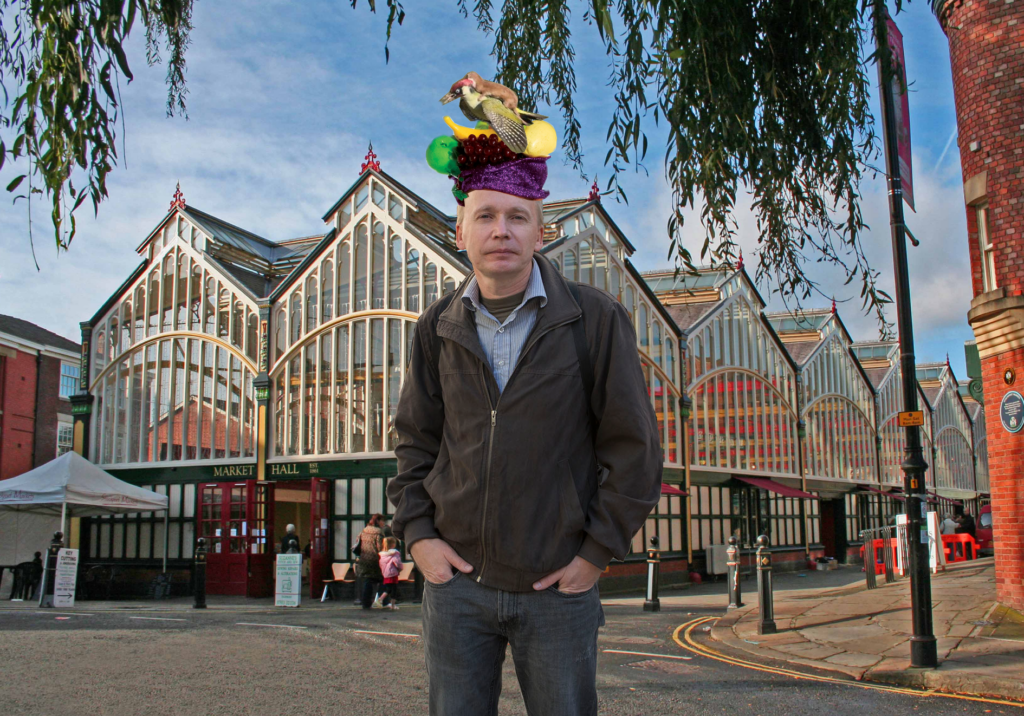
an image of Källë Kniivilä, Tutmonda Ĵurnalisto, photoshopped in front of some building — in England, if I recall correctly — wearing a Carmen Miranda hat with a weasel riding a woodpecker on top.

In 2007, when I was still engaged with the US Esperanto movement, I decided that what it needed was a tabloid newspaper to share fantastical stories about Esperanto personalities and events. I persuaded a couple of people to help (mostly Philip Brewer and Robert Read) and we produced a one-off newsletter — printed appropriately on tabloid paper — to hand out at the Landa Kongreso in Tijuana. We did it a few more times — in 2009 and 2013. I don’t know that it ever gave anyone more than a chuckle. But we had fun doing it.

I called it Oni Diras Nun! (or ODN for short.) This translates roughly as “one is saying now” but an onidiro is a rumor, so it has a tongue-in-cheek meaning more like “current rumors”. I hacked together a logo that shows the face of a prominent Esperanto journalist speaking into the ear of Zamenhof (the creator of Esperanto).

I hacked together a website for it. Eventually, however, the website quit working. Recently, I saw something that reminded me of it (an artist, Jason Chou is photoshopping Paddington Bear into everything imaginable. In ODN, I photoshopped a picture of a friend into a whole variety of unlikely places.) So I decided to take a few minutes to at least post a page that recovered the links to the PDFs of the issues — which never really left the Internet. So, for everyone (Anyone? Anyone?) who’s interested, here is OniDirasNun!

Highlights include:

  • The face of Zamenhof on toasted bread — but unfortunately the face of Felix Zamenhof, which limited its potential value.
  • The presidents of Esperanto associations who form a committee to consider the possibility of doing something.
  • A local Esperanto group success story from Champaign, Illinois.
  • An article about a memorial toilet seat where a local Esperanto group has met.
  • “Are Language Rats Human Rats?” (In Esperanto the words for “rats” and “rights” look similar).
  • The largest Esperanto library that you can never visit (the NSA’s archive of intercepted communications.)
  • KällĂ« Kniivilä Worldwide Journalist (pictures showing an Esperanto journalist photoshopped into various fantastical locales).

We did have one more issue planned that was going to include La Ligo de Esperantaj Senmortuloj — an imaginary league of immortal Esperantists who had gone by various names over the century of Esperanto’s existence. But I got busy and my enthusiasm for Esperanto waned, so that issue never saw the light of day.
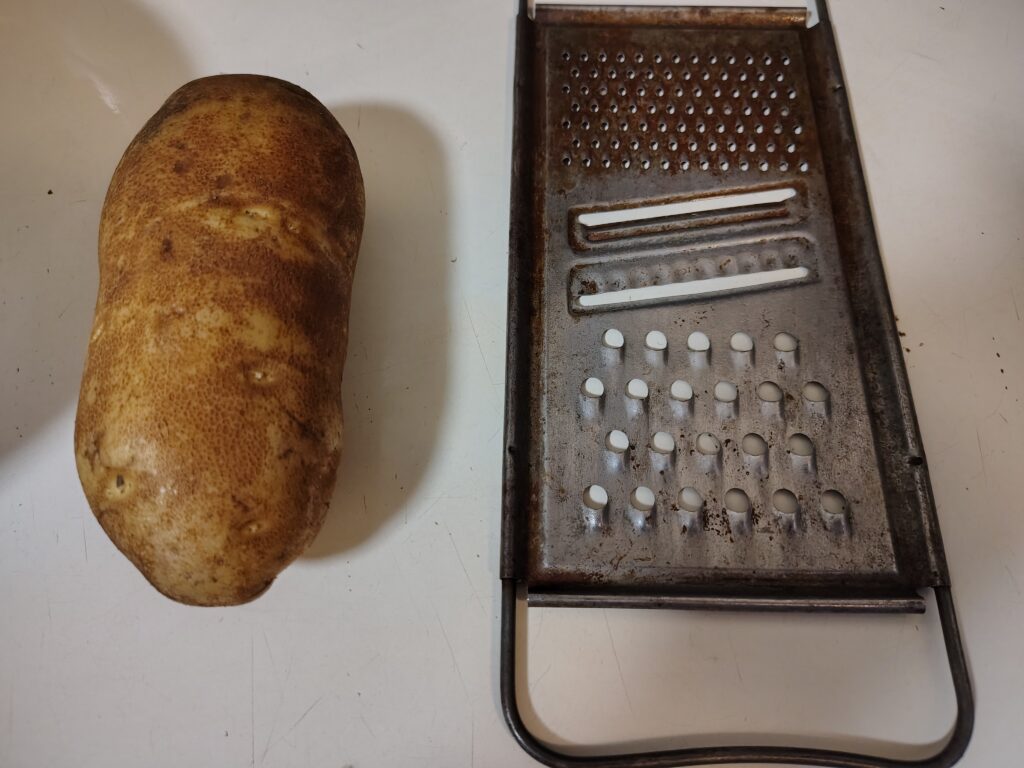
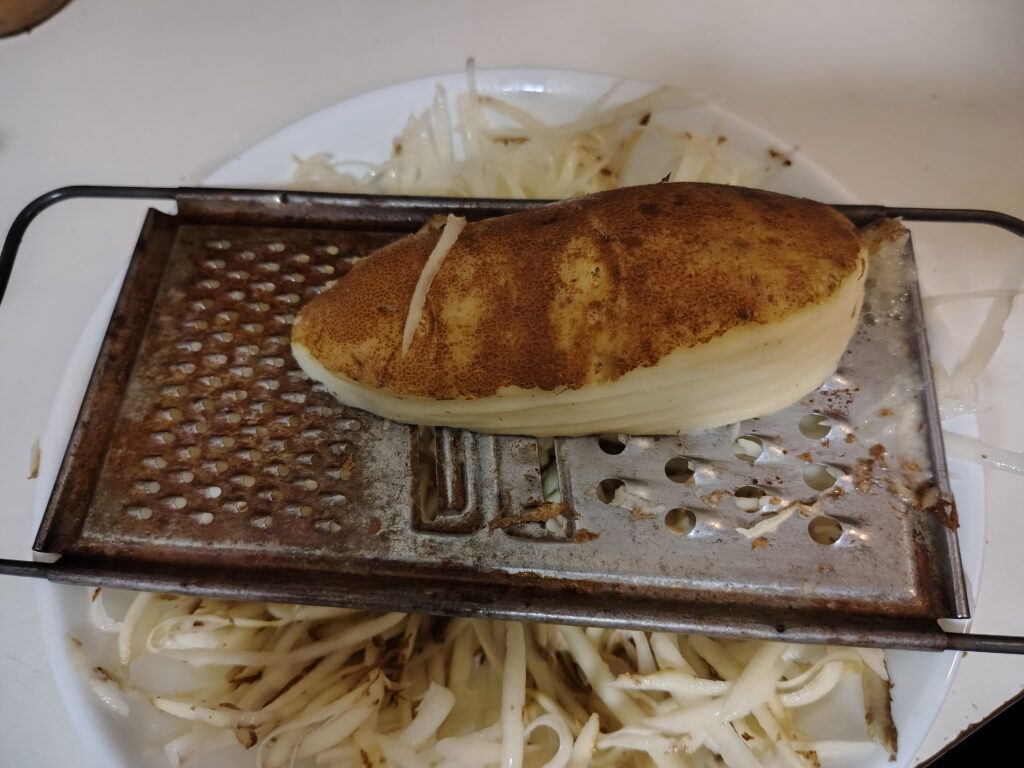
A russet potato and grater.

I’ve always loved hash browns. It’s perhaps my favorite way to eat potatoes. I don’t really like mashed potatoes (though they’re edible with enough gravy). And, as far as I’m concerned, you can discard the potato part of a baked potato because I really only like the skin. But hash-browned potatoes are special.

I tried making them a few times years ago and failed pretty utterly. Then I discovered a boxed brand of dehydrated potatoes that worked OK. They weren’t great, but it was better than nothing. Then the grocery store quit carrying that brand. So I broke down and actually looked at some recipes for hash browns. Using those, with several rounds of experimentation, I’ve developed a set of heuristics that works pretty well for making hash browns the way I like them.

I’ve tried several varieties of potatoes and found that russets seem to be the best for hash browns. The others have a tendency to become mushy. Nobody likes mushy hash browns.

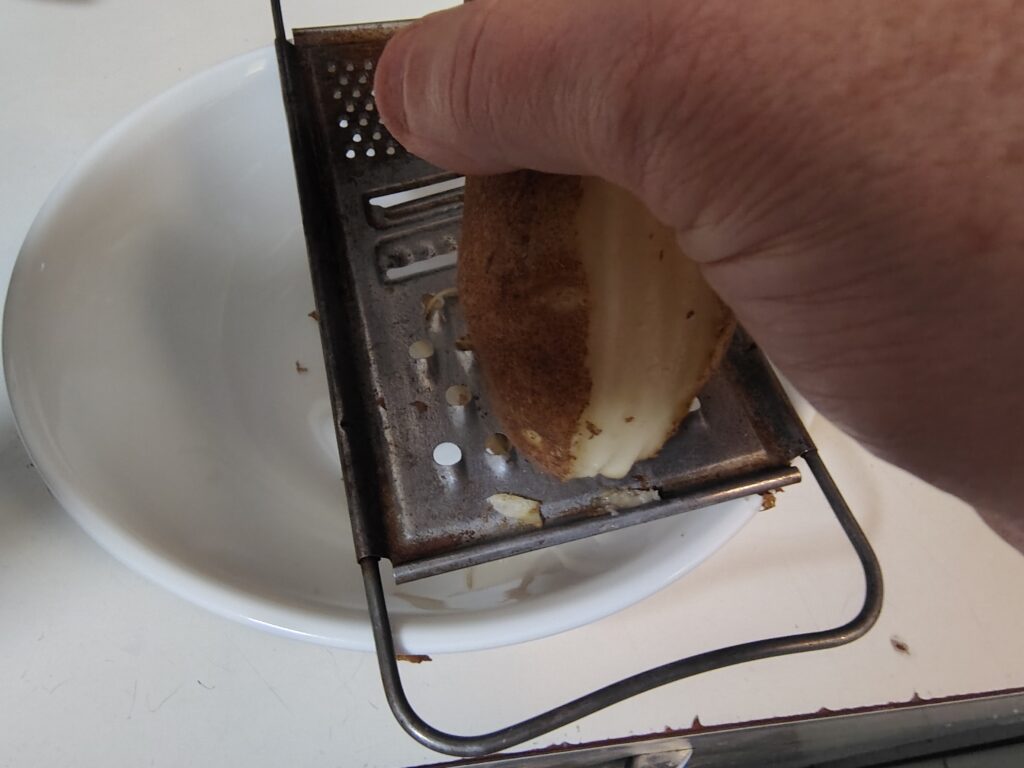
I have this ancient grater that works, but requires a few tricks. I start by grating all around the potato, to make a band around the potato. Then I rotate the potato and grate along the longest edge, periodically switching which direction I’m grating to grate the potato evenly. This gives nice long strips of potato. Eventually, I turn the potato on its end and grate it down to a tiny bit of skin.

Note that I include the skin in my hash browns. Some weirdos might like to peel the potato before grating it, but for me the skin is the best part.

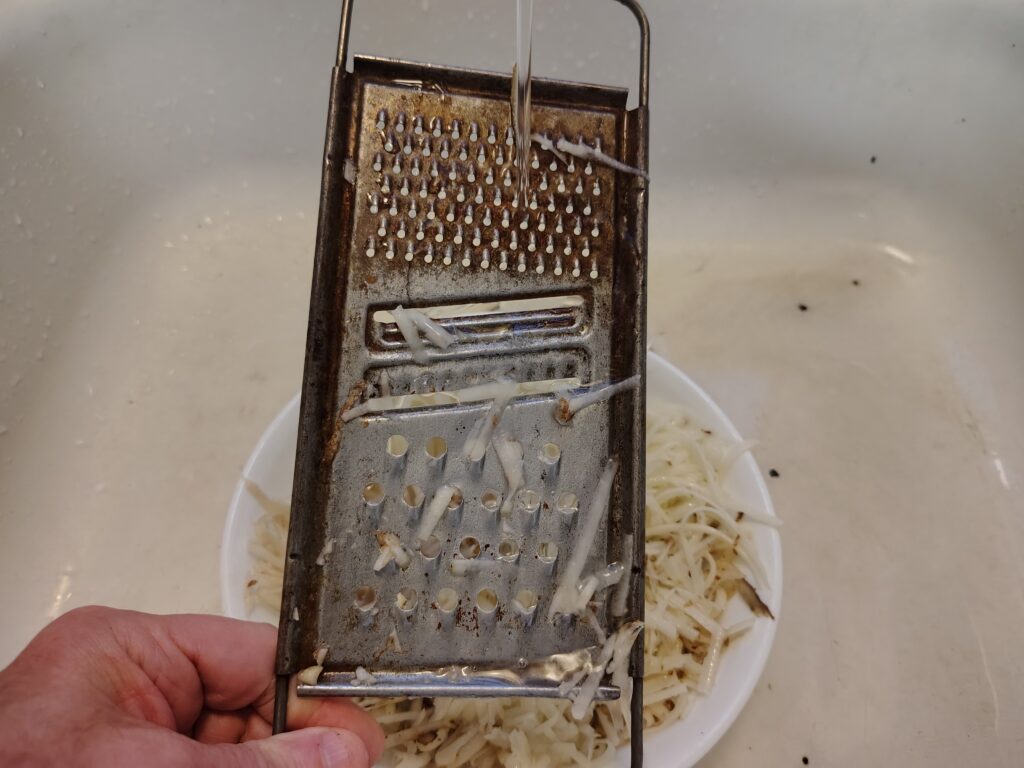
Once the potato is grated, I fill the bowl with water (which is a convenient way to rise the rinse the grater. Then I add a fair amount of salt to the water. I probably should measure how much salt I use sometime. I’m not sure it really matters all that much. Most of the salt is lost when you drain the potatoes. But I think increasing the osmolarity of the water causes the potatoes to lose water, which makes them taste better.

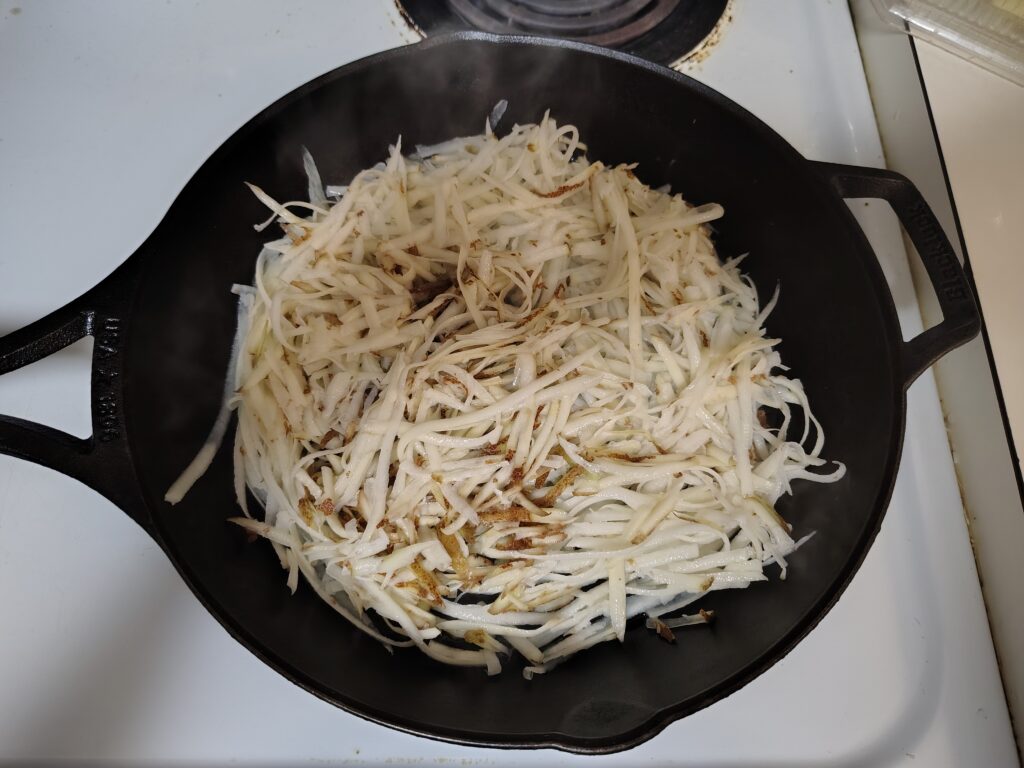
Once the potatoes are soaking, I pour a bit of canola oil into the cast iron skillet and start heating it up. I use medium heat (6/10 on my dial). As the skillet heats up, I drain the potatoes into a colander. Once the oil is hot, I spread the potatoes out in the skillet.

I let them cook until they’re brown on one side (5-10 minutes) then flip them over, usually in two portions. Rather than timing, I tend to cook them until I see and smell that they’re browning. Probably actually timing things would be better, but I’m not that kind of cook.

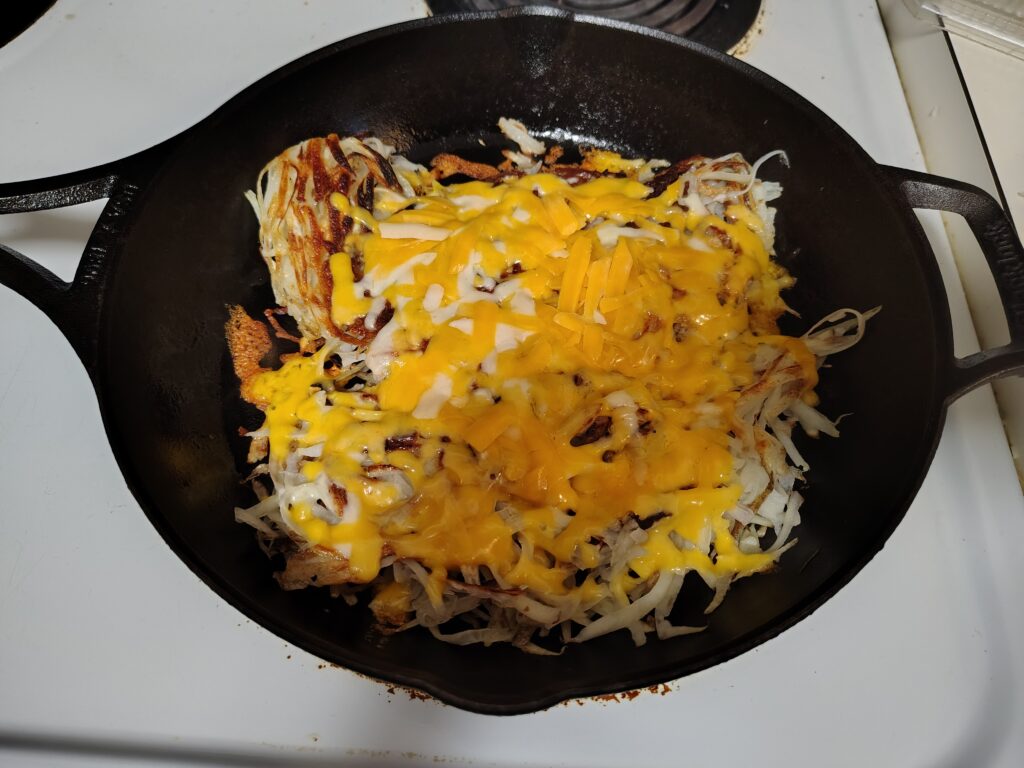
I usually like to melt some cheese on my hash browns. I sometimes joke that this is how I make my vegan hash browns non-vegan. There are other ways you could make them non vegan: e.g. use butter or bacon grease instead of canola oil. Or make breakfast stew.

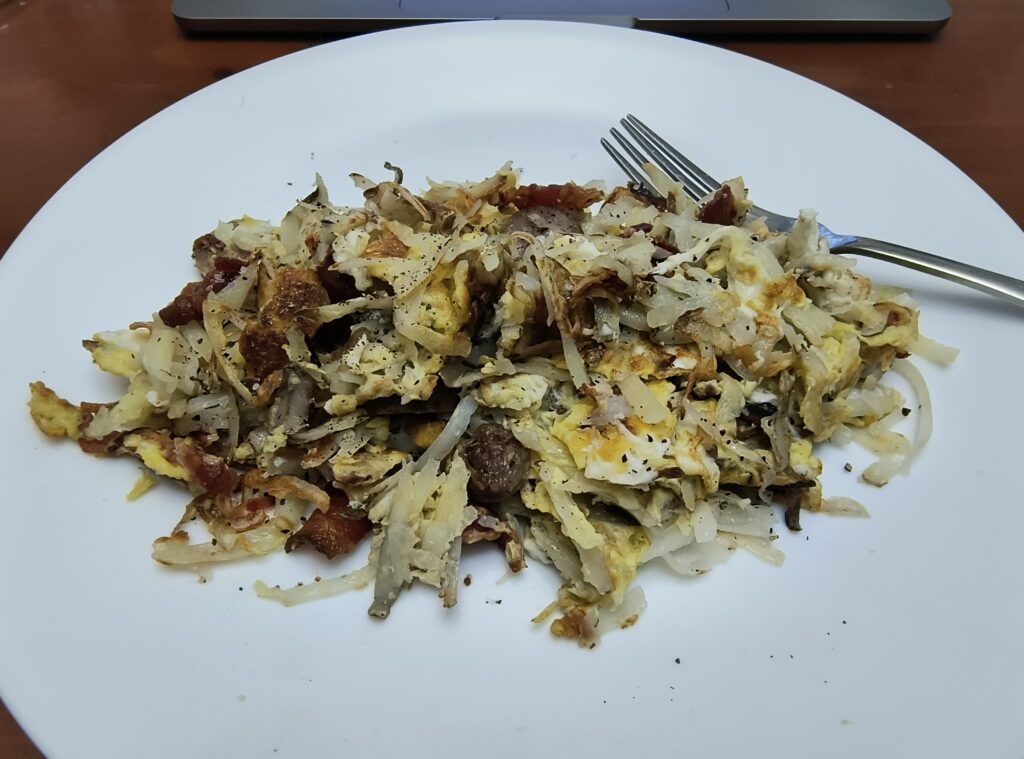
Maggot's Breakfast Spew: a plate of hashbrowns with scrambled eggs, sausage, and bacon.

A restaurant in Southwest Michigan I used to frequent in graduate school made a dish called “Maggie’s Breakfast Stew” which is easy to make at this point. Rather than adding cheese, just throw in some diced sausage, bacon bits, and two eggs, then scramble. I think they also added onions and green peppers, but I think it makes the dish a little wet. You can add cheese at the end too. Or not. It’s not going to be vegan either way.

I used to call it “Maggot’s Breakfast Spew” because it’s not a very pretty dish. I imagined they kept these giant caterpillars in the kitchen that would eat the ingredients and then they would squeeze them out into the pan to cook the dish. I have a very vivid imagination.

Maggie’s is also where I learned to make a so-called Mexican omelet, but that’s a recipe for another day.

Anyway, that’s how I make hash browns. Enjoy!

NPR headline: ChatGPT promised to help her find her soulmate. Then it betrayed her

I find it intensely annoying when people ascribe intelligence, or intentionality, to statements by AIs (i.e. Large Language Models). In today’s example, a writer said that an AI “betrayed” someone. This kind of statement is a category error. It projects intelligence onto a system that, though facile with language, does not in fact engage in human reasoning at all. It just makes pronouncements that look like human speech. I really wish writers would stop using these kinds of statements that mislead people into thinking that AIs are, in fact, intelligent.

I began trying to imagine the words that shouldn’t be used to describe AI speech. In chatting with Philip, I said, “AIs can’t ‘promise’ anything either.”

“They can say they do, though. They can say anything.”

“They can say anything. It just doesn’t mean anything.”

“I don’t know,” he said. “It ‘means’ something, in the sense that a string of words means things. I mean, the AI can’t mean anything, because it has no agency, and no real existence. But the WORDS mean things, which is how we get this puzzlement.”

I disagree. Here’s the thing. Statements (strings of words) never mean anything on their own. The receiver always has to ascribe meaning to a statement. This is a fundamental tenet of social constructivism: You can’t transmit meaning — only words. You probably had a meaning in mind when you transmitted the words, but the other person receives the words and has to construct their own meaning from them.

In a normal case, one makes the assumption that the statement meant something to the person who made it. When the receiver ascribes meaning to it, they make assumptions about what it means to themself and what it may have meant to the speaker. And, in this way, interlocutors negotiate a shared understanding. But things don’t mean anything to AIs. So you’re projecting meaning onto something that isn’t there.

It reminds me of Wittgenstein’s “Language Game.” Wittgenstein began his philosophical inquiry with that the idea that propositions (human statements) are (1) tautologies or (2) contradictions or (3) neither. He agonized over what would could be said and what could only be thought or shown. But, eventually, he came to call language a “game” and recognized that one of the principal outcomes of language was that most of what could said were things that had no corresponding referent in reality. I think he basically gave up on philosophy as a meaningful endeavor.

AIs are the language game as simulated by machines. Nothing they say has any referent. There is no intentionality or thought process behind their utterances. But when people see a statement, they are seduced into imagining there must consciousness and meaning behind it. I would recommend people not give into the temptation. AIs are not trying to accomplish anything. They do not have motives. Or goals. All they do is generate text that looks like an answer.

Do not project intelligence onto them. In fact, I would recommend not using them at all.

The people who are creating these machines obviously do have motives and goals. And it would be a mistake to believe that their goals align with yours.

an iris which means "message" in the language of flowers

When I wrote Revin’s Heart, I realized that one thing that the protagonist couldn’t really do was talk about plants. He didn’t have any background to have learned about plants.

I love plants and wanted a character that could talk about them. So I wrote in a botanical garden and a curator to run it, Lady Cecelia. She appears for the first time in Storm Clouds Gather. She didn’t have much backstory at first. Momo, one of Revin’s love interests, addressed her as “aunt” so she was the sister of the Baron’s wife.

She appears again in Then They Fight You when Revin wants to make a corsage and Cecelia advises him regarding flowers to choose:

“These yellow lilies are pretty,” Revin said, remembering the yellow dress Momo wore on the first day he met her. 

“Oh, no,” Cecelia said. “No, no, no. In the language of flowers they mean falsehood. No, a white lily, that would be more appropriate. Or perhaps one of these orange blossoms — those mean ‘purity equaling loveliness’. Does that suit, Sir Revin?”

I was fascinated by the idea when I first learned about the language of flowers. I wrote a blog post in 2020 describing it and mentioning some haiku I wrote (unfortunately posted at twitter) that were inspired at the time by the language of flowers.

I subsequently wrote a whole series of novelettes, Lady Cecelia’s Journey, that tell her backstory. I had hoped these would start appearing by now, but they haven’t. The language of flowers plays a small role in one of those stories as well.

For the Wandering Shop Stories prompt today, the word was #rue which immediately put me in mind of the language of flowers. so I wrote a brief story fragment featuring Cecelia and her sister Serena.

Serena entered the botanical garden in Ravensbelth.

Cecelia was taking notes in her notebook. She looked up and smiled.

“And how is my sister this morning?” she asked.

“I am well,” Serena replied. “But I need to send a bouquet to… an acquaintance.”

“We have a lot of nice blossoms,” Cecelia replied. “Some roses are blooming, as well as nasturtiums and mallows.”

“Oh, no,” Serena said. “No. Do you have any rue?”

“Ah,” Cecelia said. “So this is that kind of bouquet. Yes, I have some rue. And what else would you like?”

“Evening Primrose? Saint John’s wort? Tansy?”

Cecelia sucked air through her teeth.

“My… Yes, I have those.”

Serena thought for a moment.

“Any colt’s foot?” she asked.

Cecelia shook her head. “No, those are out of season.”

“A pity,” Serena said.

“Would you like me to cut and arrange them for you?” Cecelia asked, getting out her clippers.

“No,” Serena said. “For this, I’d like to do it myself. But would you keep me company?”

Cecelia smiled and nodded.

In the previous times that I wrote about the language of flowers, I included in the text what the meanings were, so the reader would know. But this time I didn’t. So I thought I might clarify using this blog post. Here’s what Cecelia and Serena are talking about:

Rose: Love (and many varieties with similar meanings.)

Nasturtium: Patriotism.

Mallow: Mildness (and several varieties with similar meanings.)

Rue: Disdain.

Evening primrose: Inconstancy.

Saint John’s wort: Animosity. Superstition.

Tansy: I declare war against you.

Colt’s Foot (tussilage): Justice shall be done you.

These meanings are drawn from Language of Flowers by Kate Greenaway (1846-1901).

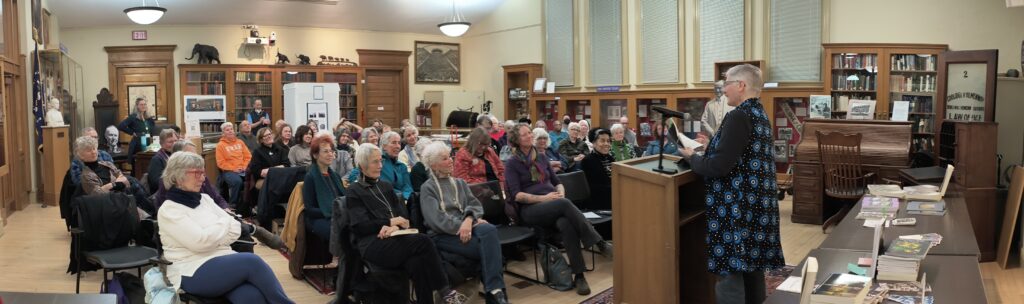
LJ Cohen reads in front of a sizeable audience

On January 31, 2026, I gave a reading from A Familiar Problem as part of the Straw Dog Writers Guild January Showcase. Authors who published a book in 2025 were eligible and a dozen were drawn from a hat. I got to read third.

As I arrived, the traffic in downtown Northampton was terrible. I had left plenty of time because I know that parking can often be hard to find, but just getting to the venue was a challenge. Luckily I found a parking place without difficulty and arrived in good order.

There was a sizeable audience. The Straw Dog Writers Guild tends older, female, and queer. I think there were two other men besides me. But I’ve been involved with Straw Dog long enough that I’m nearly a fixture, so I always feel welcome.

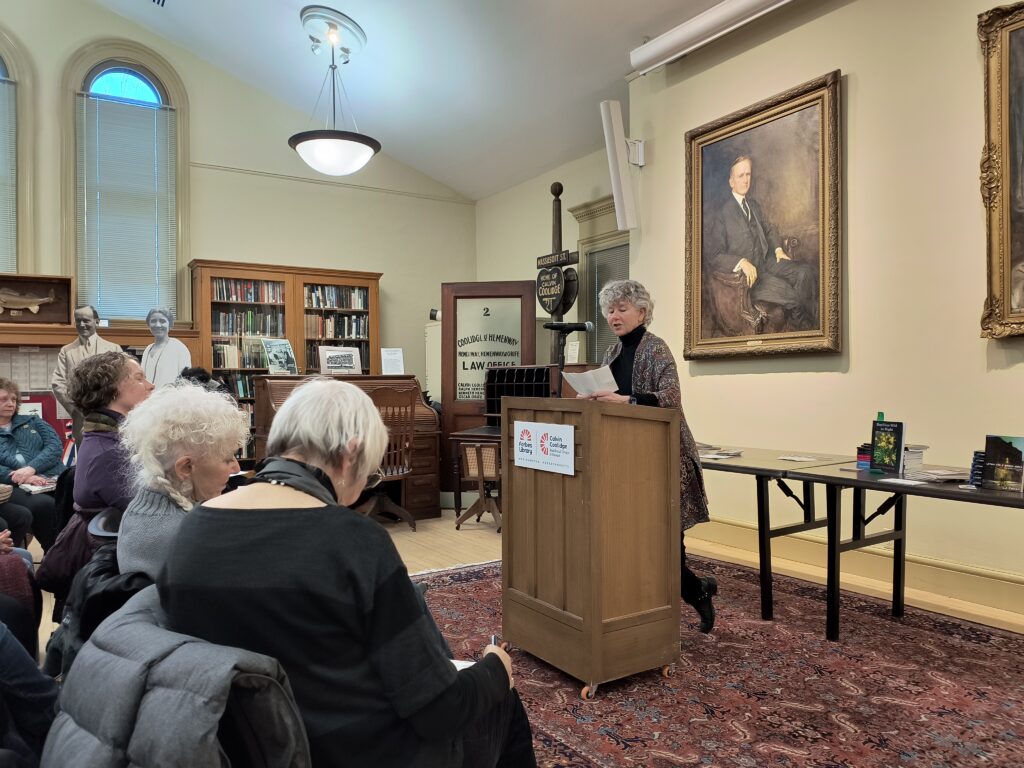
The reading was held in the Calvin Coolidge Memorial Museum in the Forbes Library in Northampton. The wood paneling and large portraits of the former President and his wife made for an elegant backdrop to the reading.

Lindsay Rockwell (pictured to the left) led the organizing for the event and welcomed the audience. I’ve served with Lindsay for several years on the Program Committee and she did a fantastic job bringing everyone together.

Andrea Hairston served as emcee. She introduced each author and brought an enthusiastic energy to the role.

Most of the readings were of poetry or memoir. My offering of my weird speculative fiction was accepted with good humor, although someone always comments how weird my writing is. And I don’t even read any of the REALLY WEIRD bits.

One of the readers, LJ Cohen (pictured at the top), also write speculative fiction. I know her from Mastodon and we’ve met a couple of times at conventions (Arisia and Readercon). I decided to buy a copy of her book and got her to sign it.

After the reading concluded, I was able to pitch my books. I even sold a couple.

After I left, I saw why the traffic had been so congested: there were ice sculptures all over town, beautifully illuminated in the dark. It was a nice way to end the day as I headed home.