Author of LGBTQIA+ speculative fiction and poetry in English and Esperanto. Emeritus teacher of scientific writing. Lover of natural history. SFWA Secretary. (he/him)
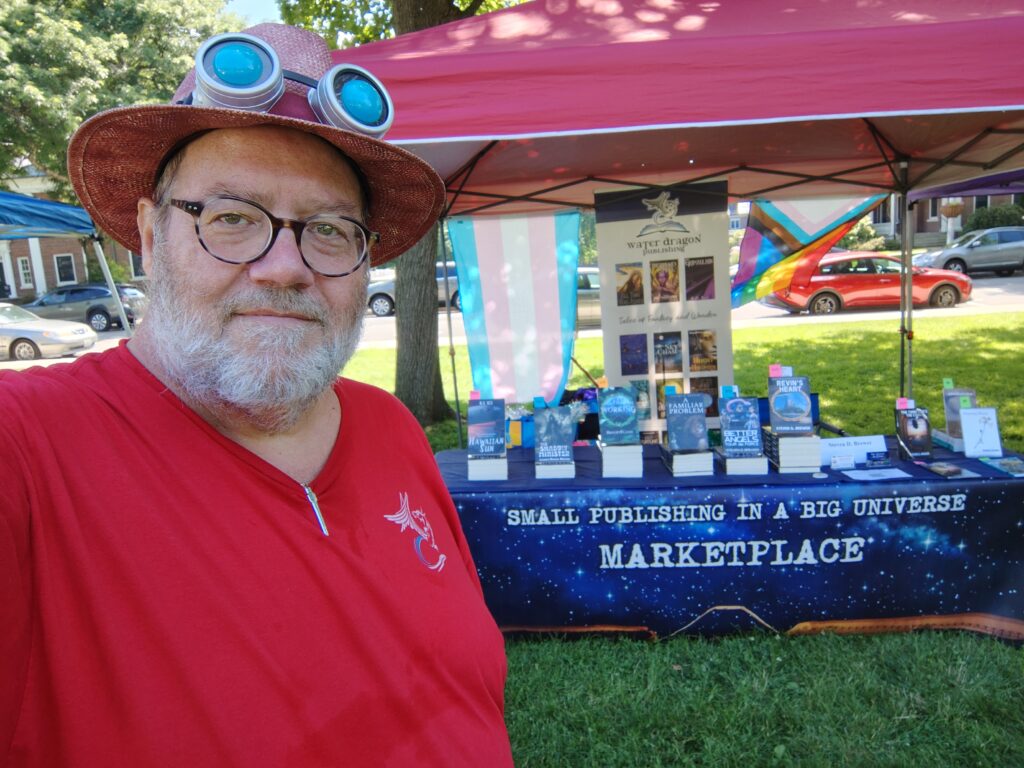
Last year, I did both the Queer Artisan Market and Amherst Pride but, this year, I decided to just do Pride. Doing two days in a row is harder for me to handle now. In any event, the weather was perfect and, thanks to my experience last year, I knew where to site my vendor tent to be in the shade. I don’t think I sold quite as much as last year, but it wasn’t too bad.
Fewer people are buying books. Partly, I think that people feel poorer than they did, so they just aren’t buying as many books. I’ve always noticed that most people simply don’t see books at all as they walk around. There are a few people who spot the books from a mile away and make a beeline to the table. But the ratio is shifting. There seem to be fewer and fewer people interested in books at all.
I tried really hard to sell M.D. Neu’s book Hawaiian Sun. This seemed like a perfect book for Pride! It was a bit hard to pitch because it has a such weird premise. “So, there’s this guy on the Hindenberg who’s come to New Jersey to see his boyfriend, but then it catches fire and he’s like isekaied into the future where he goes on an airship over the Pacific Ocean to do some Pride stuff.” I pitched it over and over, but I don’t think I sold a single copy. Oh, well. Fail.
Now, I’m exhausted and sunburned. But it was fun. Maybe I’ll do it again next year.
Today, I was scheduled to attend the Watch City Steampunk Festival to sell books. But it wasn’t to be. After several days uneasily watching the forecast, this morning I checked the radar and made the final decision to cancel my appearance. It was a “perfect storm” due not only to the rain, but also a shortened festival and higher travel costs.
Rain means death for book sales. Books themselves are particularly vulnerable to rain. Perhaps the only thing worse to try to sell in the rain would be cotton candy. Or maybe owls. Any books you put out for display are likely to get water damaged and become unsellable: nobody wants to buy books that have gotten wet. Moreover, the wet ground also makes it difficult to even protect the stock you don’t put out. And, of course, it suppresses attendance which also reduces sales. Furthermore, rain also often brings wind, which knocks over books, scatters promotional giveaways, and can even blow over the tent.
Last year it also rained. But last year, the rain was predicted to wrap up around the start of the festival. Although we got wet during setup, the festival itself was mostly dry (though cold and pretty miserable). This year, the rain is just getting started and it looks like it will only get heavier as the day wears on. There’s even a chance of thunderstorms during load-out.
In addition, this year the organizers were compelled to shorten the length of the festival. The town passed a new ordinance that events on the Common may only run for four hours. I suspect a lot of vendors were already planning to skip the event due to the difficulty of justifying the costs of attendance with the shortened time frame of the festival.
Finally, of course, gasoline prices are a lot higher this year. The trip represents about four hours of highway driving, which costs almost twice as much due to the mad king’s unconstitutional war against Iran.
As I wrote in my bookselling post at Planetside and on my blog, even in the best of circumstances, you’re doing well if you make back your table fee at these kinds of promotional festival events. It’s rare you actually come out in the black when you consider travel and other costs — to say nothing of labor. It wasn’t going to happen this year. As my mother says, “There are times when you just have to give up on things.” But at least I’m warm and dry.
At Worldcon, I got the chance to chat with Roxana Arama, the editor of Planetside (formerly the SFWA Blog). We had a great conversation and she encouraged me to write a pitch for an article.
Upon reflection, I decided to pitch an article about hand-selling books for authors as a kind of Bookselling 101. Since I had time in August (and was likely to have less time once the academic year started), I went ahead and drafted the article even before my pitch was accepted, figuring I would post it to my blog if it didn’t get accepted.
My pitch was accepted, but with a modification: They wanted a Bookselling 201 article and were most interested in having my expand on the aspect about pitching and hand-selling books. I made the necessary revisions and the article, How to Hand-Sell Books for Fun and Profit, is now live at Planetside.
I thought it would be fun to share the rest of the Bookselling 101 article I wrote here.
Where to Sell
There are a large number of opportunities where you might be able to sell your books directly to an audience. Perhaps the most important are the national and international conventions, like Worldcon, Dragoncon, and Comicon. Regional and local conventions are also worth attending. Additionally, there are often a vast number of local events that will welcome an author selling their books, including festivals, artisan markets, and holiday markets.
Conventions usually have a “dealer room” where most of the bookselling happens. Dealers pay a charge to have a space in a room with other dealers where they can sell their wares. For an individual author — especially a beginning author — the charges for a table may be higher than are warranted. But there are sometimes ways to share the cost. It may be that your publisher will already have a table. Or will pay to have the table, if you volunteer to help staff it to sell your books and others from the publisher. Some groups, like Broad Universe and Small Publishing in a Big Universe (SPBU), offer tables that multiple authors may join and share. Many conventions also offer other opportunities for individual authors to sell their books, in an “author’s alley” or via book-signing events.
Your Personal Brand
Presenting yourself and your books effectively makes a good first impression. Branding works. Many authors use some props to create a distinctive author appearance: a distinctive hat, like Tobias Buckell’s beret, or a T-shirt with a graphic design that evokes or aligns with your brand. A tablecloth and tablerunner, or banner, with branding are worth having to give your bookselling operation a polished, professional appearance.
Branded giveaways are useful to remind people about your books after they’ve walked away from your table. A business card, with a QR code linking to your website, is a no brainer here. But there are a lot of other easy and fun possibilities. Bookmarks are an obvious choice. Stickers can be good, although they’re more expensive and some venues ban the distribution of stickers. Some conferences use badge ribbons and, if you can think of a catchy hook, they have the added advantage that other attendees may see other people wearing the ribbon and will come to your dealer table because they want to get one of their own.
If people purchase several books, it’s convenient to be able to offer a bag to help them carry their books away. Be aware that in some localities, disposable plastic bags are outlawed, so paper bags are safer. The bag is another opportunity for branding: A rubber stamp works well, but stickers or labels can do in a pinch. Alternatively, you can purchase some branded reusable bags to sell.
Practical Concerns
Books are heavy, so a collapsible cart or wagon can be invaluable for moving your books and other materials during load-in and load-out. Stout cardboard boxes are ideal for protecting your books. But high quality reusable grocery bags with a flat bottom are convenient too and have the added advantage of handles. Book stands are also useful for standing up just a few books to highlight. (They’re also useful for when you’re a participant at a panel, to show your books while you present!)
It’s fun and easy to also sell books at outdoor festivals and markets, but you need some additional resources. You will probably want a collapsible 10×10 foot tent. Some are much easier than others to transport and setup by single person, so consider those factors when making your selection. Also, be sure to get some weights so that your tent doesn’t blow away in the wind. (Ask me how I know this…) You’ll need a table and some folding chairs. Usually tables and chairs are provided in dealer rooms, but for most festivals, you’re on your own. An 8-foot folding table works well. But two smaller tables — or just an additional table — can provide some flexibility.
Hand Selling Books
The most important thing I’ve learned about bookselling is that a concise, polished pitch for your book greatly increases your chances for making a sale. My article at Planetside, How to Hand Sell Books for Fun and Profit, goes into more detail about this.
Financial Concerns
Before selling anything you should make sure you have your financial ducks in a row. If you are selling on behalf of another organization, like your publisher or SPBU, they may have taken care of these details beforehand. Otherwise, you should consider setting up a separate bank account for you to keep the finances of your bookselling operation separate from other activities.
Honestly, if you’re a professional author, you should already have a separate bank account for business income and expenses. But, if you’ve resisted that up to now, stop resisting — you really need that, if you’re going to be a book seller.
Before you start selling, you will probably need a Tax ID number in order to collect and report sales tax. The rules and the amounts can vary widely depending on the locale. The rules for this vary from state-to-state or even city-to-city, so be sure to check the laws carefully in your locality.
You will need to accept payments. There are a few payment processors that offer inexpensive integrated systems you can use as a Point-of-Sale terminal. Many cell phones now can accept NFC (tap) payments with one of these using a card or phone or smart watch. There are also inexpensive devices that can accept tap payments, but allow someone to also insert a chipped card. These systems generally impose a 3-4% charge, which you will need to price your products appropriately to cover.
Different events bring people with different preferences for how they want to pay. Most transactions are usually via credit cards but, at some events, many people will want to pay cash. An envelope containing small bills is useful and that can also hold the cash collected. I usually start with $100 in one, fives, and tens to make change. I can then easily calculate the additional cash collected by the end of the event, to confirm it matches the transactions recorded in the payment processing system. Some events and populations prefer yet other payment systems, like venmo or paypal. It’s useful to be able to accept payments using whatever system the customer prefers.
I’ve generally found it convenient to price products at even dollar amounts that include the taxes and payment processor charges. Remember that, if you price something at $11, you will need a large number of ones and fives to make change, if you have many cash sales.
I’ve found that printing price tags on florescent card stock is useful. I have a template with prices along the edges that I can cut in half and then cut between the tags. These are easy to tuck in between the pages of books, so they stick up and are highly visible. You can use the different colors of tags to indicate various things: e.g. price range or genre. People like to know how much things cost. If you don’t have price tags, people will need to ask you, which will deter sales.
So, that’s it. That’s pretty much everything I know about selling books. Yep, that’s pretty much it. Oh, except you need some books to sell. You should probably go write some books now.
The Straw Dog Writers Guild arranged a table at the Northampton Antiquarian Book, Ephemera, and Book Arts Fair where authors could sell and sign books. I attended and had a two-hour shift at the Straw Dog table. Although I didn’t sell any books, I met some new people, reconnected with others, and had a great time.
The event was held at the Northampton Center for the Arts. It’s a fantastic building with many interesting spaces. The Straw Dog table was right in front of a counter that would have been great as a bar for a reception. Unfortunately they weren’t serving.
Most of the vendors were dealers in antiquarian and rare books, but there were a few literary organizations and specialty presses. As a group of current authors, Straw Dog was not a particularly good fit and few of the visitors seemed that interested in current work. It reminded me a bit of Boskone, where many attendees want to see books by Heinlein and Asimov, rather than new authors they’ve never heard of. And, at this event, what they really wanted were signed first editions.
I arrived very early, in hopes of getting a parking space and was rewarded by getting the very last one. I suspect that not arranging for vendors to be able to unload and park at a distance to let attendees use the limited parking probably limited the number of visitors a lot. But, at least, I didn’t have to schlep my books a vast distance when it came time for my shift.
I used the two hours before my shift started to wander through the whole space and see everything. There was a lot of really cool stuff. I love old books. The fact of the matter is, however, that I would be a very poor caretaker of them, so I never buy anything like that for myself. But it’s fun to look.
In addition to books, there were other interesting things. One artist had a book made with interesting handmade papers. There were various kinds of manuscripts (old property deeds and log books). One was printing with old type that had been recovered by the Yiddish Book Center. It was all fascinating.
When my shift started, I set up my books. I only brought a few copies, since I wasn’t expecting strong sales. But I also had a sign-up sheet for my mailing list; and cards to give away for myself, A Familiar Problem, and my proposed Amherst Book Festival. Plus some Airship Pirate stickers.
I spent the most time talking to the author next to me at the table. She was easy to talk to and we swapped stories while we waited for people to stop by. We would trade off talking to people that expressed interest in our books. I ended up buying a copy of the book she was promoting, Jingle These Bells, an inclusive holiday-themed romance anthology. Her story sounded fun.
There’s a small chance my new book, A Familiar Problem, will be out by then. But I will also have copies of my other books, as well as stickers and ‘zines.
Etymologically, November was originally the ninth month of the year before the Romans messed everything up by adding January and February. But nov- is also the root for “new” in Esperanto, so let’s go with that. Because I’ve got some new stuff coming up.
Although I still don’t have a new release date, A Familiar Problem is moving forward again. I’ve approved the illustration for the cover and, behind the scenes, the wheels and gears are (hopefully) grinding forward.
Once again, I’m planning to do WritingMonth during November. I did this also last year and wrote 23,100 words toward The Ground Never Lies. This year, I’m planning to work on the sequel to A Familiar Problem. I’ve got some notes and a rough outline, so its a project I think I can make some good progress towards. I do have a lot of other obligations, so I don’t know how work I’ll be able to get done, but it’s nice to have a goal.
On November 2nd, I’m scheduled to attend the SFWA Winter Worlds of Giving Kickoff Event. And afterwards, I will probably attend the SFWA Writing Date, which I haven’t been doing as much as I should.
On November 8, I am scheduled to sell books at the Mill District Holiday Arts Market. And the next day, November 9, I am hosting James Cambias for Worldbuilding 101, a face-to-face Straw Dog Writers Guild event at the North Amherst Library Community Room.
On November 15-16, I am attending SFWA Quasar where I will be on a panel on Sunday “Science Fact in Science Fiction: Getting It Right in SFF”. This is the first year that Quasar has been offered, so it’s new for everyone.
Finally, over the weekend of Nov 29-Dec 1, I will attending LOSCon 51 in Los Angeles. I am listed as a participant, but I haven’t yet seen the final schedule. I haven’t attending LOSCon before, so it will totally new for me.
The 2025 Worldcon in Seattle was generally good. I served on a lot of panels, had a good reading, and (for me) met a lot of people. But I had one unpleasant experience that left a bad taste in my mouth and left me feeling rather mixed on the whole convention.
I had a reading. At first, I realized they had scheduled my reading for Sunday when would have already left. But they were graciously able to reschedule it earlier in the Con. It was, in fact, in the second reading slot for the convention. I worried that it might not get any attendees. After Boskone, I said I would be happy if my reading had any attendees. But there were six people, two of whom came specifically to see me. I joked afterward that it had a non-zero number of attendees and some of them were not even related to me by blood.
I also served on seven panels at Worldcon. Seven is rather a lot, but I like to be busy. I moderated one panel and was a panelist on the others. Many people came up afterward to praise my performance both as panelist and moderator — and to express interest in my books. And some even came to the dealer room later to find me and buy copies.
The panel I moderated, An Hour of the Strange, Unusual, Creepy, went very well. One of the participants had emailed everyone within a day or two of the panel being proposed to start organizing it and asked everyone to introduce themselves and describe what they wanted to do talk about. I responded to the email and then, a day or two, followed up gently with the email I normally sent to panels that I’m going to moderate that introduces me as the moderator with my usual information requests, that includes how to pronounce names and solicits questions that will allow each panelist to make the points they want to make about the topic. A few days before the panel, I sent the list of questions I’d come up with. Our presentation went well and I think everyone was able to participate well and say what they wanted to say. The guy who’d tried to take over as organizer apologized after the panel for jumping the gun. He said he’d served on another panel where the moderator never reached out or did anything (which has happened to me too). I said it was no problem. I was pleased that everyone seemed happy with the result.
Most of my other panels were about biology. On Life as we know it, I got to serve with Frank Wu again. We were on a similar panel at Boskone. In the lead up to the panel, I pointed out a couple of new unusual life forms that I had heard about that Frank hadn’t yet seen. He was super excited about them and I think I earned a lot of points with him. In both Can biological research ever be independant? and Human evolution and our influence on it were well-stocked with real expertise and I felt like I could play effectively off points other people were making to add useful information and nuance.
I was on two ‘non biology’ panels. One was about self-publishing for poets, which went well where I got to show off my Esperanto books and the ‘zines I’ve made. The other was about Makerspaces. One of the participants didn’t show up for that one and so it was a little thin. But we had a good time playing off the audience’s questions and letting them to contribute useful information.
My favorite panel was Biology and Evolution of the Dog that had a perfect mix of expertise and personalities. The moderator was a PhD Doctor of Veterinary Medicine who had been deeply involved with sequencing projects. There was an evolutionary biologist and a dog training expert. And me. Since everyone else could play to their expertise, I could just be the weird author and talk about boxer dogs and my story with a character who is a NeoBoxer.
The panel got off to a rough start when it turned out that there was no projector to share the slide presentation the moderator had constructed. I suggested that we could run a zoom session that the participants could join and the moderator could share the presentation that way. In the 15 minutes before the start, I set a zoom session, everyone joined, and it worked. (Mostly. The convention center was experiencing some network issues and the moderator got dropped from the zoom session a couple of times. But we rolled with it, reorganized a couple of the points, and got through everything.)
I also had several SFWA events. I attended a board meeting, served at the SFWA “fan table” a couple of times, and attended a breakfast (for a few minutes: it was tightly packed in a small, poorly ventilated room so I left once it got busy to reduce my exposure to COVID). They had a networking reception that I unfortunately couldn’t attend, because I was on a panel at the same time. But I got to introduce myself as the Secretary to a bunch of SFWA folks, including John Scalzi, while I was serving at the fan table and selling books.
I was too busy to spend a lot of time selling books in the dealer room, but I was there much of my free time. We had brought some books (my own and others from my publisher) and dropped them off before the dealer room opened. I managed to sell most of the books I’d brought and ended up bringing home only a handful. I didn’t manage to sell any of my Esperanto chapbooks, which kind of surprised me. But not that much.
Everything went very well with one exception. One of the other authors with my publisher decided to try to chastise me on two separate occasions for things they misunderstood about what I was doing. In both cases, I felt that they were very aggressive and kind of an asshole about it. I reported the conflicts to my publisher and said that, as things stand, I will not work with this person going forward. But it made me somewhat upset and rather colored the whole Worldcon experience for me.
I should recognize my son Daniel for coming along with me. He was a boon companion and made sure I got at least one good meal each day. Plus he helped me schlep the books all the way there. I really enjoy having him come along with me for many reasons but also because, honestly, I don’t quite trust myself to manage all of the travel details anymore, and so having second set of eyes on everything is reassuring.
We checked out of the hotel around 6am Sunday morning and spent the whole day traveling home: light rail to the airport then two 3-4 hour flights with a long layover in DFW. We finally got home around 1am. I’m rather glad I’m not traveling again until November for LOSCon.
I’ll bring my own books plus a selection of other books from Water Dragon. The weather looks spectacular and I hope we’ll have a great showing. I hope to see you there!
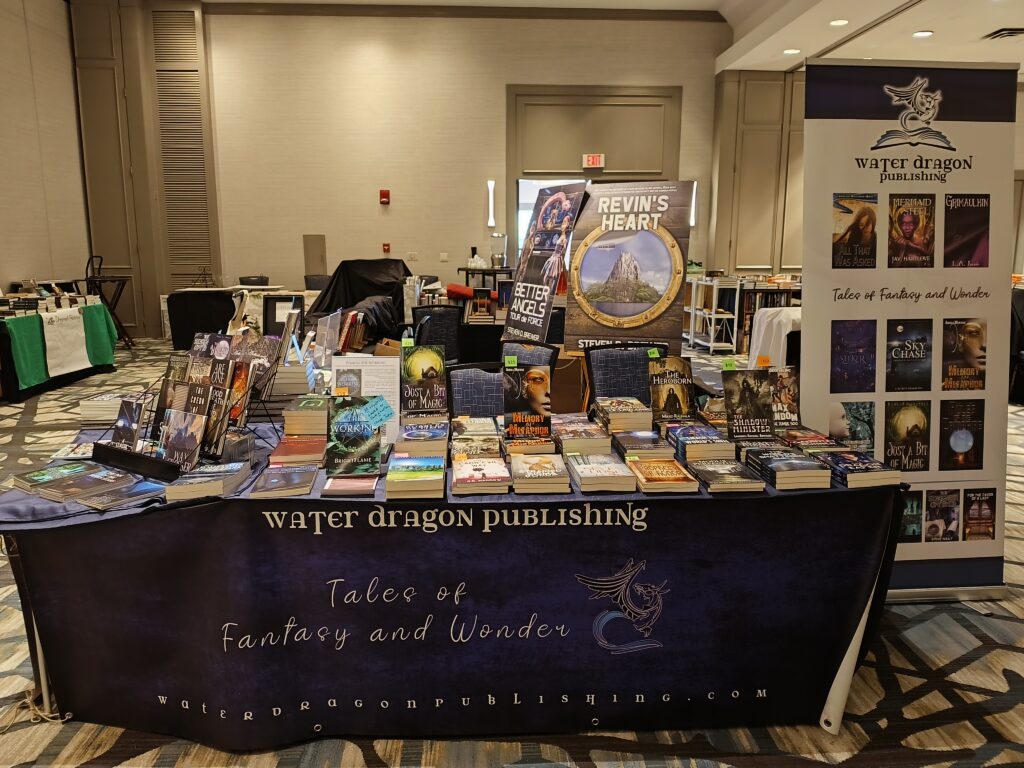
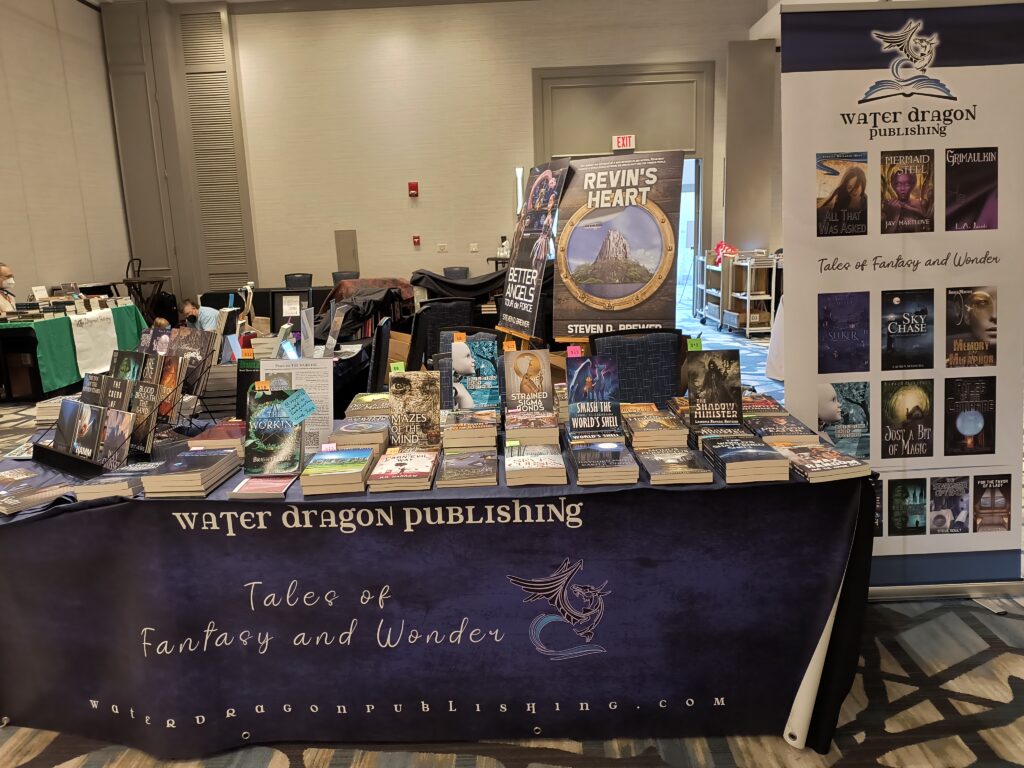
I agreed, with the welcome support of my son, to set up and run the Readercon dealer tables for Water Dragon Publishing and Small Publishing in a Big Universe (SPBU) again this year. I had a number of observations when I ran it last year. I reviewed those and tried to put some of them into effect this year.
We only had one table each for Water Dragon and SPBU this year that were at a corner. As I understand it, there were originally two authors scheduled to use the SPBU table (plus some of my books are considered SPBU), but only one actually attended. So I used the rest of the SPBU table for my books and other Water Dragon titles.
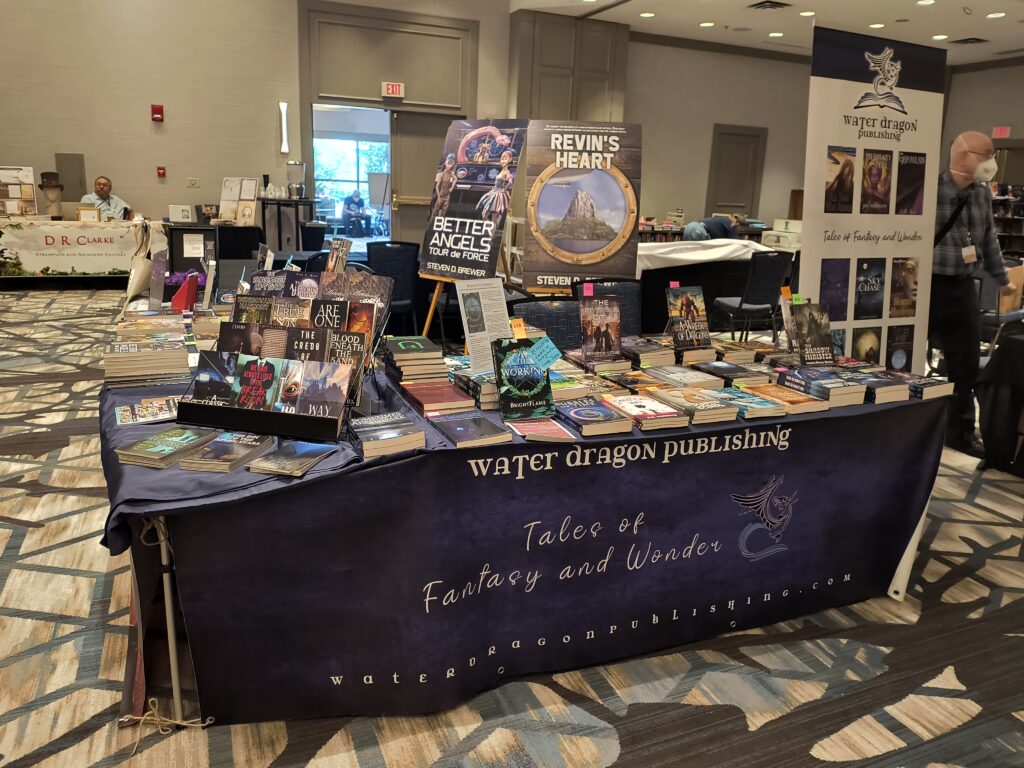
Last year, I observed we had too many titles featured. I had considered getting some bookshelves that could let people browse, but didn’t manage to accomplish that. But I did change how the books were organized on the table. This year, rather than having essentially every title on a book stand, I had most titles laying flat on the table and only put a handful of featured titles on book stands. Over the course of the three days, I switched which books were featured, so that different books had a chance to stand out and be seen. Except the books by authors who were present: their books were on display for every day of the convention.
Water Dragon Table, Day 1Water Dragon Table, Day 2Water Dragon Table, Day 3
Three authors, besides me, were available to represent our table: two other Water Dragon authors and one SPBU author. I tried to spread the books by different authors out around the tables so that there was a chair where each of the books was positioned so that the author could stand behind their book to sell it. I was pleased when someone was looking at an author’s book when the author was near the table. I was able to point the author out for them to ask a question which then led to a sale. It’s amazing what a difference it makes to be present for selling books. In point of fact, reaching out to people when they’re at the table to call attention to your books makes a huge difference as well. At least half of my sales — maybe more — are directly attributable to my reaching out to people at the table to pitch books. If your books are just “there” people are much less likely to notice them.
One thing that surprised me this year was who I didn’t see in the bookstore. I’ve often enjoyed being in the bookstore because it’s an opportunity to see everyone that comes through. But not everyone visited the bookstore at Readercon this year. I might not have noticed, but I was particularly struck because a number of the most prominent, instantly-recognizable, authors and other members of the SFF community never came into the bookstore at all, which I found personally disappointing. At some other conventions, there are a number of inducements or other activities planned associated with the bookstore (or “dealer room”) that encourage people to visit. Maybe something like that would help here.
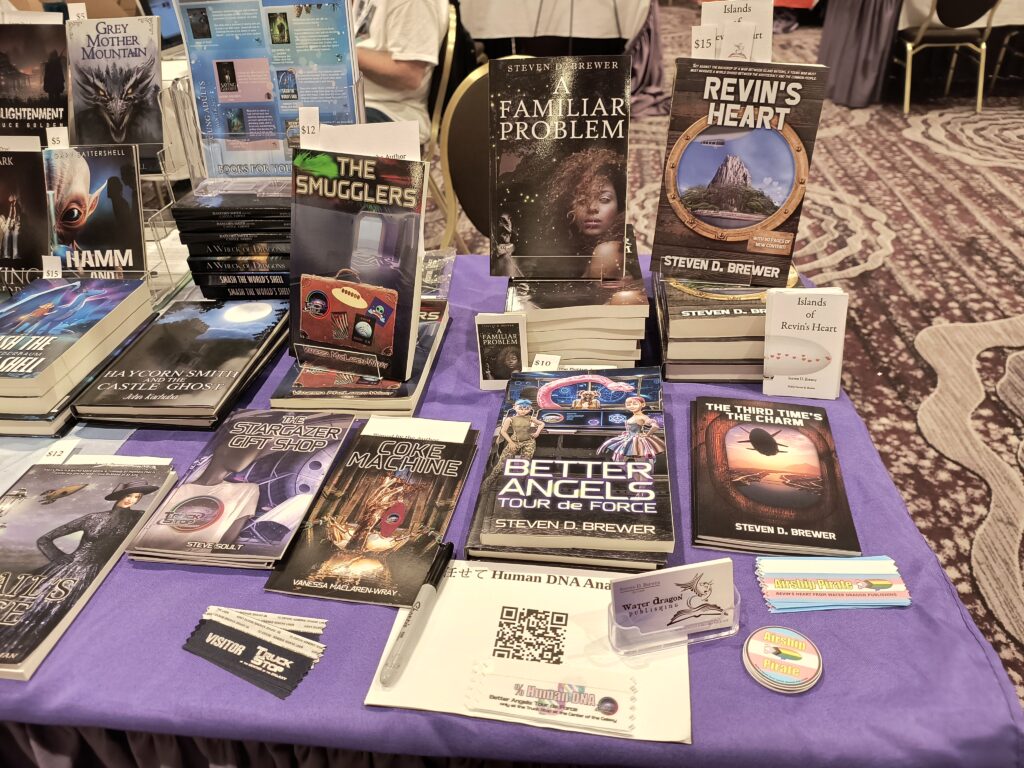
I got to pilot-test the 任せて DNA Analysis tool and Human DNA ribbon. Readercon only started using ribbons last year and there is not a strong ribbon culture. I developed a pitch centered around the tool that I introduced occasionally after my usual pitch. It was sometimes effective. Nobody seemed to find it problematic. A few people independently noticed the QR code irrespective of the pitch. (Or actually codes because I actually had two: one that led to the “Book” page of my website.) Although it didn’t seem interesting to everyone, some people really loved it. I still need to work a bit on the follow-up mini lecture about the human genome, to tighten it up and to bring it back more effectively to sell the book.
I love fountain pens. I don’t actually write by hand much. But when I sell books at conventions, its expected I sign books, so I always make a point of having a nice fountain pen that is appropriately inked before I go.
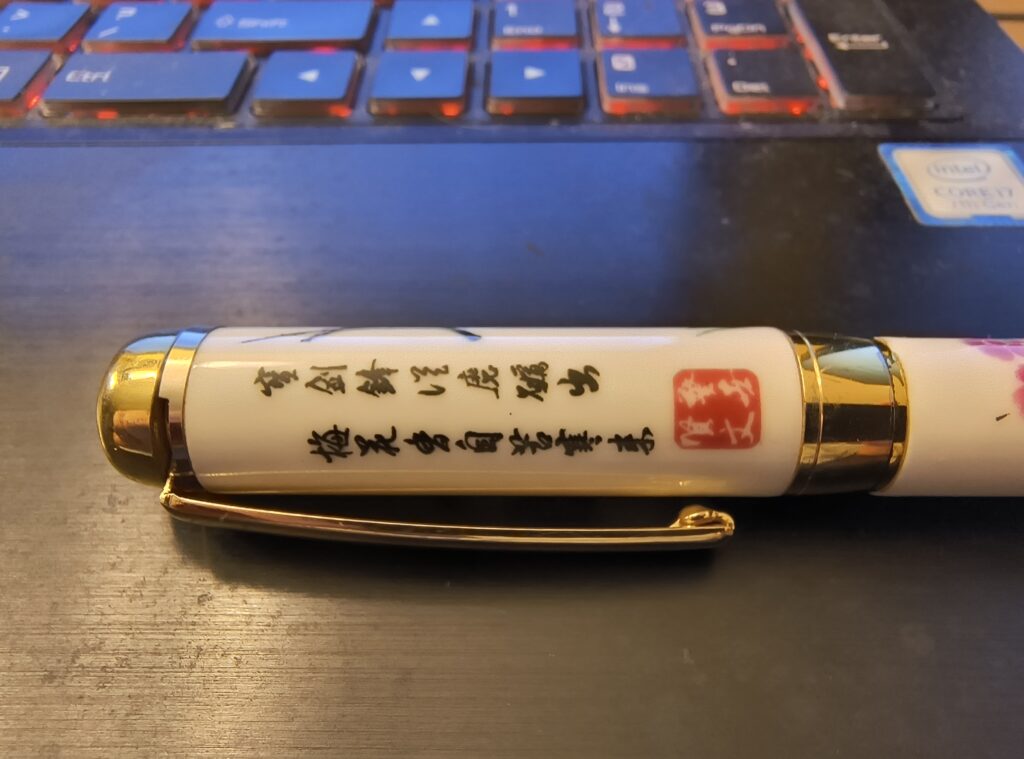
Several years ago, when I needed to get a new fountain pen, I had gotten a beautiful Jinhao pen with a porcelain barrel showing an image of delicate plum blossoms. I’d really liked that pen. When I needed a new one a few years later, I looked again, but couldn’t find the same pen. I found a similar pen, however, (pictured above) which was absurdly cheap, so I bought two:
When the pens arrived (after about a month, shipped surface via container ship) they were perfectly satisfactory. But I noticed that they had some Chinese script that, interestingly, wasn’t shown in the promotional image. It made me wonder… What does it say? Is it the name of some bank? Does it say “Death to America”? I kept meaning to get it translated but not getting around to it. This morning I finally found time.
I took the picture above and fed it into Google Translate. I usually leave Google Translate set to translate between Japanese and English and it does provide a translation in Japanese, but what it said seemed rather cryptic:
Mai Muroto Ikatoide
Plum Blossom Palace Jiku Kanta
I set it to Detect Language and let it try again. Then I set it to Chinese (Traditional) to confirm that they were the same:
The sword dance in the room is sharpened by the deer.
Plum Blossom Palace is cold and beautiful.
The first seems like some kind of proverb or saying, but one that the English Internet seems unfamiliar with. Plum Blossom Palace similarly doesn’t seem to return any obvious hits.
So now I know, anyway, for whatever good that does. I still like the pens and it makes people happy to have me use a pretty pen to sign their books.